When that “Congratulations, we’d like to extend an offer” email hits your inbox, it’s a huge rush. But once the initial excitement wears off, the real work begins. You’ve got to figure out if this offer is actually the right one for you. This gets even trickier with remote and hybrid roles, which add a whole new set of variables to the equation.
It’s tempting to just zero in on the salary, but that’s a rookie mistake. A truly great opportunity is about so much more than the base number. To avoid overlooking critical details that could affect your finances, work-life balance, and career, you need a more structured game plan.
Your Quick Guide to Evaluating Any Job Offer
Starting Your Initial Assessment
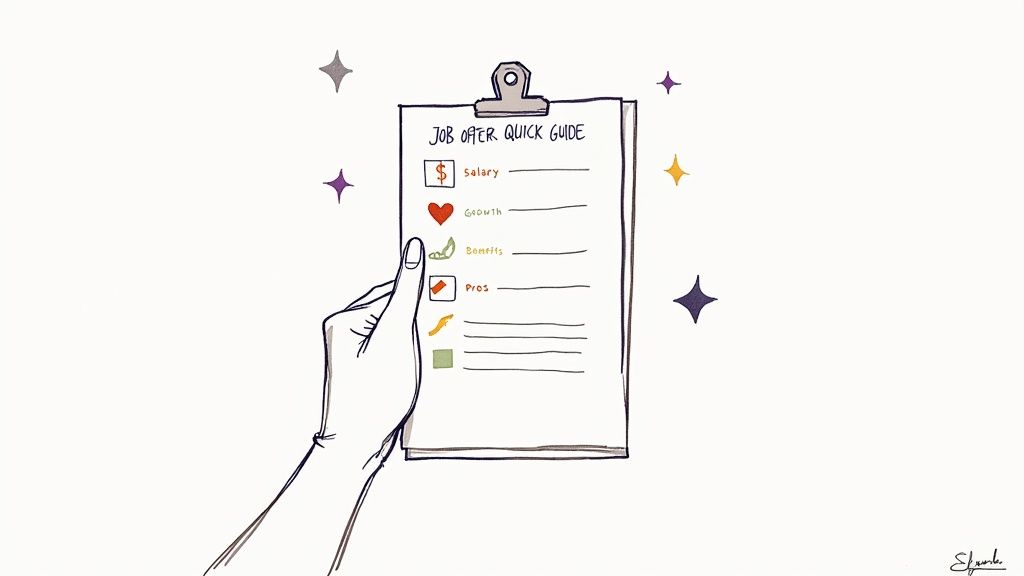
Before you get lost in spreadsheets and calculators, start with a high-level scan. A simple checklist can help you organize your gut reactions and spot any immediate pros or cons. Think of this as the first pass that tells you where you need to dig deeper.
For anyone hunting for a remote position, this initial look is about more than just money. It’s your first real clue into the company’s remote culture. Are they truly remote-first, or just remote-friendly? If you’re deep in this process, our guide on how to find a remote job is packed with insights on what separates a top-tier remote employer from the rest.
Using a clear framework helps you shift from a purely emotional “Wow, they want me!” to a logical, clear-headed assessment.
A job offer is more than a paycheck; it’s a package of opportunities, benefits, and compromises. Your goal is to see the entire picture, not just the shiniest part.
To get you started, here’s a quick checklist to guide your first look. Use it to organize your thoughts, spot potential red flags, and figure out what questions you need to ask before moving forward.
Job Offer Evaluation Quick Checklist
This table is a great starting point for any offer that comes your way. It’s designed to help you quickly identify the core strengths and weaknesses, so you know exactly what to focus on next.
| Evaluation Category | Key Questions to Ask Yourself | Example Red Flag |
|---|---|---|
| Total Compensation | Does the offer include bonuses, equity, or other financial incentives beyond the base salary? | A high salary but no mention of performance bonuses or retirement matching. |
| Benefits Package | How do the health insurance premiums and deductibles compare to your current plan? Are there wellness or development stipends? | The health plan has a very high deductible, negating a portion of your salary increase. |
| Role & Growth | Is there a clear path for advancement? Does the role offer opportunities to learn new, valuable skills? | Vague job duties or no clear answer on what success looks like in the first year. |
| Company Culture | Does the company’s approach to work-life balance (e.g., PTO, flexible hours) match your needs? | The interviewer mentioned that working late and on weekends is the “norm” for the team. |
Running through these basics gives you a solid foundation. If everything checks out here, you can confidently move on to a more detailed breakdown of the offer’s components.
Looking Beyond Salary to Total Compensation
That big, bold salary number is usually the first thing we look at, but it’s rarely the full story. A truly great job offer is more like a mosaic—a collection of different financial pieces that create your total compensation. To really understand what’s on the table, you have to look past that initial number and add up the real-world value of the entire package.
And it seems like more people are doing just that. A recent McKinsey survey found that globally, only 56% of job offers were actually accepted. It’s a clear sign that candidates are digging deeper, and a mismatch in what they think they’re being offered versus the reality is a huge reason why so many offers get turned down.
Before you even get to the offer stage, it pays to do your homework. If you’re a Product Manager, for example, a resource like a definitive guide to entry-level Product Manager salaries is invaluable for benchmarking what you should expect.
Deconstructing Your Bonus Structure
Bonuses can seriously pad your income, but they come in a few different flavors. It’s critical to know the difference so you can accurately figure out your potential earnings.
First up is the signing bonus. This is a one-time cash payment for saying “yes” to the job. It’s a fantastic perk, but be sure to check the fine print for a clawback clause. If you leave before a certain date—usually a year—you might have to pay it back.
Then there are performance bonuses. These are the tricky ones because they’re variable, tied to how you, your team, or the whole company performs. Don’t be shy about asking questions here. Is the bonus target actually achievable? What percentage of employees hit their full bonus last year? The answers will tell you a lot about how likely you are to see that money.
Understanding Equity and Stock Options
For a lot of people, especially in tech or at a startup, equity can be the single most valuable part of their compensation down the road. But remember, its value is all potential—not guaranteed cash in your pocket today.
You’ll typically see two types of equity:
- Restricted Stock Units (RSUs): Think of these as a promise of company shares. You’re granted them, but you don’t actually own them until you’ve been with the company for a set amount of time, known as a vesting schedule.
- Incentive Stock Options (ISOs): These give you the right to buy company stock at a fixed price (the “strike price”) in the future. The whole game is to buy low and, if the company does well, sell high.
When you’re looking at an equity offer, the vesting schedule is just as important as the number of shares. A classic schedule is vesting over four years with a one-year “cliff.” That cliff is a big deal—it means if you leave before your first anniversary, you walk away with nothing.
Here’s a pro tip: always ask for the total number of company shares outstanding. This little piece of information lets you calculate what percentage of the company your grant actually represents. 10,000 shares sounds amazing, but it means something completely different if the company has 1 million shares versus 100 million.
The Rise of Remote Work Stipends and Perks
In the remote-first world, companies are getting creative with perks that have real financial value. These aren’t just fluffy benefits; they can add up fast and should absolutely be part of your calculation.
Keep an eye out for perks that directly cut your own expenses:
- Home Office Stipend: A one-time or yearly allowance to buy a good desk, a proper chair, or that second monitor you’ve been eyeing.
- Monthly Internet/Phone Bill Reimbursement: A recurring payment that helps cover the utilities you need to do your job.
- Co-working Space Membership: If you can’t stand working from home every day, some companies will foot the bill for a spot at a local co-working space.
- Wellness and Learning Funds: Money you can use for a gym membership, a meditation app, online courses, or industry conferences.
These aren’t just nice-to-haves; they directly impact your bottom line. A $1,000 home office stipend plus $75 a month for your internet bill adds another $1,900 to your compensation in the first year alone. Knowing about the common remote work benefits out there helps you see what’s possible and what might be worth negotiating for. This is how you build the complete financial picture and truly compare offers.
How to Assess Benefits and Lifestyle Perks
 It’s easy to get tunnel vision and focus only on the salary, but a strong benefits package can quietly add thousands to your annual compensation. More than that, it can dramatically improve your quality of life.
The right perks can be the difference between a job that just pays the bills and one that truly supports your well-being. Thinking about how to evaluate job offers means putting a real dollar value on these hidden gems.
This goes way beyond standard health insurance. Remote-first companies, in particular, are getting creative with lifestyle perks to attract and keep top talent. These benefits often zero in on professional growth, wellness, and work-life harmony, making them a huge part of your decision.
Quantifying the Value of Your Health and Wellness
Health insurance is usually the heavyweight champ of benefits, and the tiny details matter. A slightly lower salary with a “gold-plated” health plan can easily be a better financial deal than a higher salary with a plan that has you paying out of pocket for everything.
Time to do some math.
Start by comparing the key numbers:
- Monthly Premiums: How much is coming out of your paycheck each month?
- Deductibles: What’s the amount you have to pay yourself before insurance even starts to help?
- Out-of-Pocket Maximum: What is the absolute most you could possibly spend on healthcare in a year?
Let’s say Offer A has a $500 monthly premium and a $5,000 deductible. Offer B has a $200 monthly premium and a $1,000 deductible. If you know you’ll need regular medical care, Offer B could save you thousands a year, even if the salary is a little lower.
And don’t forget to look for things like wellness stipends for gym memberships, mental health apps, or fitness classes. Those have a direct cash value, too.
Assessing Time Off and Flexibility Policies
Paid time off (PTO) isn’t just about vacation days—it’s a window into the company’s philosophy on rest and recovery. A company offering 15 days of PTO is worlds apart from one with a flexible or “unlimited” policy.
But that “unlimited PTO” deserves a closer look.
Ask direct questions about how it works in the real world. What’s the average number of days people actually take off? Does leadership actively encourage it? A genuinely flexible policy lets you disconnect without feeling guilty, which is invaluable for preventing burnout.
Generous parental leave, sick day policies, and flexible working hours are not just perks—they are foundational supports for a sustainable career and a balanced life. They reflect a company culture that values its employees as whole people, not just workers.
For remote jobs, flexibility is everything. Does the company run on asynchronous work, or are you expected to be glued to your screen during specific hours? This single detail can completely change your daily routine and freedom.
Investing in Your Professional Growth
A company that invests in your skills is investing in your future. Simple as that. Look for benefits that support your long-term career path. These perks signal that an employer sees you as a long-term asset, not just a cog in the machine.
Some of the most valuable growth perks include:
- Professional Development Fund: An annual budget for conferences, workshops, certifications, or online courses. A $2,000 annual learning stipend is $2,000 you don’t have to spend yourself.
- Tuition Reimbursement: Getting help to pursue a higher degree or advanced certifications in your field.
- Mentorship Programs: Real, structured opportunities to learn from senior leaders in the company.
Finally, think about how all these benefits support a remote work lifestyle. A home office stipend is a game-changer, helping you create a productive and comfortable workspace. You can learn more about what to prioritize in our guide on how to set up your home office.
By looking at benefits through this lens, you can build a complete picture of an offer’s true worth.
Comparing Benefit Packages Side-by-Side
Putting it all together in a simple table can make the best choice surprisingly clear. It helps you move beyond the base salary and see the real-world impact of each offer’s perks.
| Benefit | Offer A Details | Offer B Details | Analysis/Personal Value |
|---|---|---|---|
| Health Insurance | Premium: $500/mo; Deductible: $5,000 | Premium: $200/mo; Deductible: $1,000 | Offer B saves $3,600/year on premiums alone and has a much lower deductible. Big win for B. |
| Retirement Plan | 4% match on 401(k) | 6% match on 401(k) | Offer B provides a 2% higher match. On an $80k salary, that’s an extra $1,600/year. |
| Paid Time Off | 15 days PTO + 5 sick days | “Unlimited” PTO (avg. 25 days taken) | Offer B’s policy seems more generous and flexible, which is a huge plus for avoiding burnout. |
| Professional Dev. | $1,000 annual stipend | $2,500 annual stipend + mentorship | Offer B is investing more in my growth, which has long-term career value. |
| Home Office Stipend | $500 one-time | $1,000 one-time + $50/mo internet | Offer B provides better ongoing support for remote work essentials. |
| Parental Leave | 4 weeks paid | 12 weeks paid | Offer B is significantly more supportive for starting a family, which is a key priority for me. |
Laying it all out like this shows that while Offer A might have a slightly higher salary, Offer B’s superior benefits package provides thousands of dollars in extra value and aligns much better with personal and professional goals.
Finding the Right Role and Career Growth Path
A fantastic compensation package looks great on paper, but it loses its shine fast if the job itself is a dead end. When you’re weighing an offer, you have to look past the immediate paycheck and get a real sense of the day-to-day work and where this role can actually take you.
I’ve seen it happen too many times: a big salary in a job you dislike is a classic career trap. It makes you just comfortable enough to stay but miserable enough that you stop growing. The real win is making sure your next move is a strategic one that builds valuable skills and opens up doors down the road.
Before you even get to an offer, it’s worth taking the time to figure out what you truly want. A great primer on how to find the career that’s right for you can help you measure any offer against your own long-term goals.
Reading Between the Lines of the Role
The job description is your starting point, but the real story comes out during the interviews. Your mission is to uncover what your work life will actually look like and avoid that dreaded bait-and-switch where the job you accept is nothing like the one you were sold.
Think about it: the entire hiring process is a preview of the company. In fact, a recent report found that 66% of applicants accepted offers because they had a positive experience from start to finish. On the flip side, 26% rejected offers because of poor communication or fuzzy expectations. It just goes to show how much the little things matter.
To get the full picture, you need to ask targeted questions that go way beyond the official job description:
- What does a typical day or week really look like for the person in this position?
- What are the biggest challenges I’ll face in the first three months?
- How is performance actually measured, and what does success look like in the first year?
The answers you get will reveal the true priorities and potential pain points of the job, giving you a much clearer sense of things than any formal document ever could.
A job title is just a label. The day-to-day responsibilities are what define your experience. Dig deep to understand what you’ll actually be doing, not just what your title says you are.
Charting Your Career Advancement Path
A job offer isn’t just about today; it’s a stepping stone for your future. A role with a clear path for growth can be way more valuable in the long run than one with a slightly higher starting salary but nowhere to go.
You have to do some digging to see what career progression looks like at this specific company. Don’t just assume a path exists because the company is big or seems to be growing quickly.
Here are some direct questions to ask your potential manager:
- What are the typical career paths for someone who succeeds in this role?
- Can you share an example of someone who started here and was promoted?
- What kind of mentorship and professional development opportunities are available to the team?
Asking these questions shows you’re serious about building a career, not just collecting a paycheck. It also helps you figure out if the company genuinely invests in its people. Vague answers are a huge red flag—it probably means growth is unstructured or just not a priority.
Understanding the remote work landscape can also help you make a smarter decision. Check out our guide on the best careers for remote work to see how different roles can evolve over time.
Using a Simple Matrix to Make Your Final Call
You’ve done the hard work of analyzing the compensation, weighing the benefits, and picturing your future career path. But what happens when you’re stuck between two great—but very different—offers? This is where it’s easy for emotion to take over and cloud your judgment.
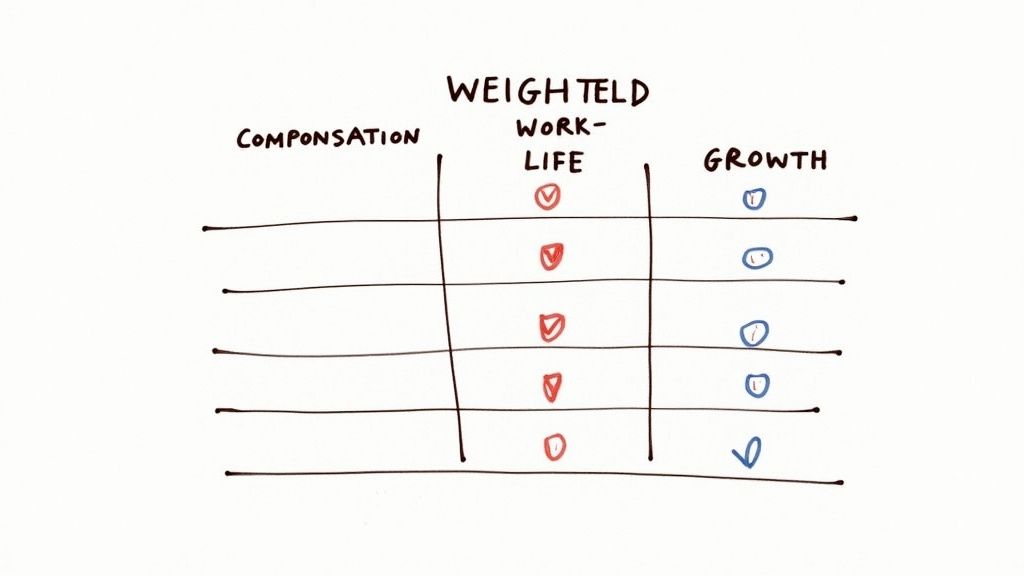
To cut through the noise, you can lean on a simple but incredibly effective tool: a weighted decision matrix. It’s a way to step back from pure gut feeling and make a clear-headed choice based on what actually matters to you. Think of it as a way to quantify the pros and cons, ensuring your final decision truly aligns with your priorities.
It helps to remember that not all offers are created equal, especially in today’s competitive landscape. In the U.S., recruiters manage about 54 hires per month, which is a staggering 85% higher than the global average. Even with all that activity, the offer acceptance rate hovers around 79%, while some industries see rates as high as 92%. What does that tell you? Candidates are being selective. A structured approach like this is more valuable than ever. For a deeper dive into these numbers, check out the 2025 Global Recruitment Report.
Building Your Personal Decision Matrix
Creating your own matrix is a straightforward, three-step process. The goal is to build a personalized scorecard that reflects what you really want.
- List What Matters: First, jot down every factor that’s important to you. Go beyond the obvious like salary. Think about company culture, work-life balance, the quality of the remote setup, and opportunities to learn new skills.
- Assign Weights: Now, give each of those factors a “weight” based on how crucial it is to you. A simple scale of 1 to 5 works well, with 5 being non-negotiable. This is the most important step because it personalizes the entire exercise.
- Score Each Offer: Finally, rate each job offer against your criteria, maybe on a scale of 1 to 10. Try to be as objective as you can, using everything you learned during the interview process.
Once that’s done, you just multiply each score by its weight and add it all up for each offer. The one with the higher score is, logically, the better fit. The process is a lot like figuring out how to prioritize tasks at work—you assign value to different items to see where you should focus your energy.
A Real-World Scenario: Corporate vs. Startup
Let’s walk through an example. Imagine a software developer named Alex is choosing between two remote jobs. Offer A is from a huge, stable tech corporation. Offer B is from a fast-growing—but definitely riskier—startup.
Here’s how Alex’s decision matrix might look:
| Factor | Weight (1-5) | Offer A (Corporate) Score (1-10) | Offer A Weighted Score | Offer B (Startup) Score (1-10) | Offer B Weighted Score |
|---|---|---|---|---|---|
| Base Salary | 5 | 8 | 40 | 6 | 30 |
| Work-Life Balance | 5 | 9 | 45 | 4 | 20 |
| Career Growth | 4 | 6 | 24 | 10 | 40 |
| Equity Potential | 3 | 3 | 9 | 9 | 27 |
| Job Security | 4 | 9 | 36 | 3 | 12 |
| Company Culture | 3 | 7 | 21 | 8 | 24 |
| Total Score | 175 | 153 |
Looking at the numbers, the corporate role comes out on top. Even though the startup offered killer growth potential and exciting equity (which Alex clearly cared about), the matrix laid it all out. Alex’s top priorities—a solid salary, good work-life balance, and stability—were just better met by Offer A.
This methodical approach doesn’t remove your intuition from the decision; it informs it. By translating your priorities into numbers, you get a clear, logical reason for why one offer feels better than the other, giving you ultimate confidence in your choice.
This simple tool can transform a confusing, emotional tug-of-war into a clear and confident decision. It helps ensure you’re not just taking the next job, but consciously choosing the best path forward for your career.
Common Questions About Evaluating Job Offers
Even with the best game plan, the final moments of a job offer can feel like a high-wire act. This is where the really tricky, high-stakes questions pop up, and you have to find that perfect balance between protecting your interests and being a great future colleague.
Let’s break down the most common dilemmas you’ll likely face and how to handle them like a pro.
How Do I Professionally Ask for More Time to Decide?
First off, it’s completely normal to need a few days to think. You might have other interviews wrapping up or you just want to be absolutely sure. The trick is to ask for that time with grace and enthusiasm, so the company feels like a priority, not a backup plan.
Always start by saying thank you and showing how excited you are. This immediately reinforces that you’re genuinely interested.
Then, just state your request clearly and give them a specific, reasonable timeline. Companies expect this. Honestly, they’d rather you make a thoughtful, committed decision than a rushed one you might regret later.
Here’s a great way to phrase it:
“Thank you so much for this wonderful offer! I am very excited about the opportunity to join your team. To ensure I can give this important decision the full attention it deserves, would it be possible to have until the end of the day this Friday to provide my final answer?”
This approach comes across as confident and respectful, and it sets a clear expectation for everyone. You’re not being indecisive; you’re being diligent.
What Should I Do if I Receive a Second Offer?
Getting a second offer while you’re still considering the first is a fantastic problem to have. It does, however, require some careful communication. Transparency is your friend here, but you have to handle it professionally. You can absolutely use this situation to your advantage without burning any bridges.
The first move is to contact the company that made the initial offer. Reiterate how much you want their role—this is crucial. Then, let them know you’ve received another competitive offer and want to give them a chance to put their best foot forward.
For example, you could say something like this:
“I’m still very excited about this role and the team. As a matter of transparency, I wanted to let you know I’ve just received another competitive offer. Since your company remains my top choice, I wanted to see if there is any flexibility to discuss the compensation package before I make my final decision by [Date].”
This opens the door for negotiation and shows you’re making a deliberate choice, not just playing games. It gives both companies a fair shot, which gives you the complete picture you need to make the right call.
How Should I Handle an Exploding Offer?
An “exploding offer” is a high-pressure tactic where a company gives you an impossibly short deadline—often just 24-48 hours—to accept. It can feel really intimidating, but the first step is to stay calm. Don’t let their pressure rush you into a bad decision.
Acknowledge the offer immediately and express your gratitude. Then, you can try one of two approaches:
- Ask for an Extension: Politely ask for more time, explaining that you want to give their offer the consideration it deserves. Mentioning your positive interview experience helps reinforce your interest. You could say, “I truly enjoyed learning about the role and am very interested. A decision this important typically takes me a bit more than 24 hours to review thoroughly. Would it be possible to have until [Propose a Reasonable Date]?”
- State Your Timeline: If you’re waiting on another offer, it’s okay to be transparent about your process. For instance: “I am very enthusiastic about this opportunity. I am in the final stages with another company and have been told I will have an update by Wednesday. Would it be possible to extend the deadline until then so I can compare both offers fairly?”
Some companies might not budge, but a reasonable employer who really wants you will often grant a short extension. If they flat-out refuse? That could be a major red flag about their company culture. A great employer wants you to join their team feeling 100% confident in your choice.
Is It Okay to Accept an Offer and Then Back Out?
Technically, yes, you can rescind your acceptance. But this is a move you should avoid at all costs.
Reneging on an accepted offer can do serious damage to your professional reputation, especially in smaller, tight-knit industries. Recruiters and hiring managers have long memories, and they move between companies all the time.
Burning a bridge with one company could slam doors shut at others down the road. Instead of accepting and then backing out, the smarter strategy is always to ask for more time to consider the first offer. This lets you wait for the second one to come through so you can make a final, committed decision you can stand by.
At the end of the day, your integrity and professionalism are your most valuable long-term assets.
Ready to find a job that meets all your criteria? Remote First Jobs connects you with thousands of verified, spam-free remote roles from trusted companies. Use our simple filters to find your perfect fit in tech, marketing, design, and more—no sign-up required. Start your search today at https://remotefirstjobs.com.