To nail a phone interview, you need a game plan that goes way beyond a quick skim of the company’s homepage. It’s about digging into the job description like a detective, weaving a compelling story about your career, and coming up with smart questions that show you’re not just looking for any job, but this job. This is the groundwork that builds real confidence and helps you make a killer first impression.
Your Pre-Call Preparation Playbook
That first phone screen isn’t just a warm-up; it’s the main event that gets you to the next round. In a competitive market, especially for great remote jobs, this initial conversation is everything. Your goal isn’t just to answer their questions—it’s to connect the dots between your experience and exactly what they’re struggling with.
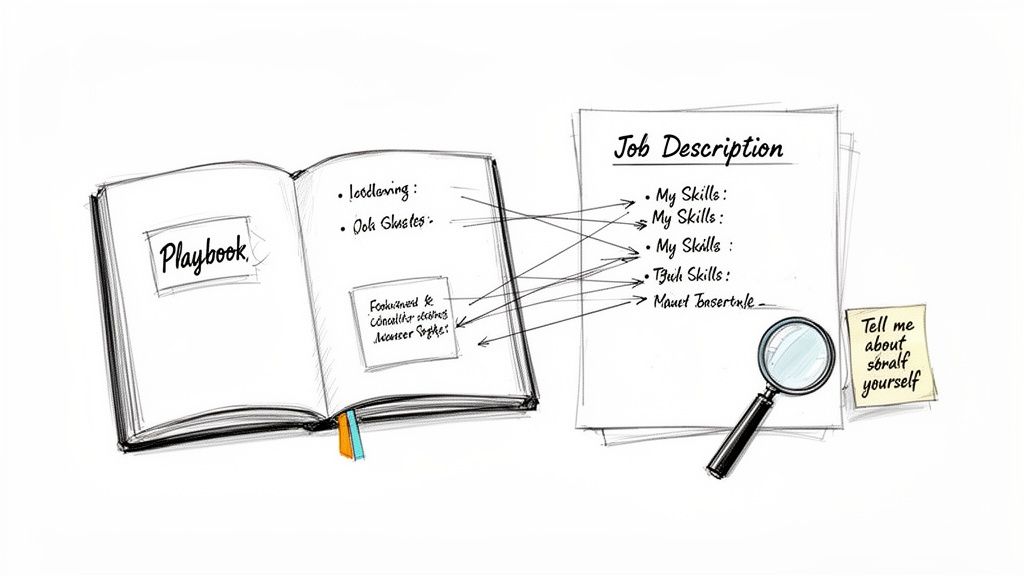
This means you need more than just a vague idea of what to say. You need a solid playbook. It all starts with treating that job description less like a list of chores and more like a treasure map.
Deconstruct the Job Description
First things first: print out the job description and get a highlighter. Your mission is to pinpoint the absolute core responsibilities and skills they’re hammering on. Don’t just glance over them. For every single point, connect it directly to something you’ve actually done.
For instance, if they mention “experience managing cross-functional projects,” immediately think of that one project where you had to wrangle the marketing and engineering teams. Jot down the essential details: what it was, what you did, how it turned out, and what hurdles you cleared. This simple exercise turns abstract corporate-speak into concrete stories you can tell.
Go Beyond Basic Company Research
Look, everyone glances at the “About Us” page. To really separate yourself from the pack, you have to go deeper—especially when you’re interviewing for a remote role where culture is everything. Start digging into their digital footprint to get a real feel for how they operate.
- Read their blog and press releases: What are they celebrating? What challenges are they tackling? Dropping a mention of a recent product launch shows you’re paying attention.
- Explore employee reviews: Check out sites like Glassdoor, but zero in on what people say about management, work-life balance, and the tools they use. This is gold for understanding the real day-to-day of a remote employee.
- Check their social media: A company’s LinkedIn or Twitter feed is often a window into its soul. Do they champion collaboration? Do they celebrate individual wins? This helps you understand what they value.
Doing this level of homework doesn’t just make you look good. It helps you understand their pain points so you can frame yourself as the perfect solution.
Think about how tough it is just to get this far. Recent data from High5Test reveals a stark reality: U.S. employers have an average applicant-to-interview ratio of just 3%. That means for every 100 people who apply, only three even get that initial call. Your preparation is what makes you stand out from the other 97.
To give you a quick reference, here’s a simple table to keep your prep on track.
Pre-Interview Action Plan
| Preparation Area | Key Action | Why It Matters for Remote Roles |
|---|---|---|
| Job Description Analysis | Match each requirement to a specific personal achievement. | Proves you can deliver results autonomously without constant oversight. |
| In-Depth Company Research | Investigate blogs, social media, and employee reviews for culture clues. | Shows you understand the unique communication and collaboration styles of a remote team. |
| Narrative Crafting | Develop a 90-second “Tell me about yourself” story. | Your first chance to prove you’re a concise, effective communicator—a critical remote skill. |
| Talking Points | Create bullet-point examples for key skills, not scripts. | Helps you sound natural and adaptable, not like you’re reading from a teleprompter. |
This structured approach ensures you’re not just ready, but truly prepared to make a lasting impression.
Craft Your Narrative and Talking Points
The most predictable first question—”Tell me about yourself”—is your moment to shine. Don’t just walk them through your resume. Instead, craft a tight, 90-second story that bridges your past experience with this specific opportunity. Frame it as a journey that logically led you to their doorstep.
For everything else, think in bullet points, not paragraphs. This keeps you from sounding robotic. For every major requirement you highlighted in the job description, have a bullet point with a quick example ready to go. This ensures you’re ready to back up your claims on the spot, whether you found the opening on a niche board or a major site like the one that features excellent remote first jobs. Being prepared is what turns an opportunity into an offer.
Creating a Flawless Remote Interview Environment
When you’re prepping for a remote phone interview, your environment says a lot about you before you even answer the first question. A dropped call, a barking dog, or terrible echo can accidentally paint a picture of you as disorganized or unprofessional—exactly the opposite of what you’re going for.
Think of your setup as your first impression. It shows the interviewer you’re serious about the role and already have the discipline needed to crush it as a remote employee. A smooth, professional-sounding call proves you can communicate clearly in a distributed team, where that’s a non-negotiable skill.
Nail Your Connection and Audio
Your number one technical goal is crystal-clear audio. Nothing kills an interview’s momentum faster than a choppy connection where you’re both constantly asking, “Can you hear me now?”
First, check your cell signal in the exact spot you plan to sit for the call. If you’re using a VOIP service like Skype or Google Voice, run a speed test beforehand. Don’t just assume your internet will be fine—test it.
Next up, your audio gear. Holding your phone to your ear is an option, but it’s far from the best.
- Use a headset with a microphone. This is a simple move that makes a huge difference. It cuts down on background noise and kills the weird echo that often happens on speakerphone.
- Test your equipment. Do a quick call with a friend the day before to make sure they can hear you loud and clear and that your voice doesn’t sound like it’s coming from a tin can.
A small investment in a decent headset pays off big time in how professional you sound.
Carve Out a Distraction-Free Zone
Your physical space is just as critical as your tech. Find a quiet, private spot where you can give the conversation your undivided attention.
A home office with a door you can shut is the gold standard, but any quiet room will do the trick. The real key is to get ahead of any potential interruptions so you can stay locked in with the interviewer.
In today’s remote-first world, the hiring game has gotten way more competitive. Companies are now conducting 42% more interviews per hire than they did in 2021, sometimes holding nearly 20 interviews to fill just one role. This tells you just how intentional and layered the hiring process has become, making every single detail of your preparation count.
That increased scrutiny means a quiet background isn’t just polite; it’s a direct reflection of your readiness for a remote role.
Have a Plan for the Unexpected
Even the best-laid plans can go sideways. A neighbor might decide it’s the perfect time to fire up a leaf blower, or an Amazon delivery could arrive mid-sentence. The goal isn’t to build a soundproof bunker, but to have a game plan for handling these moments without missing a beat.
Here’s a quick checklist to head off surprises:
- Give your household a heads-up. Let family or roommates know your exact interview time and ask them not to interrupt you.
- Handle your pets. If you have a furry friend, make sure they’re in another room for the call.
- Silence all notifications. Put your computer and any other devices on do-not-disturb to avoid random pings and buzzes.
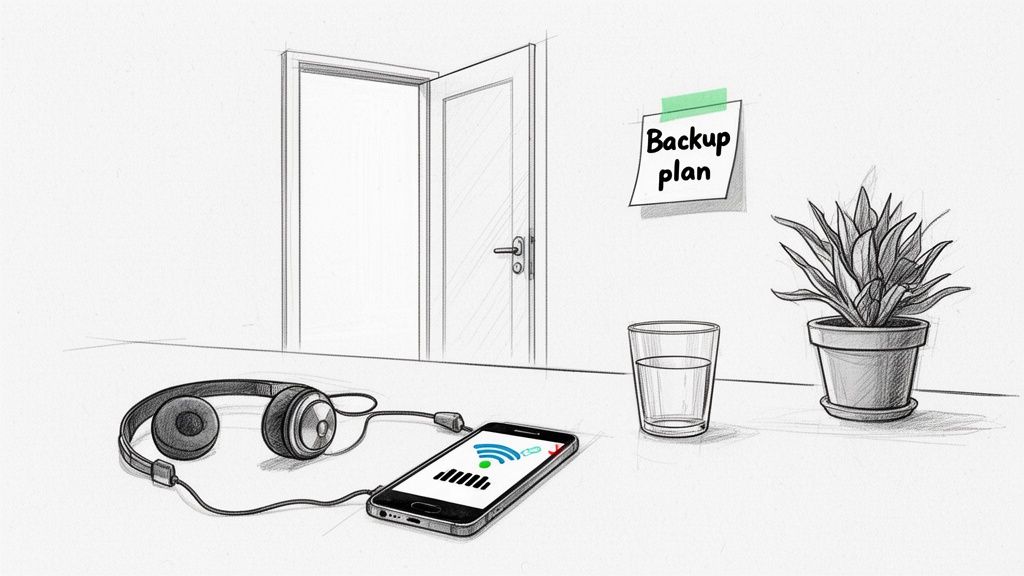
- Prep a backup. Know what you’ll do if your phone dies or your Wi-Fi cuts out. Having a secondary device or phone number ready shows you’re a planner and a problem-solver.
By thinking through these things, you demonstrate that you can manage the realities of working from home. If a video call is the next step, your visual presentation is just as important. Optimal lighting can make you look and feel more professional—for more on that, check out a complete guide to home office lighting setup to really perfect your space.
Answering Common Phone Interview Questions
This is it. The phone screen is where all your preparation pays off. It’s your chance to prove that the person on paper is just as compelling in a real conversation.
The key isn’t to memorize canned answers. It’s about having a solid framework to structure your thoughts and tell a story that actually sticks with the interviewer. You want to move past generic, forgettable responses and share specific examples that show you’re the solution to their problem.
Mastering the STAR Method for Impactful Stories
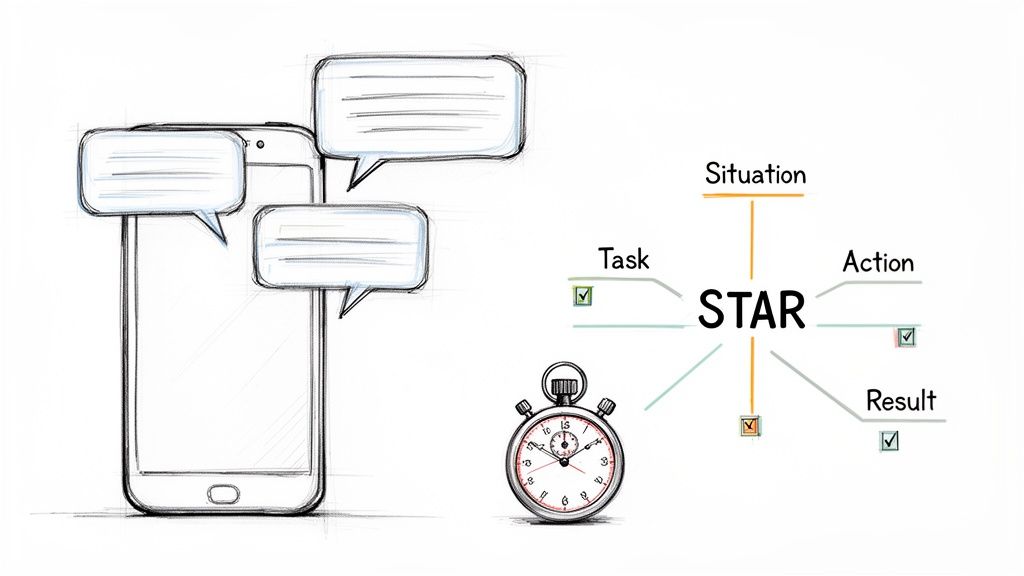
When an interviewer throws a behavioral question at you, like “Tell me about a time when…,” they’re not just making small talk. They’re looking for concrete proof of your skills. The STAR method is your best friend here, giving your stories a clear beginning, middle, and end.
Here’s how it works:
- Situation: Briefly set the stage. What was the project? What was the challenge?
- Task: What was your specific goal or responsibility? What needed to get done?
- Action: Detail the steps you personally took. This is where you shine, showing off your skills and how you think.
- Result: What happened because of your actions? Use numbers and data to show the tangible impact. Think metrics, percentages, and dollar amounts.
Using this framework stops you from rambling and keeps you focused on what truly matters. For remote roles, it’s even more critical—it’s how you demonstrate that you’re self-motivated and results-driven without a manager looking over your shoulder.
A well-told story using the STAR method does more than just answer a question—it builds a narrative of competence. It shows you can analyze a situation, take ownership, execute a plan, and deliver measurable results, all key traits for a successful remote employee.
Now, let’s put this into practice with some of the most common questions you’re likely to hear.
Tackling Key Interview Questions
You can’t read the interviewer’s mind, but you can definitely prepare for the classics. Having solid, thoughtful answers ready will make you feel way more confident and help you guide the conversation.
Question 1: Why Are You Interested in This Role?
What they’re really asking is: “Did you actually read the job description, or are you just spamming applications?” Your answer needs to be a bridge connecting your skills to their specific needs.
- Weak Answer: “I’m looking for a new challenge and your company seems like a great place to work. The role looks interesting and fits my experience.”
- Strong Answer: “I’ve been following your company’s work in AI-driven customer support, and this role perfectly combines my background in SaaS with my passion for improving user experience. I was particularly excited by the job description’s focus on asynchronous project management, as I successfully led a remote team to launch a new feature set 20% ahead of schedule using similar methods in my last position.”
See the difference? The strong answer is specific, shows genuine interest, and ties a past win directly to the job requirements.
Question 2: What Do You Know About Our Company?
This is another gut-check on your preparation. They want to see you’ve done more than just a 30-second scan of their homepage.
- Weak Answer: “You’re a tech company that makes software for businesses. You’re well-known in the industry.”
- Strong Answer: “I know that you’re a leader in providing personalized fitness coaching and recently expanded into the UK market. I also read your CEO’s recent interview about using data to enhance user engagement, which aligns with my interest in behavior-driven design. I’m impressed by how your product adapts to individual users over time.”
Mentioning specifics—like a recent market expansion or a CEO interview—proves you’re serious about the opportunity.
Navigating the Salary Question
Ah, the salary question. It almost always pops up in a phone screen. The goal here is to give a thoughtful range without lowballing yourself or getting screened out.
Your best move is to come prepared. Before the call, do your homework. Use sites like Glassdoor or Levels.fyi to research the market rate for similar remote roles in your industry. This gives you data to stand on.
When they ask, state your range with confidence.
Example Response: “Based on my experience level and the market rates I’ve seen for this type of remote role, my salary expectation is in the $85,000 to $95,000 range. Of course, I’m flexible and open to discussing the total compensation package as we get to know each other better.”
This shows you’re informed, gives them a clear number, and keeps the negotiation open. When you prepare for the phone interview, you’re not just practicing answers—you’re arming yourself with crucial data like this.
To make it even clearer, let’s look at a few more examples side-by-side.
Common Phone Screen Questions vs. Strategic Answers
The table below breaks down a few more common questions, showing how to transform a forgettable answer into one that makes a real impression.
| Common Question | Generic Answer to Avoid | Strategic Answer to Use |
|---|---|---|
| “Tell me about yourself.” | “I’ve worked in marketing for five years, starting as a coordinator and now I’m a specialist. I’m looking for my next step.” | “I’m a marketing specialist with five years of experience in the B2B SaaS space, focused on demand generation. In my last role, I drove a 30% increase in qualified leads by revamping our content strategy, and I’m excited about bringing that expertise to your team.” |
| “What is your biggest weakness?” | “I’m a perfectionist.” | “I used to overcommit to projects because I was eager to help. I’ve since learned to manage my workload by using a prioritization matrix, which helps me focus on high-impact tasks and deliver better results without burnout.” |
| “Where do you see yourself in 5 years?” | “Hopefully in a management position here.” | “My goal is to become a true subject matter expert in product marketing. I’m eager to join a team where I can take on more strategic projects, learn from senior leaders, and eventually mentor new team members.” |
These strategic answers aren’t just better—they tell a story of a candidate who is self-aware, results-oriented, and has a clear vision for their career. That’s the person they want to hire.
Making a Strong Impression During the Call
Without eye contact and body language, your voice has to do all the heavy lifting. It’s not just what you say, but how you say it that builds rapport and shows you’re confident. The interviewer is listening for enthusiasm and professionalism—two things every great remote employee needs.
Think of the call as a performance where your voice is the star. Small adjustments can make a huge difference. For instance, I always recommend standing up while you talk. It naturally injects more energy into your voice by opening up your diaphragm, making your tone richer and more authoritative.
Project Confidence and Enthusiasm
Your tone is your number one tool for showing excitement and engagement. A flat, monotone delivery can easily be mistaken for disinterest, which is a massive red flag for any hiring manager. You need to sound genuinely thrilled about the opportunity.
Here’s a surprisingly effective trick: smile while you speak. The interviewer can’t see you, of course, but smiling physically changes the shape of your mouth and adds a natural warmth to your voice. You’ll sound more approachable and positive without even trying.
Pacing is another big one. Nerves can make us talk a mile a minute. Force yourself to slow down and articulate your words. Taking a brief pause before answering a question doesn’t make you sound slow—it makes you sound thoughtful.
The Power of Active Listening
A phone interview is a conversation, not a monologue. Active listening is how you prove you’re engaged, respectful, and can follow a discussion. It’s about truly hearing what the interviewer is saying, processing it, and responding in a way that shows you were paying attention.
When they’re talking, give them your full attention. Don’t interrupt or jump in to finish their sentences. Once they’re done, it’s perfectly fine to take a beat to formulate your response. This shows you’re considering their words carefully.
Active listening demonstrates respect and strong communication skills. You can confirm you’ve understood a complex point by briefly summarizing it back. For example, you might say, “So, it sounds like the biggest challenge for the team right now is scaling the new feature…” This simple act proves you’re not just hearing, but understanding.
This little technique does two things: it confirms you’re on the same page and gives you a moment to structure your answer around their specific pain points.
Handling Hiccups with Grace
Let’s be real—no interview is perfect. Your dog might start barking, or your connection could drop. What matters isn’t the interruption itself, but how you handle it. Think of these moments as a pop quiz on your adaptability.
If an unexpected noise pops up, don’t pretend it didn’t happen. Acknowledge it briefly and professionally.
- Example: “My apologies for that background noise; a delivery just arrived. I’ve moved to a quieter spot now.”
If a technical glitch happens, stay calm. If the call drops, immediately try to call back. If that fails, shoot them a quick email explaining what happened and ask if they can resume or reschedule.
- Quick Email: “Hi [Interviewer’s Name], it seems we were disconnected. My apologies for the interruption. I’m available to continue the call whenever is convenient for you.”
Turning a potential disaster into a display of professionalism shows you can handle the unpredictable nature of remote work. It proves you’re resourceful and can keep your cool under pressure. Keep a glass of water nearby, have your notes ready (but don’t read from a script!), and you’ll navigate the call with confidence. Every step you take to prepare for a phone interview makes for a smoother, more impressive conversation.
Crafting a Memorable Post-Interview Follow-Up
So, you’ve hung up the phone. You can breathe a sigh of relief, but don’t close the book on this interview just yet. What you do next is one of the most overlooked yet powerful parts of how you prepare for a phone interview.
A lot of people fire off a generic “thank you” and move on. That’s a missed opportunity. A strategic follow-up email doesn’t just show good manners; it reinforces your enthusiasm, reminds the interviewer why you’re a great fit, and proves you’re a proactive communicator—a golden trait for any remote employee.
The Art of the Timely Thank You
Timing is everything. Send an email two minutes after the call, and you might seem a little too eager. Wait two days, and you risk looking disinterested.
The sweet spot? Within 24 hours of your phone interview.
This gives you enough time to gather your thoughts and write something meaningful without letting too much time pass. If your interview was in the morning, aim for later that afternoon. If it was in the afternoon, the next morning is perfectly fine.
Beyond the Basic “Thanks for Your Time”
Your follow-up is your last chance to make an impression, so make it count. The real magic is in the details. Your goal is to jog the interviewer’s memory and connect back to a specific moment in your conversation.
Think back to the call. Did they bring up a particular challenge the team is working through? Did you bond over a piece of software or an industry trend? Mentioning that shows you weren’t just waiting for your turn to talk—you were actively listening.
- Reference a specific detail: “I really enjoyed our conversation about your team’s unique approach to asynchronous project management. It reminded me of a similar system I helped get off the ground in my last role.”
- Reiterate your value: Briefly connect one of your core skills to a company goal or pain point they mentioned. It’s a subtle way to land one final, impactful point about why you’re the right person for the job.
- Express genuine enthusiasm: End on a high note. Make it clear you’re excited about the role and believe in what the company is doing.
This kind of personalization makes your email feel less like a template and more like a genuine continuation of a great conversation. Don’t underestimate this step; a thoughtful follow-up can seriously boost your chances. For more ideas, check out these actionable follow-up email examples to help you leave a lasting impression.
A personalized follow-up email isn’t just good manners; it’s a strategic tool. It’s your final opportunity to demonstrate your communication skills, attention to detail, and genuine interest in solving the company’s problems.
When an interviewer is stuck between two equally qualified candidates, a standout thank-you note can absolutely be the tie-breaker.
What if You Don’t Hear Back?
The waiting game is tough. If the interviewer gave you a timeline and that date has passed, or if it’s been a week with radio silence, it’s okay to send a gentle nudge. You have to be your own advocate.
Keep this second message short, sweet, and professional. You’re just politely checking in, not demanding an update.
Example Follow-Up After a Week: “Hi [Interviewer’s Name], I hope you’re having a great week. I’m just following up on our conversation last Tuesday about the [Job Title] role. I’m still very excited about the opportunity and was wondering if you had any updates on the timeline. Thanks so much, [Your Name].”
This simple note keeps you on their radar without being pushy. In the remote job market, every little touchpoint can make a difference. Just getting a phone screen is a win, especially when you consider how much internal referrals can stack the deck. Referred candidates often see a 30% hire rate, while standard applications are closer to 7%. That reality check makes your performance in every stage, including a sharp follow-up, that much more important.
Answering Your Top Phone Interview Questions
Even when you’ve done all the prep work, some parts of the phone interview can still feel like a curveball. Let’s tackle some of the most common questions and tricky situations that pop up, so you can handle them like a pro.
How Long Does a Typical Phone Screen Last?
Most of the time, that initial call with a recruiter is short and sweet—think 15 to 30 minutes. They’re not trying to grill you; they just want to confirm your basic qualifications, get a feel for your background, and check on your salary expectations.
Consider it a quick sanity check for both sides. If the conversation goes longer or a hiring manager jumps in with deep technical questions, you’ve likely moved into a more formal first-round interview. Either way, block out the full scheduled time just in case.
What Are the Biggest Red Flags to Avoid?
You’d be surprised how easily you can sink your chances without realizing it. The most obvious deal-breakers are badmouthing a former boss, having zero clue what the company does, or stumbling when asked to talk about your own experience.
For remote interviews, a few specific things can set off alarm bells for the interviewer:
- Bad audio: Crackling, echoing, or faint audio immediately suggests your home office setup isn’t up to par.
- Background noise: Barking dogs, kids yelling, or a loud TV can make it seem like you don’t have a professional space to focus.
- No energy: Enthusiasm is hard to fake, but a flat, monotone voice is a killer. It’s the only tool you have to show you’re actually interested.
One more thing: hold off on asking about PTO and benefits. Bringing that up too early can make it seem like that’s all you care about. Wait until they bring it up or you’re further along in the process.
The first call is your chance to sell your professional value, not to figure out personal logistics. Keep the conversation focused on what you can do for them, and you’ll come across as a serious candidate.
Should I Use Notes During a Phone Interview?
Absolutely! This is one of the biggest perks of not being on video, so you should take full advantage of it. Having your key info right in front of you can be a massive confidence booster.
Keep your resume, the job description, and a list of your questions for them visible. The key is to use your notes as a reference, not a script. Jot down bullet points and keywords that can trigger your memory. This little bit of organization shows you’ve done your homework and are genuinely invested in the role.
How Do I Answer the Salary Expectations Question?
Talking money can feel awkward, but it doesn’t have to be. The best strategy is to avoid giving a single, hard number. Instead, offer a well-researched salary range.
Before your call, do some digging on sites like Glassdoor or Levels.fyi to see what similar remote roles are paying. Look at companies of a similar size and in the same industry to get an accurate picture.
When they ask, state your range with confidence.
You could say something like: “Based on my experience and the market rates for this kind of remote role, I’m looking for a salary in the $85,000 to $95,000 range. Of course, I’m flexible and open to discussing the full compensation package as we get to know each other better.”
This does two things perfectly. First, it shows you know your worth. Second, it gives them a solid starting point for a conversation without locking you into a specific figure. It’s a small bit of prep that makes a huge difference.
Ready to find a remote role where you can put your skills to the test? Remote First Jobs is the best job board for finding real, verified remote-first positions from trusted companies. Browse thousands of live vacancies and apply directly—no sign-up required. Find your next opportunity at https://remotefirstjobs.com.