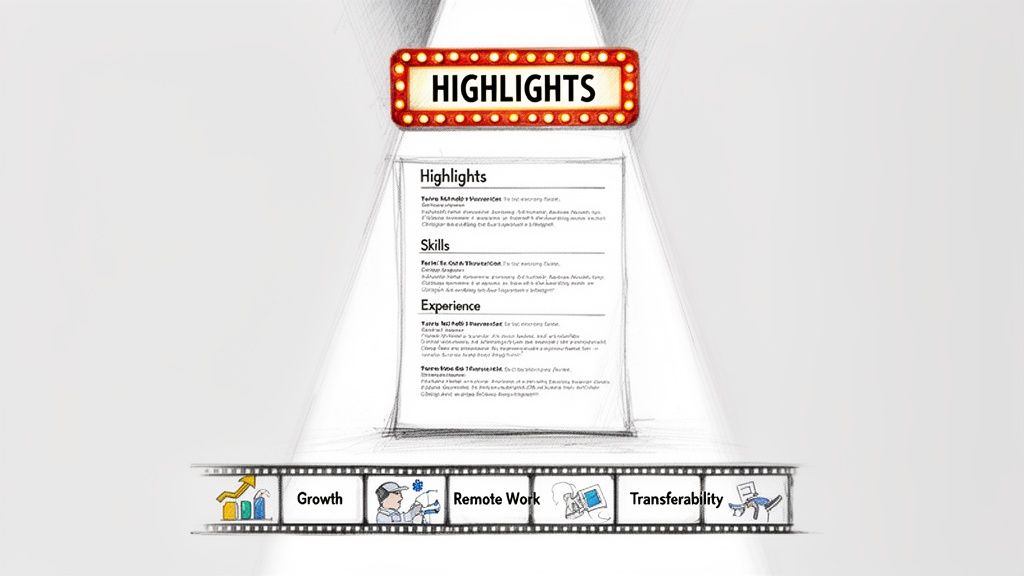
The hybrid resume is your best bet for standing out in today’s job market. It’s a smart format that cleverly combines the best features of a traditional resume with a modern, skills-focused approach.
It leads with a powerful summary of your skills and qualifications to immediately catch a recruiter’s eye. Then, it follows up with your work history in chronological order to provide the necessary context. Think of it as giving the hiring manager the highlights reel before they settle in to read your full career story.
What Is a Hybrid Resume and Why You Need One Now
The traditional resume makes a recruiter hunt for your qualifications. The hybrid resume, on the other hand, flips the script entirely. It’s built on a simple, powerful principle: answer the hiring manager’s most important question right away—”Can you do this job?”
This format, often called a combination resume, is a direct answer to the realities of modern hiring. Recruiters are busy. They spend an average of just seven seconds scanning a resume. The hybrid format is designed specifically for that quick scan, putting your most relevant skills and accomplishments at the very top where they can’t be missed.
The Rise of Skills-First Hiring
There’s a reason the hybrid resume has become one of the most popular formats in 2026. It perfectly aligns with a major shift in how companies hire. In fact, 43% of businesses now consider skills-first hiring their main priority. At the same time, 70% of recruiters say finding candidates with the right skills is their single biggest challenge.
The hybrid resume solves this problem head-on, which is why it’s become the top choice for job seekers who know what they’re doing. You can see the full analysis on which resume formats are dominating here.
This structure isn’t just for human eyes, either. It’s also incredibly effective at getting past the Applicant Tracking Systems (ATS) that most companies use. These systems scan your resume for specific keywords. By front-loading your resume with a detailed skills section, you give the software exactly what it’s programmed to find, dramatically increasing your chances of making it to a human reviewer.
The hybrid resume tells a story of capability first and chronology second. It bridges the gap between what you can do and where you’ve done it, making it the perfect tool for career changers, remote job seekers, and anyone whose skills are more impressive than their linear job history.
Is the Hybrid Resume Right for You?
While the hybrid format is a game-changer for many, it’s not a universal solution. It’s all about picking the right format for your unique career path. Knowing when to use it—and when a different approach might serve you better—is key to a successful job search.
Use this quick comparison to decide if the hybrid resume format is the right choice for your career goals.
Which Resume Format Fits Your Career Goals
| Resume Format | Best For | Avoid If |
|---|---|---|
| Hybrid | Career changers, remote workers, professionals with diverse skill sets, or those with employment gaps. | You are an entry-level candidate with very limited skills or have a long, stable career path in one industry. |
| Chronological | Professionals with a strong, linear career progression in a single field and extensive relevant experience. | You have significant career gaps or are trying to switch industries without many transferable skills. |
| Functional | Students, recent graduates with no work experience, or individuals with major, long-term employment gaps. | You have relevant work experience that you want to highlight, as recruiters are often skeptical of this format. |
Ultimately, the best resume format is the one that tells your professional story in the most compelling way. If your skills and abilities are your strongest selling points, the hybrid format is almost certainly the way to go.
Building Your Winning Hybrid Resume Section by Section
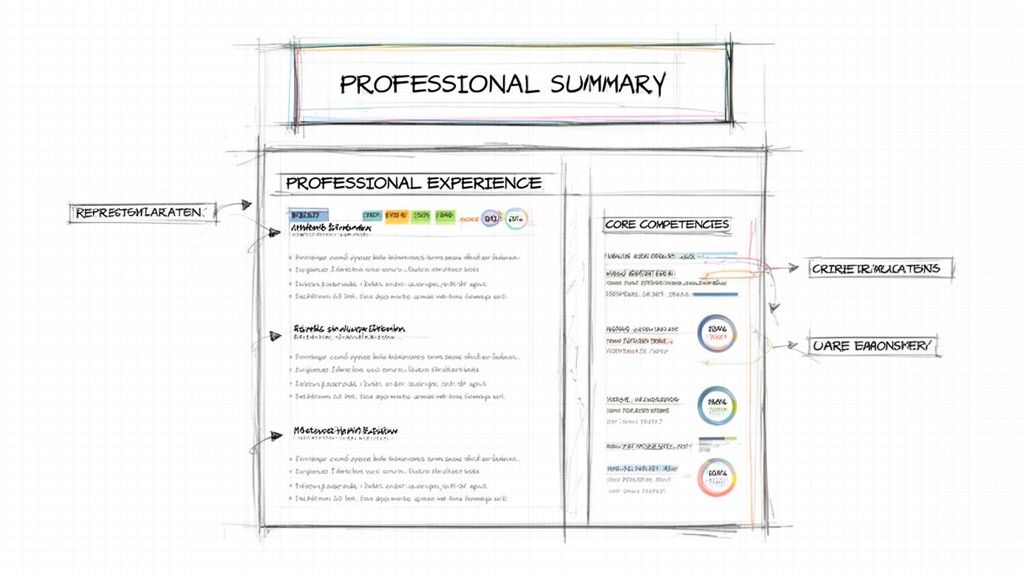
Alright, let’s get into the nuts and bolts. A great hybrid resume isn’t just a list of facts; it’s a carefully crafted story where every piece has a purpose. Getting the structure right is everything. Think of it less like filling out a form and more like building a compelling case for why you’re the perfect fit.
Here’s how to build each section so it captures attention and proves your worth from top to bottom.
Your Contact Information Header
Let’s start at the very top. Your contact header needs to be clean, professional, and dead simple to use. The goal here is pure function—a recruiter should know how to reach you in a split second, without any hunting around.
Make sure you include these key pieces of information:
- Your Full Name: Put this in bold and make it a little larger than the rest of the text.
- Location: Your city and state are all you need. For your own security, never put your full street address on a resume.
- Phone Number: List a number you can reliably answer.
- Professional Email: Stick to a standard format, something like
[email protected]. - Portfolio or LinkedIn: Add a direct link to your LinkedIn profile or personal portfolio site. It’s expected.
The Professional Summary
Right after your contact details comes your Professional Summary. This is your prime real estate. Forget those old-school “Objective” statements that talked about what you wanted. This is a punchy, 2-3 sentence pitch that immediately tells an employer what you can do for them.
Your summary needs to be the highlight reel of your career, hitting on who you are as a professional, what top skills you have for this specific job, and one killer achievement that proves you can deliver. It’s the trailer for the movie of your career—make it exciting enough that they’ll want to see the whole thing.
The Core Competencies or Skills Section
This section is the real engine of the hybrid resume format. Placing it right under your summary is a strategic move that pays off big time. It gives the hiring manager an immediate, scannable snapshot of your most valuable qualifications, and it’s also a goldmine for the Applicant Tracking Systems (ATS) that read your resume first.
A huge mistake I see people make is just dumping every skill they can think of into one giant, unreadable block. Instead, be selective. A curated list of 9-12 of your most relevant skills, sorted into logical groups, shows you’re organized and strategic.
Organizing your skills this way makes a much bigger impression:
Technical Skills: Python, SQL, Jira, Salesforce, Google Analytics Marketing Tools: HubSpot, SEMrush, Ahrefs, Marketo Leadership Abilities: Stakeholder Management, Cross-Functional Team Leadership, Budgeting
With a clean layout like this, you’re proving your capabilities before the recruiter even gets to your work history.
The Professional Experience Section
So you’ve grabbed their attention with your top skills. Now it’s time to back it all up with proof. Your experience section should still be in reverse-chronological order (your latest job comes first), but how you describe it is what matters. This isn’t the place to list what you were responsible for—it’s where you show what you accomplished.
For every role, you need to focus on results you can measure. A great way to frame your bullet points is by thinking in terms of the STAR method (Situation, Task, Action, Result). What was the problem, what did you do about it, and what was the quantifiable outcome?
Here’s the difference it makes:
- Instead of: “Managed social media accounts.”
- Write: “Spearheaded a new content strategy for Instagram and TikTok, increasing audience engagement by 45% and driving 20% more traffic to our website in six months.”
See the difference? The second one transforms a passive duty into a story of tangible success.
The Education and Certifications Section
Last but not least, your education section wraps everything up. Keep this part short and sweet. Unless you just graduated, no one needs to see your GPA or a list of relevant coursework.
Just list your degree, the university, and its location. If you’ve earned important credentials (like a PMP, a Google Analytics IQ, or an AWS certification), give them their own “Certifications” subsection so they don’t get lost. This adds another layer of credibility and reinforces the skills you highlighted at the top of the page.
How the Hybrid Format Unlocks Career Change Success
Trying to change careers can sometimes feel like you’re standing on one side of a canyon, with your dream job on the other. A traditional, chronological resume often just highlights the side you’re on now, leaving recruiters to guess how you’ll ever make the leap.
This is exactly where the hybrid resume format comes in. Think of it as the bridge that connects your past experience to your future goals. It makes your career pivot feel less like a random jump and more like a logical, well-planned next step.
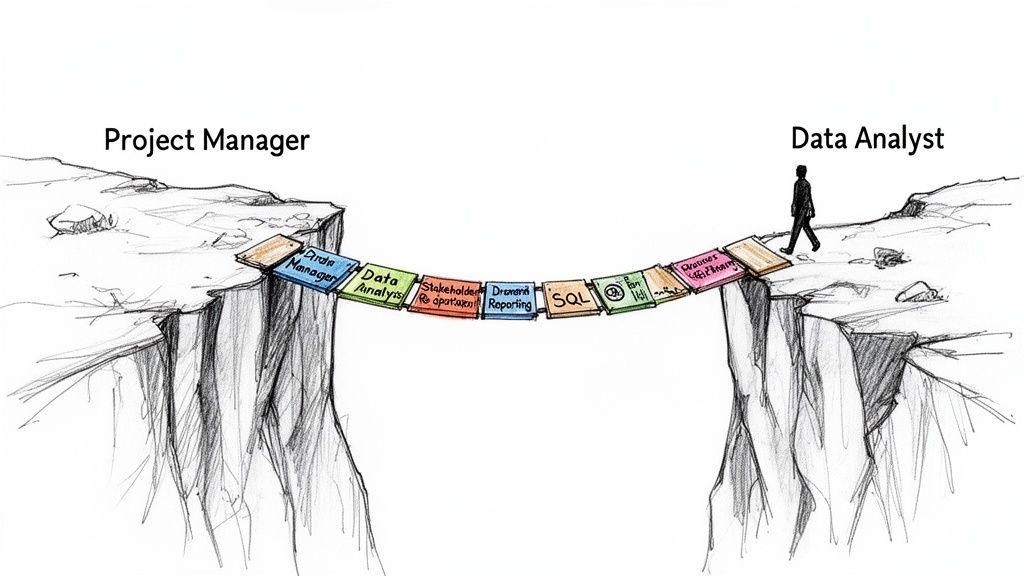
From Project Manager to Data Analyst: A Real-World Scenario
Let’s imagine “Alex,” a project manager with eight years under their belt who’s ready to pivot into a data analyst role. Alex is a pro at managing teams and timelines, but the job descriptions are all calling for Python, SQL, and Tableau.
Alex’s first resume was purely chronological. It led with “Senior Project Manager” and was filled with duties like “oversaw project lifecycles.” While true, it pigeonholed Alex as a project manager, forcing recruiters to hunt for any data-related skills. The result? Silence. The resume didn’t answer the one question the hiring manager had: “Can this person do the job of a data analyst?”
The Hybrid Resume Transformation
Frustrated but not defeated, Alex decided to switch to a hybrid format. This one structural change completely rewrote the story.
Here’s how it worked:
- A New Professional Summary: Alex’s new summary immediately stated the goal and connected it to past experience. It now read something like: “Detail-oriented professional moving into data analytics, bringing 8+ years of experience in quantitative analysis and data-driven project management to uncover actionable business insights.”
- A Prominent Skills Section: Right up top, Alex added a “Technical & Analytical Skills” section. It was packed with keywords from target job descriptions: Python (Pandas, NumPy), SQL, Tableau, Statistical Analysis, and A/B Testing.
- Reframed Work Experience: The work history was still in reverse-chronological order, but every bullet point was rewritten to spotlight data-focused achievements.
A chronological resume makes the recruiter do the hard work of connecting the dots. A hybrid resume connects the dots for them. It builds the case for why you’re a great fit before they even get to your work history.
This shift in perspective is what makes all the difference when you’re making a career jump. The hybrid format gives you a platform to prove you have the right skills, easing any doubts a recruiter might have about you switching fields.
Before and After: The Impact of Reframing
Let’s look at a single bullet point from Alex’s resume to see just how powerful this change is.
Before (Chronological Format):
- “Responsible for generating weekly status reports for project stakeholders.”
This is passive and vague. It focuses on a task but says nothing about the skill or the impact.
After (Hybrid Format):
- “Analyzed project performance data using Excel to create weekly KPI dashboards for stakeholders, identifying a key bottleneck that led to a 15% improvement in team efficiency.”
See the difference? The “after” version is a mini-story of success. It starts with a strong action verb (“Analyzed”), names the tool (“Excel”), and, most importantly, quantifies the result (”15% improvement”). It showcases a core data analysis skill: turning data into a tangible business outcome.
By applying this thinking to every bullet point, Alex’s resume started getting callbacks. It no longer read like a project manager’s resume; it read like the resume of a data analyst who just happens to have a strong background in getting things done. For anyone looking to make a similar move, checking out the best resume templates for career change can provide a solid foundation for this kind of powerful reframing.
Optimizing Your Hybrid Resume for ATS and Remote Work
Before a hiring manager ever sees your perfectly polished hybrid resume, it has to get past a critical gatekeeper: the Applicant Tracking System (ATS). Think of it as a digital bouncer for your career. Its sole purpose is to scan incoming resumes and filter out anyone who doesn’t look like a solid match on paper, long before a human knows you’ve even applied.
This isn’t just a big-company thing anymore. Over 98% of Fortune 500 companies rely on ATS, and that number is quickly growing for businesses of all sizes. The software isn’t reading for a compelling story; it’s hunting for specific keywords and phrases that align with the job description. Your hybrid resume’s structure gives you a great head start, but to really stand out, you have to make sure it speaks the algorithm’s language.
Thinking Like an Algorithm to Beat the Bots
The trick to getting past the ATS is to temporarily stop thinking like a human writer and start thinking like a simple keyword-matching program. Your main goal is to mirror the exact language from the job description you’re targeting. This doesn’t mean awkwardly copying and pasting—it’s about strategically weaving those key terms into your resume’s most important sections.
Start by dissecting the job posting. Seriously, print it out or copy it into a separate document. Then, go through with a highlighter and mark up the core responsibilities, essential skills, and qualifications. Pay close attention to both hard skills (like “Salesforce” or “Python”) and the softer skills they mention (like “stakeholder management” or “cross-functional collaboration”).
These highlighted terms are now your North Star. You need to make sure they show up naturally in a few key places:
- Professional Summary: Work in 2-3 of the most crucial keywords right at the top.
- Core Competencies/Skills Section: This is your primary keyword hub. Make sure it closely reflects the most important skills listed in the ad.
- Professional Experience: Use your bullet points to provide concrete examples of how you used these skills to get things done.
For example, if the job description mentions “customer lifecycle marketing” three times, that exact phrase needs to be on your resume. Simply writing “email marketing” isn’t good enough. The ATS is literal and looks for a perfect match.
Tailoring Your Resume for Remote-First Roles
When you’re applying for remote jobs, there’s another layer of optimization to consider. Companies hiring remote workers aren’t just looking for someone who can do the job; they’re also looking for proof that you can succeed without direct, in-person supervision. You have to signal that you’re ready for the unique demands of a distributed workplace.
Your resume needs to clearly show that you understand the tools and culture of remote work.
A resume optimized for remote work demonstrates self-sufficiency and a proactive communication style. It tells the employer you won’t need hand-holding and are already equipped to contribute effectively from anywhere.
To do this, sprinkle in terms that highlight your experience with the remote work stack. This includes:
- Communication Style: Mention your experience with asynchronous communication, which is the foundation of most successful remote teams.
- Collaboration Tools: Name-drop the specific platforms you’ve used, like Slack, Miro, Asana, Jira, or Trello.
- Remote Culture: Weave in phrases like distributed teams, remote collaboration, or virtual environments.
For instance, a simple bullet point can be transformed into something much more powerful:
- Before: “Led weekly team meetings.”
- After: “Facilitated project planning for a distributed team using Jira and asynchronous communication to ensure all members were aligned across time zones.”
See the difference? The “after” version is packed with keywords that tell both the ATS and the hiring manager that you’re a seasoned remote professional. To get a feel for the kind of language top companies are using, you can explore the curated listings of remote-first jobs and see what skills are in demand.
Your Final ATS and Remote-Ready Checklist
Before you hit that “submit” button, run your hybrid resume through this final audit. Think of it as your last line of defense to make sure your application has the best possible chance.
- Keyword Alignment: Does my skills section feature the top 5-7 keywords from the job description?
- Exact Phrasing: Have I used the exact job title and terminology I found in the posting?
- Simple Formatting: Is my resume free of tables, columns, or fancy graphics that might confuse an ATS?
- Standard Section Headers: Am I using clear, standard headings like “Professional Experience” and “Education”?
- Remote-Specific Terms: Have I included tools and concepts like “asynchronous,” “distributed team,” or software like Slack or Miro?
- File Type: Is my resume saved as a .docx or PDF, based on what the application asks for?
By systematically optimizing your hybrid resume format for both the software and the human who will read it next, you dramatically increase your chances of moving from the digital slush pile straight to the “must-interview” list.
Expert Hybrid Resume Examples and Templates
It’s one thing to talk about the theory behind the hybrid resume format, but seeing it in action is what really makes it all click. So let’s bridge that gap between concept and reality. We’re going to walk through two great examples of hybrid resumes built for popular roles: a Software Engineer and a Digital Marketing Specialist.
Think of these as your visual playbook. I’ve added callouts to pinpoint exactly why certain phrases are so effective, how achievements are backed by hard numbers, and how the skills section perfectly sets the stage for the work history that follows. This will give you a tangible feel for how to build your own.
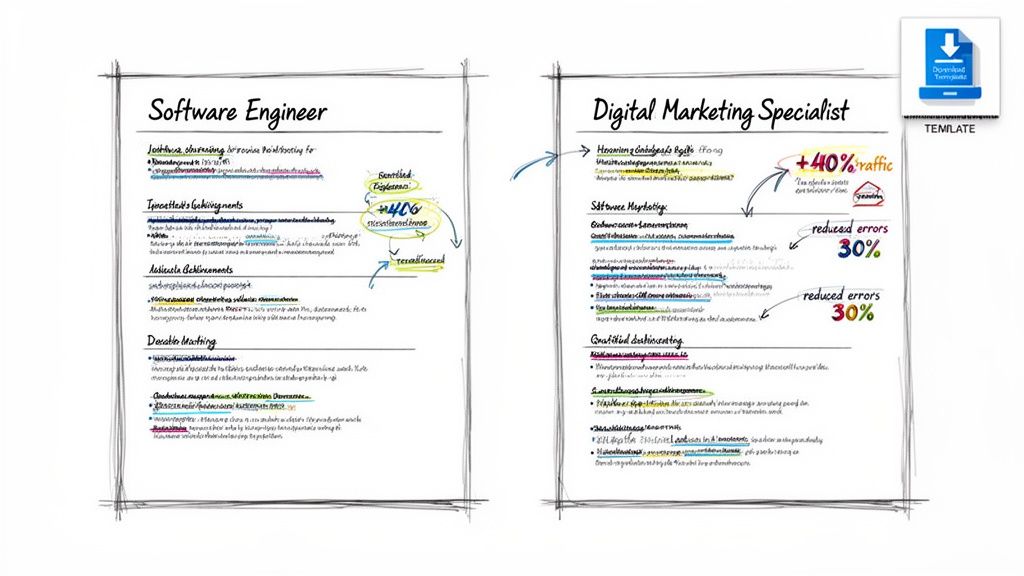
Annotated Hybrid Resume Example: Software Engineer
Here’s a breakdown of an effective hybrid resume for a mid-level Software Engineer targeting a job that requires both front-end skills and cloud experience.
Professional Summary:
Detail-oriented Software Engineer with 5+ years of experience building and deploying scalable web applications. Proven expertise in JavaScript frameworks and AWS cloud services, with a track record of improving application performance by 30% through code optimization and infrastructure upgrades.
- The Breakdown: This summary is powerful because it immediately states the years of experience, names the core technologies (JavaScript, AWS), and drops a huge, quantifiable achievement—a 30% improvement. It answers the hiring manager’s biggest question, “Can you deliver results?” in the first two lines.
Core Competencies:
Languages: JavaScript (ES6+), Python, TypeScript, HTML5/CSS3
Frameworks & Libraries: React.js, Node.js, Express.js
Cloud & DevOps: AWS (EC2, S3, Lambda), Docker, CI/CD, Terraform
The Breakdown: The skills are neatly sorted into logical groups, which is a gift to a busy recruiter (and the ATS). This layout makes it incredibly easy to scan and confirms the engineer has the specific tech stack mentioned in the job description.
Professional Experience (Sample Bullet Point):
Engineered a new user authentication module using React and AWS Lambda, reducing login times by 40% and supporting a 25% increase in concurrent users.
The Breakdown: This bullet point is a masterclass in showing impact. It kicks off with a strong action verb (“Engineered”), lists the specific tools (React, AWS Lambda), and finishes with undeniable metrics: a 40% reduction and 25% increase.
Annotated Hybrid Resume Example: Digital Marketing Specialist
Now, let’s pivot to a Digital Marketing Specialist who wants a role focused on SEO and content strategy.
Professional Summary:
Data-driven Digital Marketing Specialist with 4 years of experience developing and executing SEO strategies that have increased organic traffic by over 200%. Adept at using tools like Ahrefs and Google Analytics to identify content gaps and drive lead generation.
- The Breakdown: This summary grabs attention by leading with a massive win—a 200% traffic increase. Mentioning industry-standard tools by name instantly signals practical, hands-on expertise and credibility.
Core Competencies:
SEO & Analytics: Keyword Research, On-Page/Off-Page SEO, Google Analytics, Ahrefs
Content Marketing: Content Strategy, Blog Management, Copywriting, WordPress
Paid Media: Google Ads, Facebook Ads, Campaign Optimization
The Breakdown: The skills are organized by marketing discipline. This shows the candidate isn’t just a one-trick pony but possesses a well-rounded skill set that covers the key areas of modern digital marketing.
Professional Experience (Sample Bullet Point):
Launched a targeted blog content strategy based on keyword gap analysis, resulting in 15 articles ranking on the first page of Google within six months and a 60% increase in organic leads.
The Breakdown: This is a perfect example of a mini-story. It shows the action (launched a strategy), the process (keyword gap analysis), and the fantastic results (15 articles on page one, 60% lead increase). It’s compelling and easy to understand.
Powerful Action Verbs to Strengthen Your Resume
Choosing the right verb is the fastest way to make your experience sound more dynamic and impactful. Instead of saying you were “responsible for” something, use a powerful action verb that shows you took charge. This curated list will help you get started.
| Leadership & Management | Technical & Development | Creative & Marketing | Analytical & Research |
|---|---|---|---|
| Orchestrated | Engineered | Authored | Assessed |
| Mentored | Architected | Conceptualized | Audited |
| Spearheaded | Deployed | Curated | Forecasted |
| Executed | Refactored | Launched | Modeled |
| Overhauled | Automated | Revitalized | Quantified |
| Aligned | Integrated | Promoted | Validated |
Sprinkling these verbs throughout your experience section will instantly elevate your resume, helping you stand out from a sea of passive descriptions. Choose verbs that accurately reflect your contribution and feel authentic to your work.
Common Hybrid Resume Mistakes and How to Fix Them
You’ve put in the work to build a great hybrid resume, but a few small, avoidable missteps can trip you up right at the finish line. These common errors can be the difference between getting an interview and having your application overlooked. Let’s walk through a final quality check to make sure your resume is polished, professional, and free of any red flags.
Even a single typo can signal a lack of attention to detail, which is a dealbreaker for almost any role. Before you send anything out, a thorough proofread is essential. Using a tool like the best grammar checker can be a lifesaver, catching those small mistakes that your own eyes might miss and protecting your credibility.
Mistake 1: Creating a Dense Wall of Skills
I see this all the time. A candidate knows the skills section is important for a hybrid resume, so they create a massive, jumbled block of keywords right at the top. While the intention is good, the result is an overwhelming wall of text that’s impossible for a busy recruiter to scan.
The fix is all about organization.
- Group Your Skills: Don’t just list them. Create logical subheadings like “Technical Skills,” “Marketing Platforms,” or “Leadership Abilities.” This shows you know how to structure information.
- Be Selective: You don’t need to list every single thing you’ve ever done. Zero in on the 9-12 most relevant skills that directly match the job description.
- Use Columns (Sparingly): If you truly have a lot of relevant skills, a two-column layout within this section can make it much easier to read without looking cluttered.
This approach isn’t just about looking cleaner. It subtly proves you’re an organized thinker.
Mistake 2: Failing to Quantify Accomplishments
Simply stating your job duties is one of the biggest missed opportunities on any resume. A line like “Managed social media accounts” is forgettable. It tells a hiring manager what you did, but not how well you did it. They want to see your impact, not just your responsibilities.
The solution? Let the numbers tell your story.
Before: “Wrote blog articles for the company website.” After: “Authored 20+ blog articles on SEO best practices, increasing organic search traffic by 45% in six months and generating over 500 MQLs.”
See the difference? You’ve gone from describing a task to proving your value with measurable results. That’s what gets you noticed.
Mistake 3: Using Inconsistent Formatting
Your resume’s design speaks volumes before a single word is read. When your fonts, spacing, and heading styles are all over the place, it just looks sloppy. Even worse, it can confuse Applicant Tracking Systems (ATS), which might cause your resume to be filtered out automatically.
Consistency is key for both human eyes and an ATS.
- Font: Stick to one professional font for the whole document. Think Calibri, Arial, or Georgia.
- Headings: Make sure all your main section headings (like “Experience” and “Skills”) are the same size and style.
- Bullet Points: Use the same bullet symbol and indentation throughout your experience section.
By sidestepping these common pitfalls, you allow your hybrid resume format to do its job effectively, presenting you as the meticulous, high-value professional you are.
Frequently Asked Questions About the Hybrid Resume Format
Even with a detailed guide in hand, a few questions always seem to pop up. Let’s tackle some of the most common ones I hear from job seekers so you can feel confident hitting that “apply” button.
A big one is always page length. Can a hybrid resume stretch to two pages? My advice is almost always no. For anyone with under 15 years of experience, the one-page rule is still your best friend. The whole point of the hybrid format is to be concise and powerful; spilling onto a second page dilutes that impact. Save the two-pagers for senior executives or academics with a long list of published work.
Is This a Good Format for Recent Graduates?
I get this question a lot, and the answer is a resounding yes. The hybrid resume is fantastic for new grads because it lets you lead with your strengths—your skills, internships, and impressive academic projects—right at the top. This strategy puts your qualifications front and center before a recruiter’s eyes even drift down to your work history dates, which might be a little thin.
How Many Skills Should I List?
When it comes to your skills section, think “curated” not “comprehensive.” You want quality over quantity every time.
Don’t just dump every skill you have into a massive, disorganized list. Instead, pick 9-12 of your most relevant hard and soft skills and group them into logical categories like ‘Technical Skills,’ ‘Marketing Tools,’ or ‘Languages.’
This simple trick does two things: it makes your skills easy to scan and it shows the hiring manager you know how to organize information—a valuable skill in itself. Nailing these details is what separates a good resume from a great one, ensuring you make a strong impression on both the ATS and the human on the other side.
Ready to find high-quality remote jobs without the noise of traditional job boards? Remote First Jobs gives you a head start by sourcing over 44,000 verified listings directly from company career pages, letting you apply before the roles go viral. Find your next remote job now.