You’re probably doing what many job seekers do when they start looking for remote jobs india opportunities. Open LinkedIn. Type “remote.” Add “India.” Scroll for an hour. Save ten roles. Apply to six. Hear back from none. Then you jump to Indeed, find a pile of “work from home” listings, and half of them read like recruiter spam, commission-only sales, or jobs that don’t even make it clear who’s hiring.
That frustration is rational. The problem usually isn’t your experience. It’s the search method.
Good remote roles in India exist. Strong companies are hiring across tech, marketing, product, support, and operations. But the public boards are where demand and noise collide. If you keep competing where everyone else competes, you’ll keep getting the same result. The edge comes from getting in earlier, filtering harder, and applying to direct-hire roles before they become crowded.
The Remote Work Paradox in India
Remote work in India is booming, and that’s exactly why the search feels harder.

On one side, the opportunity is real. India’s remote workforce is projected to reach between 60 to 90 million by 2025, up from 1.5 million in 2022, and the country is projected to contribute over 20% of the global remote workforce, according to this analysis of remote work growth in India.
On the other side, that same growth has flooded the biggest job platforms with applicants, reposts, recycled listings, and low-quality “WFH” offers. More people want remote work. More companies say they offer it. More boards claim they list it. That doesn’t mean your search gets easier.
Why more remote jobs can create a worse search experience
A growing market attracts three groups fast:
- Serious employers looking for distributed talent
- Recruiters and aggregators copying and reposting the same jobs
- Scammers and low-quality operators hiding behind the language of flexibility
That’s the paradox. A bigger remote market creates more opportunity, but also more clutter between you and the opportunity.
If you’ve been applying through mainstream boards, you’ve probably already seen the pattern. Roles look promising until you notice they were posted again. Or they redirect through multiple recruiter layers. Or they ask for broad “good communication skills” without clear responsibilities, team structure, or reporting lines.
Practical rule: When a market expands fast, the fastest-growing layer is often noise, not quality.
The real bottleneck is attention, not listings
Most job seekers assume they need to apply more. Usually they need to apply earlier and with better filters.
That matters because remote jobs india searches attract people from every major city, every Tier-2 market, return-to-work professionals, career switchers, and international candidates for some roles. A decent remote listing can get attention immediately, especially if the company name is recognizable or the role allows broad geographic hiring.
The answer isn’t to abandon job boards completely. It’s to stop treating them as your primary discovery channel.
The strongest candidates I’ve seen don’t win because they’re always the most qualified on paper. They win because they reach real openings before those openings become public feeding frenzies, and because they avoid wasting energy on fake or weak opportunities.
Escape the Job Board Black Hole
Here’s the hard truth. Big job boards are useful for awareness, but they’re often poor tools for timing.
By the time a role is widely visible on LinkedIn or Indeed, it may already have a crowded applicant pile. That delay matters most in categories where remote demand is intense and the supply of genuinely flexible roles is still limited.
In Indian tech, that limit is very clear. As of mid-2024, only 38% of Indian IT job postings were fully remote or hybrid, according to The Economic Times coverage of Indian tech hiring patterns. That’s a meaningful share, but it also means remote-friendly roles are a constrained slice of the market, and they attract heavy attention.
Why aggregators put you in the slow lane
Most job seekers use this sequence:
- Search on LinkedIn or Indeed
- Filter by remote
- Sort by most recent
- Apply after the listing has already circulated widely
That process feels efficient, but it puts you in line behind everyone else using the same filters.
A better mental model is job post latency. A company publishes a role on its own careers page first. Later, that role gets indexed, scraped, reposted, shared, screenshotted, discussed, and circulated. Every extra step increases visibility and applicant volume. Your odds don’t improve when you join at the end of that chain.
What first-mover advantage actually looks like
First-mover advantage in job search isn’t magic. It’s operational.
You want to find roles when they are:
- Fresh on the company site
- Still tied to the hiring team
- Less exposed to mass-market traffic
- More likely to be actively reviewed
That’s why direct sourcing works. Instead of fishing in the same public pool as everyone else, you monitor the places where companies publish jobs first: their own ATS and career pages.
One useful example is Remote First Jobs, which focuses on jobs pulled directly from company career pages rather than relying on the usual board-to-board recycling. The principle matters more than the brand name. Direct discovery beats delayed discovery.
If you’re always applying where everyone else applies, your resume isn’t only competing on quality. It’s competing on arrival time.
What doesn’t work
A few habits consistently waste time:
- Mass applying through Easy Apply because it feels productive
- Using only one keyword, usually just “remote”
- Ignoring hybrid wording and discovering too late that office presence is required
- Applying through recruiter reposts instead of the employer’s actual listing
What works is narrower and less glamorous. Build a shortlist of target companies. Track their hiring pages. Apply directly. Use boards for research, not dependence.
That shift alone changes the game. You stop acting like a browser and start acting like a recruiter who knows where jobs originate.
Your Toolkit for Finding High-Quality Remote Roles
The best remote jobs india searches run like a pipeline, not a random hunt.
You need three things working together: a target list, direct visibility into company career pages, and alerts narrow enough that you can act quickly without drowning in irrelevant posts. India’s remote hiring environment supports this approach because the infrastructure is already there. The country has over 800 million internet users and some of the world’s lowest data costs, which has helped make India a major hub for remote talent in fields like IT, digital marketing, and data science, as noted in this overview of India’s remote talent landscape.
Build a search system, not a hope system
Start with company types, not just role titles.
If you only search for “remote marketing manager” or “remote product designer,” you’ll keep seeing the same recycled demand. Instead, build a list of employers that are already comfortable hiring distributed talent. Look for companies that use language like remote-first, distributed, work from anywhere, async, global team, or home office stipend on their careers pages.
Then split your target list into buckets:
- Core fit companies where your background already matches their industry or product
- Stretch companies where the role fits but the domain is new
- Opportunistic companies that hire remotely across functions and geographies
This keeps your effort focused. You don’t need thousands of targets. You need a credible list you can monitor consistently.
Use direct-source alerts with tight keywords
Generic alerts are noisy. Precision wins.
Set alerts around combinations like:
- Product manager + remote + India
- Content marketing + distributed
- Customer success + APAC
- Backend engineer + async
- Demand generation + remote first
The keyword strategy matters because many solid roles won’t use the exact phrase “work from home.” They may frame the role around geography, team model, or overlap hours instead.
Here’s the simplest comparison.
| Strategy | Job Quality | Competition Level | Speed Advantage |
|---|---|---|---|
| Large public job boards | Mixed, often repetitive | High | Low |
| Recruiter reposts | Unclear until vetted | High | Low |
| Company career pages | Usually stronger and more current | Lower early on | High |
| Direct-source career page monitoring | High, with better verification | Lower than mass boards | Highest |
What to check before you apply
Before sending an application, open the actual company page and check for signals that the role is current and real:
- Team context matters. A real posting usually explains who you report to, who you’ll work with, or which function owns the role.
- Responsibilities should be concrete. “Own onboarding for enterprise clients” is better than “handle multiple tasks.”
- Remote terms should be explicit. If the role says India only, APAC, or overlap with US hours, treat that as useful information, not a downside.
A small practical detail also helps during interviews. If you’re preparing to work remotely full-time, candidates who present a calm, functional workspace often come across as more ready for distributed work. If you need ideas that are practical, this guide on how to set up a practical home office is worth a look.
Better search systems reduce wasted applications. They also improve the quality of the jobs you pursue, which matters just as much.
How to Spot and Avoid Remote Job Scams
A remote listing can look polished and still be a bad opportunity.
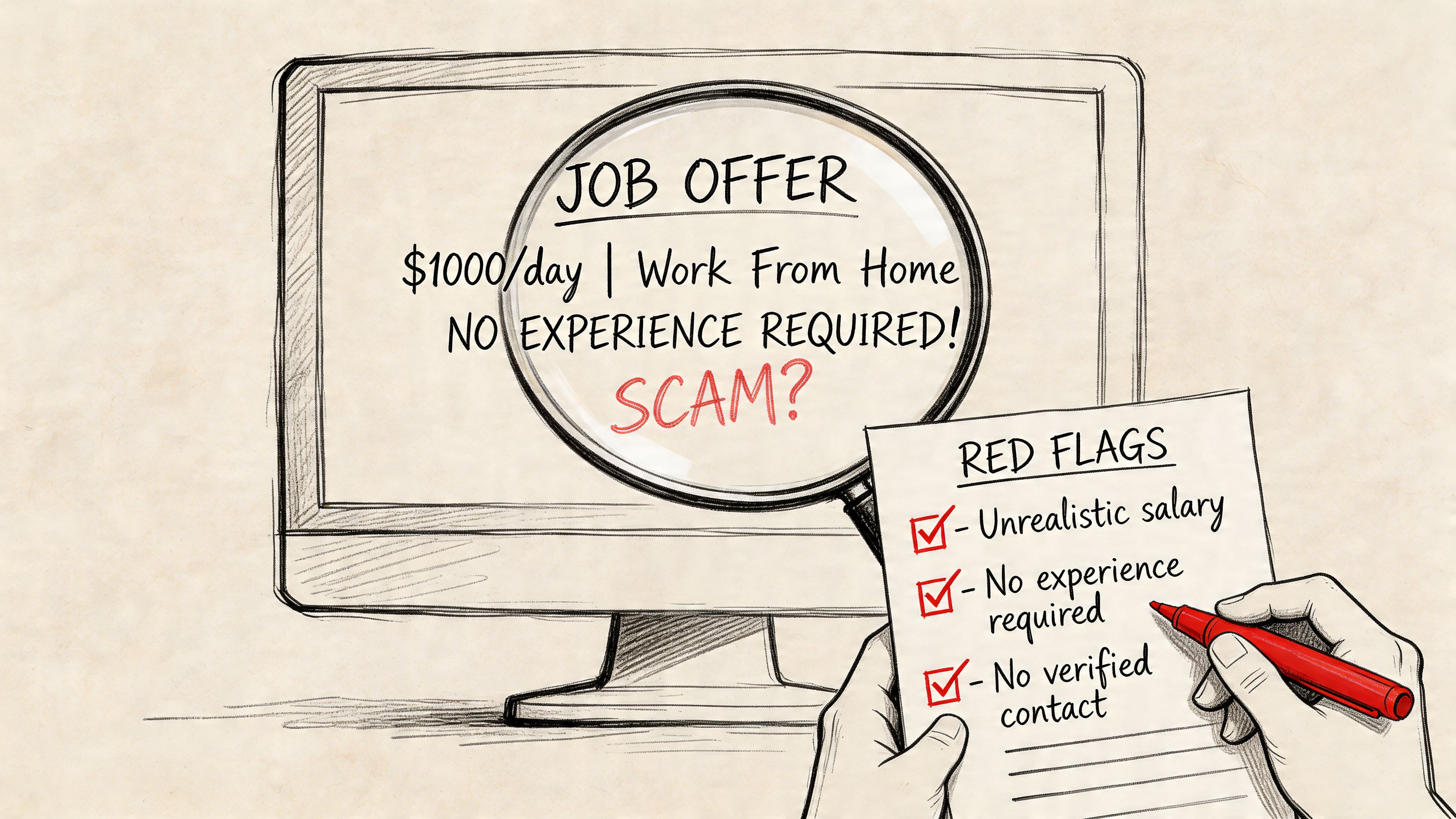
That’s especially true at entry and mid level, where vague “work from home” ads often hide recruiter spam, commission-only sales structures, or jobs that never clearly identify the employer. On platforms like Indeed, up to 70% of remote job listings in India are posted by agencies or recruiters rather than the hiring company directly, and many entry-level roles are commission-only traps. That model has seen a 30% surge in the last year, according to Indeed-based market observations on entry-level remote jobs in India.
The red flags that show up again and again
Some warning signs are obvious. Others are subtle enough that tired job seekers talk themselves into ignoring them.
Watch for these:
- Missing employer identity. If the listing won’t clearly name the company, proceed carefully.
- Commission-heavy language. Phrases like “earn per closure,” “high incentives,” or “unlimited earning potential” often signal a weak or unstable base.
- No real job scope. If the role doesn’t explain deliverables, team setup, tools, or reporting structure, it’s probably not a serious full-time opening.
- Pressure tactics. Urgent WhatsApp replies, immediate joining demands, or requests to “pay for onboarding” should end the conversation.
- Recruiter relay chains. If your application passes through multiple agents before you know who’s hiring, you lose transparency fast.
How genuine remote-first companies sound different
Legitimate distributed employers usually write job descriptions with operational clarity. They tell you what outcomes matter. They explain how the team works. They mention collaboration norms, async habits, overlap expectations, or documentation culture.
That doesn’t guarantee a perfect company. It does show that the employer has thought beyond “sit at home and do tasks.”
Green flags include:
- Specific responsibilities
- Named tools or workflows
- Clear employment type
- Direct apply route on the company site
- Reasonable interview process
- Visible company presence across website, leadership, and product pages
A real remote company sells the work, the team, and the mission. A scam sells urgency, vague income, and convenience.
A quick vetting checklist
Use this before every application:
- Search the company website and confirm the role exists there.
- Check whether the description matches the version on the board.
- Look for a real product, client base, or service offering.
- Scan employee profiles on LinkedIn to see whether the company has staff in relevant functions.
- Read the compensation language carefully. If there’s no base pay clarity and the role sounds sales-heavy, slow down.
- Ask one direct question before interview scheduling: “Is this a direct hire with the company, and is there a fixed salary component?”
That one question filters out a lot of junk.
A short explainer like this can also sharpen your instincts before you spend time interviewing:
Don’t confuse remote-tolerant with remote-first
Candidates frequently encounter pitfalls here.
A remote-tolerant company may allow work from home but still manage people like an office team. Meetings pile up. Communication lives in private chats. Managers expect instant responses. Promotions favor people near headquarters.
A remote-first company designs work so distributed employees can succeed without being treated like second-class staff. The job ad often gives this away. If you see clarity, process, documentation, and ownership, that’s promising. If you see only hype and flexibility slogans, stay skeptical.
Tailoring Your Application for Distributed Teams
Most resumes are written for office jobs and then lightly edited for remote roles. Hiring managers can tell.
A strong remote application shows that you can operate with autonomy, communicate clearly in writing, and move work forward without constant supervision. You don’t need to say “I’m great at remote work” ten times. You need proof in the way you frame your experience.
Rewrite your experience around remote signals
Start with your bullets.
A weak bullet says:
- Managed client communication and project coordination
A stronger remote-ready version says:
- Coordinated client updates across Slack, email, and shared documentation, tracked decisions asynchronously, and kept delivery moving without daily supervision
That kind of wording helps both ATS filters and human readers. It tells them how you work, not just what your title was.
Useful phrases to include where they’re true:
- Distributed team
- Asynchronous communication
- Cross-functional collaboration
- Self-management
- Written documentation
- Remote onboarding
- Stakeholder updates across time zones
- Independent ownership
Your resume should answer unspoken concerns
Remote hiring managers often worry about three things:
- Will this person need constant hand-holding?
- Can they communicate clearly without a room full of meetings?
- Will time zone friction create problems?
Address those concerns directly inside your application materials.
For example, if you’ve worked with clients, vendors, or teammates outside your city or country, say so. If you’ve owned projects from kickoff to completion, show it. If your work involved reporting, dashboards, ticketing systems, or documentation, include those details.
Hiring teams don’t just screen for skill. They screen for trust.
Cover letters should be shorter and sharper
Most remote cover letters are too generic. Keep yours tight.
A good structure is:
- Why this company
- Why this role fits your background
- Why you’re effective in a distributed setup
You can also proactively address work style in one line: “I’m comfortable working in distributed teams and used to maintaining clear written communication, documented handoffs, and reliable turnaround across shared ownership.”
That’s better than long claims about passion.
Handle time zone questions before they become objections
If a company is in the US or Europe, don’t wait for them to worry about IST overlap.
Use one plain sentence in your note or application: “I’m based in India and comfortable maintaining agreed overlap hours for meetings, handoffs, and response windows.”
If late-evening coverage is fine for you, say so carefully. If you prefer partial overlap and async-first work, say that instead. Clarity beats trying to sound endlessly available.
The same applies in interviews. Give practical answers. Mention how you structure your day, handle updates, and escalate blockers. Remote managers want predictability. Show them you already work that way.
Landing International Roles and USD Salaries
This is the part many candidates want most, and it’s also where unrealistic advice does the most damage.
Verified USD-paying remote roles for Indian professionals are scarce, with Glassdoor listing fewer than 50 such roles as of April 2026, according to Glassdoor search results for remote USD-paying jobs in India. That doesn’t mean you shouldn’t pursue them. It means you should treat them as a focused campaign, not a broad spray-and-pray search.

What international employers quietly screen for
They may not state it openly, but many teams evaluate Indian applicants on a few hidden variables:
- Time zone overlap
- Written English and meeting clarity
- Independent execution
- Cultural fit with distributed teams
- Whether payroll and contracting will be easy
You improve your odds by answering those concerns before they ask. Mention overlap windows. Show concise communication. Present clean documentation and portfolio samples. Keep your resume free of clutter and local jargon that global teams may not understand.
Aim for friction reduction
The strongest international candidates reduce uncertainty.
That means being ready to discuss whether you’re open to contractor arrangements, employer-of-record structures, or region-specific hiring terms. It also helps to show that you can communicate reliably outside chat apps. For interview scheduling, follow-ups, or occasional voice coordination with overseas teams and clients, having a dependable option for cheap international calls to India can be useful when internet calling quality drops at the worst moment.
Don’t lead with salary. Lead with fit.
If the role pays in USD, the competition is global. Your pitch should focus first on value and operating style.
Talk about outcomes you’ve owned, systems you’ve improved, and how you collaborate across distance. Salary negotiation works better once they believe hiring you will be easy, low-drama, and productive.
A lot of candidates chase international roles emotionally. The better approach is clinical. Fewer roles. Better targeting. Cleaner applications. Stronger proof. That’s how remote jobs india searches turn into global offers.
If you’re tired of late, recycled, and spam-heavy listings, Remote First Jobs is worth using as your first discovery layer. It pulls verified remote roles directly from company career pages, monitors 21,135+ remote-first companies, shows 44,000+ active jobs, detects 200,000+ new opportunities monthly, and is used by 10,000+ job seekers each month. If your goal is to apply before a role gets flooded on LinkedIn or Indeed, that speed advantage is the whole point.