Think your resume is solid, but all you’re hearing back is silence? It’s a common story. You send out application after application, and it feels like they just vanish into a digital black hole. You’re not imagining it, and you’re definitely not alone.
The world of manufacturing is competitive. A single machine operator opening can pull in hundreds of resumes, and hiring managers are completely swamped. In that sea of applicants, a basic, run-of-the-mill resume just won’t get a second look.
Why Your Current Resume Isn’t Getting Interviews
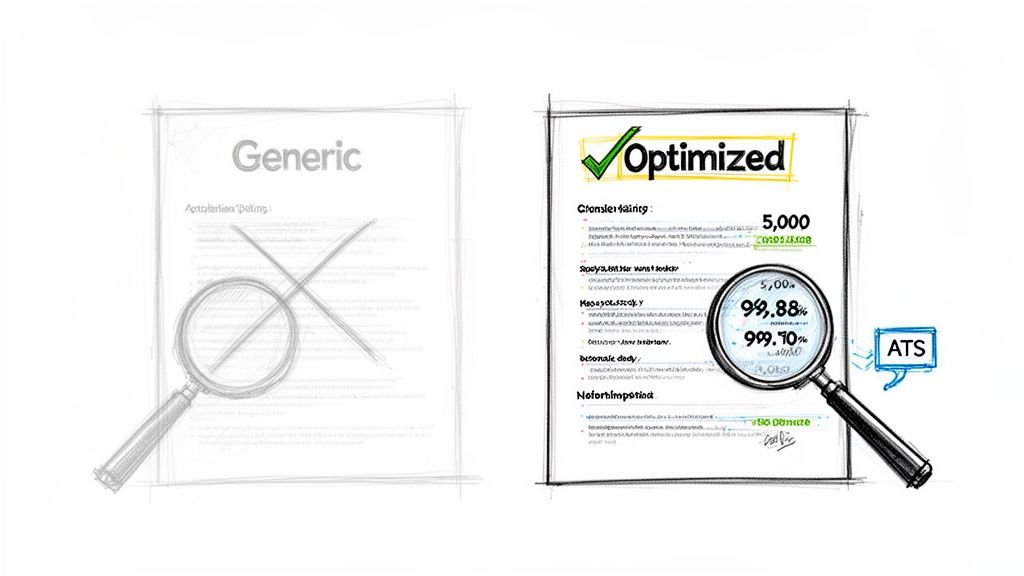
So, what’s the real problem? Most of the time, it’s because the resume describes what you did instead of what you achieved.
Simply listing “Operated CNC machine” tells a hiring manager next to nothing. It’s the bare minimum. A powerful resume translates that duty into a result: “Operated CNC machines to produce 1,500 parts daily with a 99.7% accuracy rate, consistently exceeding team targets by 15%.” See the difference? That one shift—from passive duties to active accomplishments—is the single biggest upgrade you can make to your resume.
The High Turnover Reality
The demand for skilled machine operators is incredibly high. Right now in the United States, there are over 1,267,157 machine operators employed. But here’s the kicker: data from over 276,000 resumes shows that the average operator only stays in a role for 1-2 years.
This constant churn means there are always openings, but the competition is fierce. Hiring managers are looking for people who can hit the ground running and show a clear history of making a real impact. You can dig into more machine operator career demographics on Zippia.com.
Your resume isn’t just a list of jobs you’ve had. It’s a sales pitch. Every single line needs to answer the hiring manager’s big question: “How will this person make our operation better?”
The other major roadblock is something called an Applicant Tracking System, or ATS. Think of it as a robotic bouncer for your resume. This software scans your document for specific keywords and qualifications from the job description before a human ever lays eyes on it. If your resume isn’t formatted correctly or is missing those crucial terms, you’re automatically filtered out. Game over.
From Outdated to Outstanding
To get your resume past the bots and into the hands of a real person, you need to think like a marketer. It has to be loaded with metrics, targeted keywords, and solid proof of how you’ve improved safety, quality, and efficiency.
The gap between a resume that gets ignored and one that lands an interview is huge. Let’s break down exactly how to reframe your experience for a modern resume that gets results.
This table shows the difference between the old way of writing a resume and the modern, achievement-focused approach that actually gets you noticed.
| Resume Component | Outdated Approach (What to Avoid) | Modern Approach (What to Do) |
|---|---|---|
| Professional Summary | “Experienced machine operator seeking a challenging role.” | “Detail-oriented Machine Operator with 5+ years of experience in CNC milling and lathe operation. Proven ability to reduce material waste by 15% and improve production uptime by 10% through diligent maintenance and process optimization.” |
| Work Experience | “Responsible for machine setup and operation.” | “Set up and calibrated 5-axis CNC machines for complex jobs, reducing average setup time from 45 minutes to 25 minutes.” |
| Skills Section | “Hard-working, detail-oriented, team player.” | “Hard Skills: G-Code, Blueprint Reading, Micrometers & Calipers. Soft Skills: Problem-Solving, Quality Control, Preventative Maintenance.” |
Notice how the “Modern Approach” is all about action and numbers. It doesn’t just say what you did; it proves the value you brought to the role. That’s how you write a resume that opens doors.
Crafting Your Core Resume Sections
Think of your resume like a finely tuned machine—every part has to work together perfectly. We’re going to build the core framework that gets seen first by both hiring managers and the automated systems they use.
Your contact info, professional summary, and work experience are the foundational pieces. Get these right, and you’ll make a powerful first impression that puts you ahead of the pack. Let’s get them assembled.
Perfecting Your Contact Information
This might seem obvious, but you’d be surprised how many people get it wrong. Little details here signal your professionalism right away. Of course, you need your name, phone number, and city/state.
But it’s the other stuff that makes a difference. Use a professional-sounding email. Something like [email protected] looks a lot more serious than [email protected]. It’s a tiny change that has a big impact.
Finally, include your LinkedIn profile URL. Take a minute to customize it in your settings so it’s a clean “vanity” URL (like linkedin.com/in/john-smith-operator). This shows you’re an engaged professional and gives managers another way to see your skills.
Writing a Compelling Professional Summary
Forget the old-school “objective statement.” A hiring manager doesn’t need to know what you want—they need to know what you can do for them. That’s where a professional summary comes in. It’s your 3-4 sentence elevator pitch right at the top of your resume.
Your goal is to answer one question immediately: “Why should we hire you?”
A great summary is a miniature story of your value. It connects your years of experience, a key hard skill, and a powerful, quantifiable achievement. It’s the hook that makes a manager want to keep reading.
Let’s piece one together. You start with your job title and years of experience, add a specific skill set, and then cap it off with a major win.
- Example for a CNC Operator: “Highly skilled CNC Machine Operator with over 7 years of experience in high-volume aerospace manufacturing. Expert in 5-axis milling and G-code programming. Proven track record of reducing cycle times by 18% through strategic tool path optimization, directly contributing to increased production output.”
This summary is instantly impressive. It’s packed with keywords (CNC Machine Operator, 5-axis milling, G-code) and a hard number that proves your value.
Detailing Your Work Experience
Here’s the heart of your resume. This is where you provide the hard evidence to back up the claims you made in your summary. Every bullet point should tell a quick story of an accomplishment, not just list a boring daily task.
A simple formula makes this incredibly effective: Action Verb + Quantifiable Result + Context.
Let’s unpack that:
- Action Verb: Kick off every bullet with a strong verb like Calibrated, Operated, Maintained, or Reduced.
- Quantifiable Result: This is where you bring in the numbers. Use percentages, dollar amounts, or production figures to show your real impact.
- Context: Briefly explain what you did, the machine you used, or the goal you were working toward.
This approach turns a simple duty into a tangible achievement. For instance, instead of saying, “Responsible for quality control,” you’d write something like, “Implemented a new three-point check system that reduced product defects by 25% over six months.”
Examples for Different Operator Roles
The best way to demonstrate your worth is with concrete, data-driven examples. Machine operator resumes truly stand out when they’re filled with real-world metrics, like boosting machine uptime from 89% to 96% or producing over 1,200 precision parts weekly at 99.6% accuracy. Numbers prove you can deliver in production environments where every bit of efficiency matters. You can look at more proven resume examples that land interviews to get a feel for this.
Let’s see how this works for a couple of different roles:
For a Press Operator:
- Weak: “Operated a hydraulic press.”
- Strong: “Operated a 100-ton hydraulic press to stamp over 4,000 steel components per shift, maintaining a 99.8% quality assurance score.”
For a Packaging Machine Operator:
- Weak: “Filled and sealed packages.”
- Strong: “Managed a high-speed automated bottling line, achieving a consistent output of 200 units per minute and reducing material spillage by 12% through precise calibration.”
See the difference? The “strong” examples paint a clear, powerful picture of your skills. They use specific numbers a hiring manager can immediately grasp and value. This is what separates an okay machine operator resume from a great one.
Showcasing Your Skills And Certifications To Get Past The Robots
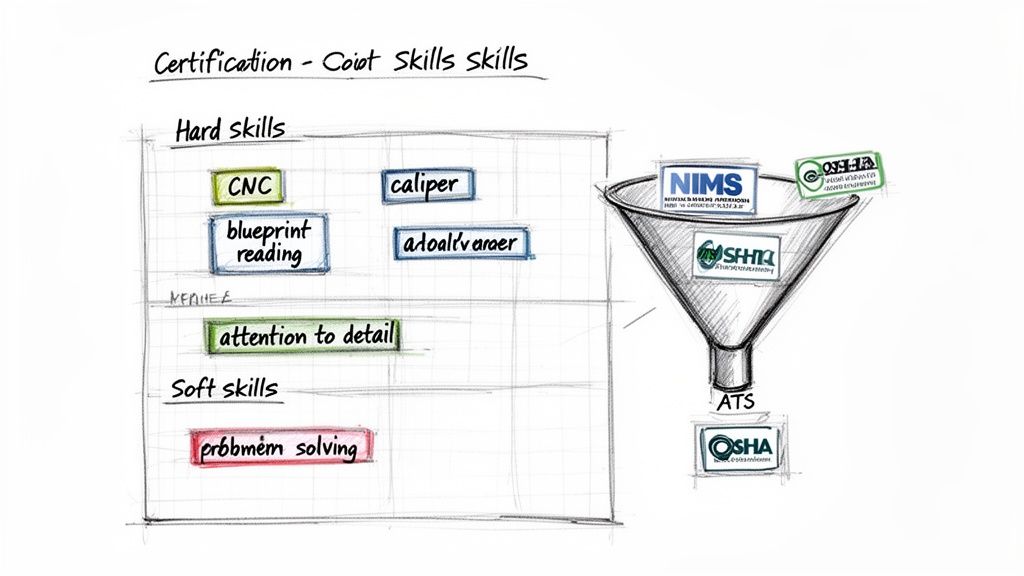
The skills section of your resume has to do two things at once. First, it needs to be loaded with the right keywords to make it past the Applicant Tracking System (ATS)—the software that first screens your application. Then, it has to prove to the actual hiring manager that you’ve got what it takes.
Just throwing a list of skills onto the page won’t cut it. The best approach is to have a dedicated skills section and weave those same skills into the stories you tell in your work experience. This gives the hiring manager the context they need to see you’re the real deal.
Hard Skills vs. Soft Skills
A great resume shows you can handle the machinery and work well with the people around you. This means showing off both your hard skills (the technical, hands-on stuff) and your soft skills (how you approach your work and interact with others).
- Hard Skills: These are your bread and butter—the specific, technical abilities that are non-negotiable for the job. Think of these as your main ATS keywords.
- Soft Skills: These are the interpersonal traits that make you a great teammate. They’re best shown through the results you highlight in your work experience.
Put simply, hard skills get you past the bots. Your soft skills—proven with real examples—are what land you the interview.
Essential Hard Skills For Your Resume
You absolutely have to tailor your hard skills for every single job you apply for. Read the job description like a detective, pulling out every specific machine, software, or technical term they mention. Then, make sure those exact terms appear on your resume.
Here are some of the most common hard skills to get you started:
- Machine Operation: CNC Milling/Lathing, Press Brakes, Injection Molding, Forklift Operation, PLC Programming
- Technical Knowledge: Blueprint Reading, G-Code/M-Code, CAD/CAM Software (like SolidWorks or AutoCAD)
- Quality Control: Caliper & Micrometer Use, Geometric Dimensioning & Tolerancing (GD&T), Quality Assurance (QA) Protocols
- Maintenance: Preventive Maintenance, Troubleshooting, Lockout/Tagout Procedures
When you mention a technical skill, it helps to show you have deep knowledge. For instance, if you’re an expert in maintaining complex equipment, you can demonstrate your expertise by noting your experience in areas like understanding Hydraulic Power Units.
Showcasing Critical Soft Skills
Soft skills are what really separate a good operator from a great one. You can list a few in your skills section, but they make a much bigger impact when you connect them to an actual achievement.
Key Takeaway: Don’t just write “Problem-Solver.” Prove it with a powerful bullet point like: “Identified and resolved a recurring machine jam, reducing downtime by 3 hours per week and saving an estimated $5,000 in lost production annually.”
Some of the most valuable soft skills for a machine operator include:
- Problem-Solving
- Attention to Detail
- Team Collaboration
- Communication Skills
- Adaptability
- Time Management
- Safety Consciousness
This method gives hiring managers solid proof of what you can do. You’re not just telling them you’re a team player; you’re showing them how you collaborated to hit a production target.
Highlighting Your Certifications
Certifications are gold. They tell an employer that your skills have been officially verified and that you’re serious about your craft. Give them their own dedicated section on your resume so they don’t get missed.
Put this section right after your work experience or skills. Make sure you list the full certification name, who issued it, and the year you earned it.
Common and Valuable Certifications:
- OSHA Safety Certification (10-hour or 30-hour): This is a must-have. It immediately shows you’re trained in critical workplace safety standards.
- NIMS (National Institute for Metalworking Skills): NIMS credentials are highly respected and prove you have specific machining skills.
- MSSC (Manufacturing Skill Standards Council): The Certified Production Technician (CPT) cert is a strong signal of your all-around manufacturing knowledge.
- Forklift Operation Certification: If the job involves moving materials, this is non-negotiable.
By organizing your skills and certifications this way, you create a powerful one-two punch that satisfies both the automated screening systems and the expert eye of a hiring manager.
Turning Your Duties Into Quantifiable Achievements
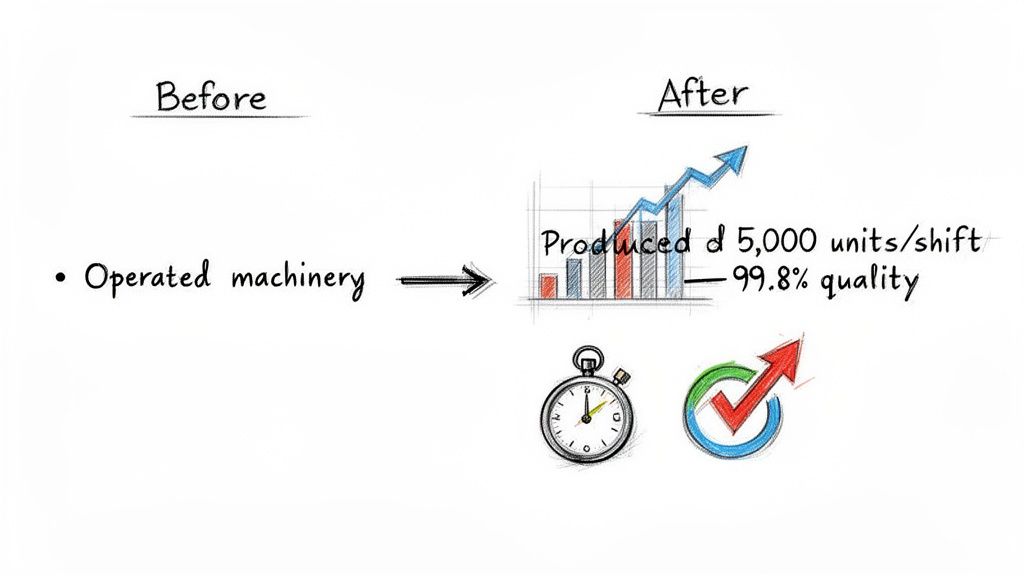
Here’s the secret that turns a good machine operator resume into a great one. Instead of just listing your daily duties, you need to show the results of your work. Hiring managers aren’t looking for a copied-and-pasted job description; they want to see your track record.
The key is adding numbers. Metrics—like efficiency, quality, and safety stats—are a language every plant manager understands and respects. A bullet point that just says “Operated machinery” is a missed opportunity.
But what if you rephrase it? “Operated a 50-ton hydraulic press to produce 5,000+ units per shift with a 99.8% quality rating” tells a compelling story about your skill and reliability. Let’s dig into how you can find these numbers and frame them to make your resume stand out.
Finding Your Key Metrics
You might be thinking, “I don’t track my performance with a spreadsheet.” Don’t worry, you don’t have to. The data is all around you if you know where to look.
Start by thinking about your work through these three lenses:
- Efficiency and Productivity: How much did you produce? Did you find a way to complete a run faster? Did you help reduce resource consumption?
- Quality and Accuracy: How good was your work? Did you lower the number of defects or reduce material waste? Did you help improve the quality of the final product?
- Safety and Compliance: How did you contribute to a safe work environment? Were you part of a team that hit a safety milestone or aced an audit?
Every time you tweaked a machine setting for a smoother run or spotted a potential defect before it became a problem, you were adding value. Now it’s time to put a number on that value.
The Power of Before and After
Let’s get practical. Seeing the difference between a weak and a strong bullet point makes the concept click. A weak one lists a task, while a strong one showcases a measurable accomplishment that ties directly to the company’s goals.
This is more important than you might think. While the U.S. Bureau of Labor Statistics puts the national average salary for operators around $47,060 a year, that number climbs to over $53,800 in states like Washington and Oregon where specialized skills are in demand. Resumes that command higher pay are the ones that show real impact—like identifying a process error that led to 30% efficiency gains or managing 3,000-unit monthly runs with perfect ISO compliance. You can see more examples of how achievements drive machine operator resume success on Resume-Now.com.
To show you exactly how to transform your own experience, let’s look at how to upgrade some common responsibilities.
From Basic Duty To Powerful Accomplishment
Here are some real-world examples of how to turn a passive duty into a metric-driven accomplishment that will grab a hiring manager’s attention.
| Common Responsibility | Weak Resume Bullet (Before) | Strong Resume Bullet (After) |
|---|---|---|
| Machine Setup | Responsible for setting up machinery. | Reduced average machine setup time by 35% by creating a standardized pre-check procedure for all CNC lathes. |
| Quality Control | Checked parts for quality. | Maintained a 99.9% accuracy rate on over 250,000 stamped parts by conducting hourly inspections with digital calipers. |
| Maintenance | Performed routine maintenance. | Implemented a weekly preventive maintenance schedule that decreased machine downtime by 15% quarter-over-quarter. |
| Safety | Followed safety rules. | Contributed to a 2-year record of zero lost-time incidents by leading daily safety briefings and promoting proper PPE usage. |
See the difference? The “After” examples don’t just say what you did; they prove the positive impact you had on the operation.
What If You Don’t Have Exact Numbers?
It’s a common situation. Not every operator has access to detailed performance dashboards. But that doesn’t mean you can’t quantify your achievements. You can make honest, educated estimates based on your experience.
Don’t invent data. Instead, use your professional experience to create a logical estimate. Think in terms of daily, weekly, or monthly improvements that you personally observed or influenced.
Here’s how to approach it:
- Estimate Production: Think about your average output. How many parts did you typically handle per hour or shift? Do the math to get a daily or weekly figure. For example: “Processed an average of 800-1,000 units per shift.”
- Estimate Time Savings: Did you figure out a faster way to do something? How much time did it save each time you did it? Maybe it was five or ten minutes. You could write: “Reduced tool changeover time by approximately 10 minutes per cycle.”
- Estimate Waste Reduction: If you suggested a process change that resulted in less scrap, try to put a percentage on it. Something like: “Helped decrease material waste by an estimated 5-10%.”
Even if they’re estimates, these numbers are far more powerful than vague statements. They show you’re a professional who thinks about results and your role in the company’s success—and that’s exactly the kind of person they want to hire.
Finalizing Your Resume For Each Application
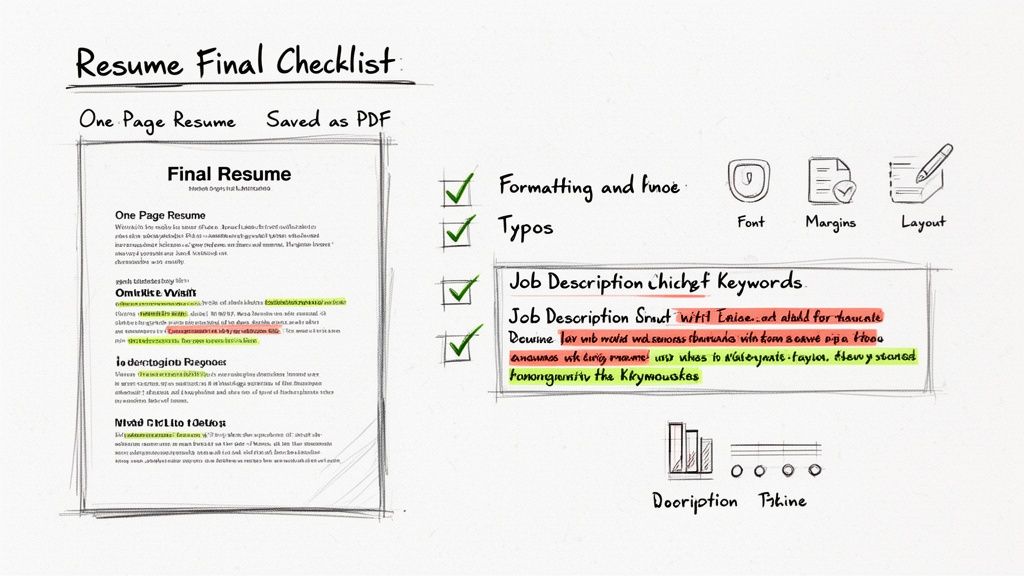
Alright, you’ve put in the hard work and built a resume packed with solid achievements and the right skills. But don’t hit “send” just yet. The final phase—tailoring and polishing it for every single job—is what separates the pros from the rest of the pile.
So many operators skip this step, but sending out a generic resume is like using the wrong wrench on a precision bolt. It just won’t get the job done. Let’s walk through the last few checks to make sure your resume is sharp, targeted, and ready to impress.
Nailing The Professional Format
First impressions are everything, and your resume’s layout is the first thing a hiring manager or recruiter sees. The goal here is simple: make it clean and easy to read. A cluttered document is an instant red flag.
The golden rule? Keep your resume to one single page. Hiring managers are busy people. They don’t have the time to sift through a novel for an operator role. A tight one-pager shows you know how to communicate what’s important, and fast.
Stick with professional, clean fonts like Calibri, Arial, or Cambria. Your body text should be between 10 and 12 points—anything smaller is a headache to read. Use bold text to make your name, job titles, and key numbers stand out, but don’t go overboard.
Tailoring Your Resume For The Job
This is without a doubt the most important thing you’ll do before submitting your application. You have to customize your resume to reflect the exact language and needs outlined in the job description. It’s how you show them you didn’t just stumble upon their listing; you are the perfect person for this specific job.
Grab a highlighter and print out the job description. Go through it line by line and mark every keyword you see related to:
- Specific Machinery: Are they talking about a “5-axis CNC,” “hydraulic press,” or “robotic welders”?
- Software or Programming: Look for terms like “G-code,” “AutoCAD,” or a specific ERP system.
- Key Responsibilities: Note phrases like “preventive maintenance,” “quality assurance,” or “meeting production quotas.”
- Soft Skills: Do they keep mentioning “attention to detail,” “team collaboration,” or “problem-solving”?
Now, look at your resume. Swap your general terms for the specific ones they used. If the job description asks for “Blueprint Interpretation,” your resume had better say that exact phrase, not just “Blueprint Reading.” This isn’t just for the human reader; it’s critical for getting past the Applicant Tracking System (ATS) software.
Your resume should feel like a direct answer to the job description. The more it reflects the employer’s exact language and needs, the more compelling your application will be.
Once your machine operator resume is perfectly tailored, the next crucial step is often the job interview. For many, successfully navigating job interviews requires specific preparation strategies. This preparation ensures that the strong impression your resume makes carries through to your in-person meeting.
The Final Review Checklist
You’re almost there. Before you save that file, run through this quick checklist. Think of it as your final quality control inspection—your last chance to catch small errors that can make a big, negative impression.
- Proofread for Typos: Seriously, read your resume out loud. It forces you to slow down and catch embarrassing spelling or grammar mistakes you’d otherwise skim over.
- Check Your Numbers: Double-check every single percentage, dollar amount, and production figure. Are they accurate and consistent throughout the document?
- Verify Contact Info: Is your phone number right? Is your email address spelled correctly and professional? Does your LinkedIn link actually work?
- Confirm Formatting: Look for consistency. Are all your job titles bolded? Is the date format the same for every single entry?
- Save as a PDF: Always, always save the final version as a PDF. This locks in the formatting so it looks exactly how you want it to on any device. Name the file something professional, like
John-Smith-Machine-Operator-Resume.pdf.
Taking these final steps ensures every application you send is a professional, targeted, and polished reflection of your skills. It’s the small bit of extra effort that moves your resume from the “maybe” pile straight to the “must-interview” list.
Even after you’ve nailed down the main sections of your resume, a few nagging questions can pop up. Let’s clear the air on some of the most common ones I get asked by operators, so you can finalize your resume and apply with total confidence.
How Far Back Should My Work History Go?
This is a classic question. How far back is too far back? As a rule of thumb, focus on the last 10-15 years of your work history. This gives a hiring manager a solid picture of your recent experience without overwhelming them with ancient history.
What if your best, most relevant experience is from more than 15 years ago? You don’t have to erase it. Just add a short section at the bottom called “Previous Professional Experience.” List the job title, company, and location, but skip the detailed bullet points. It’s a clean way to show your deep roots in the industry without cluttering the main part of your resume.
Your main goal here is relevance. A hiring manager cares most about what you’ve done recently and how it matches the job they need to fill right now. Give your most current, high-impact roles the prime real estate on the page.
How Do I Handle Employment Gaps?
First, take a deep breath. Employment gaps are incredibly common and aren’t the deal-breaker they used to be. The trick is to be honest without drawing a spotlight on the time off. Whatever you do, don’t lie or fudge the dates.
Instead of leaving a mysterious blank space, you can account for the time in a simple, professional way.
- Show What You Learned: If you took courses, got a new certification (like an OSHA card), or did any substantial volunteer work, list it! You could add a line like, “Independent Skill Development (2025-2026)” and a bullet point on the new skills you picked up.
- Let Your Skills Do the Talking: A powerful skills section and a sharp professional summary can easily overshadow a gap. When your qualifications and measurable successes are front and center, a hiring manager is much less likely to get hung up on your timeline.
- Switch Up the Format: The standard chronological resume puts any gaps on full display. If you have a few, consider a “combination” resume format that leads with your skills before getting into your work history.
Is It Okay To Have A Two-Page Resume?
For a machine operator role, the answer is almost always a hard no. A one-page resume is the industry standard. Think about it from the hiring manager’s perspective—they’re sorting through dozens, maybe hundreds, of applications. A clean, one-page document shows you respect their time and can get straight to the point.
Sticking to one page forces you to be ruthless about what’s most important. You have to trim the fat and highlight only the most impressive, data-backed achievements that directly relate to the job you’re targeting. Unless you have 20+ years of incredibly specialized, high-level experience, one page is the golden rule.
Ready to stop scrolling through endless job boards filled with spam and ghost jobs? Remote First Jobs gives you a head start by finding remote opportunities directly from company career pages before they go public. Find your next role with less competition at https://remotefirstjobs.com.