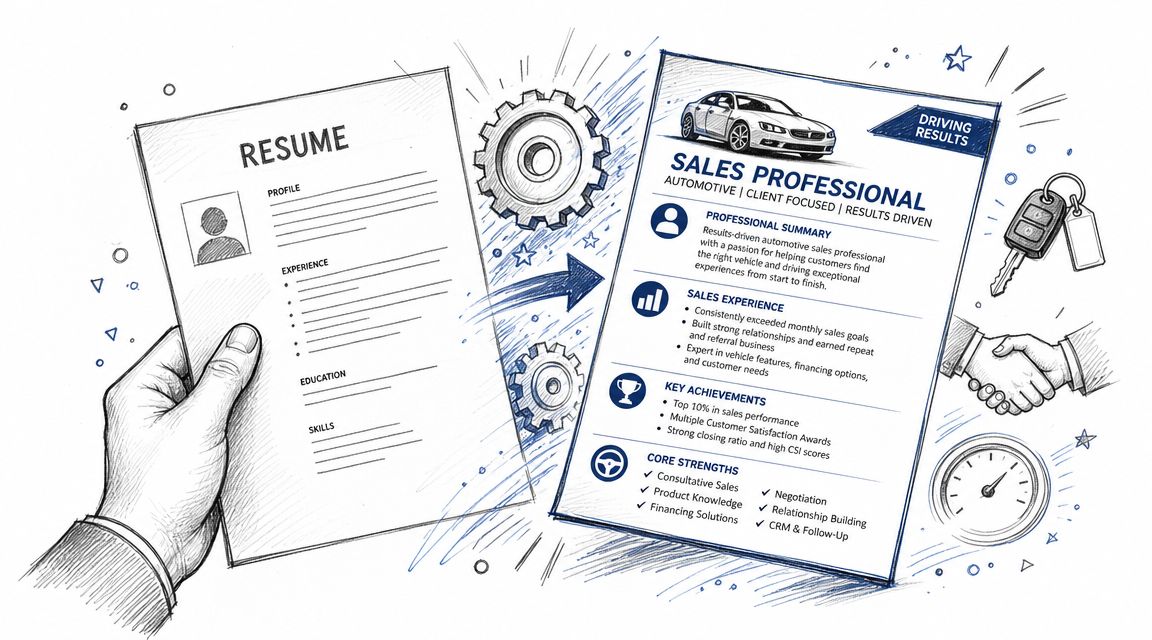
You’re probably staring at a resume draft that says things like “helped customers,” “sold vehicles,” and “provided great service,” and you already know it’s weak. The hard part isn’t that you don’t have experience. It’s that dealership experience rarely translates cleanly onto paper unless you write it the way a desk manager or general sales manager reads it.
In a store, everybody talks in numbers, pace, gross, appointments, CSI, and follow-up. On a resume, too many candidates switch into generic HR language. That’s where good applicants disappear.
Why Your Car Dealership Resume Needs a Tune-Up
A car dealership resume has one job. It needs to prove you can produce, hold gross, follow process, and stick around long enough to matter.
That’s different from a generic retail or outside sales resume. In dealership hiring, managers scan for evidence that you can work a lead, desk a deal properly, protect the customer experience, and keep your pipeline moving without constant babysitting. If your resume reads like a task list, it won’t hold attention for long.
Workforce data also explains why the bar feels high. Zippia’s automotive sales demographics data reports more than 13,432 automotive sales people employed in the United States, with 89.0% men and 11.0% women, and an average age of 40. That tells you something important. You’re often competing against experienced adults, not just first-time applicants.
What hiring managers really read for
When I review resumes for dealership roles, I’m not looking for “passion for cars” first. I’m looking for signs of stability and repeatable production.
A few things stand out fast:
- Tenure that makes sense. If someone has bounced every few months, I assume they never got through ramp-up or couldn’t hold performance.
- Metrics tied to dealership reality. Units, gross, appointment activity, referral business, CSI, finance handoff quality.
- Fit for the store model. A high-volume used car operation hires differently than a luxury rooftop or a store with a heavy digital retail workflow.
Practical rule: A dealership resume should read like a performance report, not a job description.
There’s also a business side to all this that job seekers miss. If you understand how a store makes money, your resume gets sharper because you stop selling yourself as “friendly” and start presenting yourself as commercially useful. If you want that broader context, this breakdown of car dealership business planning is worth reading because it clarifies how dealerships think about inventory, margins, operations, and growth.
Why generic resumes fail in this industry
Generic resumes fail because auto retail isn’t abstract. Managers know the difference between someone who can greet a walk-in and someone who can manage CRM follow-up, set appointments, run a proper demo, coordinate with F&I, and protect CSI after delivery.
If your resume doesn’t show output, consistency, and process discipline, it gets treated like unverified sales talk.
Structuring Your Resume for the Showroom Floor
A desk manager has three resumes on the printer between deals. One reads like a generic sales profile. One is overloaded with graphics and vague claims. One shows recent store history, clean formatting, and enough detail to answer the question fast. Can this person produce, follow process, and fit this rooftop? The third resume gets the interview.
That is the standard your format has to meet. In dealerships, resume structure is not a design choice. It is a speed-to-confidence tool.
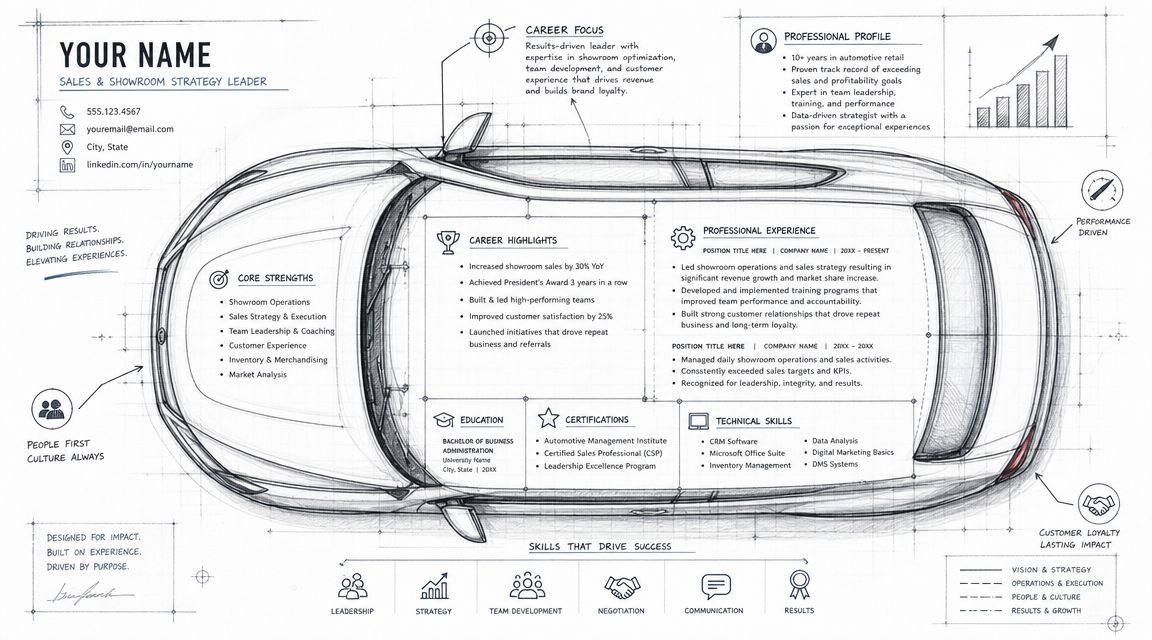
According to LiveCareer’s automotive sales resume guidance, the resume works best as a sales document built around three moves: match the posting language, open with a short summary that states your experience and strongest value, and list your roles in reverse order with accomplishment-focused bullets.
Use reverse chronological order
Start with your current or most recent dealership role. Hiring managers want to see your latest store, your latest responsibility level, and whether your production holds up over time.
For each position, include:
- Job title
- Dealership or company name
- Location
- Dates of employment
- Bullets focused on business outcomes
This matters more in auto retail than in many other fields. A candidate who moved from floor sales into internet, BDC, F&I support, lease retention, or team lead work should show that progression immediately. It tells me how much of the sales process they can handle without hand-holding.
Build a summary that sounds dealership-ready
Your top summary has one job. It should tell a hiring manager what lane you work in and what numbers or process strengths you usually bring with you.
Good summaries usually cover three points:
- Experience level. Sales, BDC, F&I, service drive, or management support.
- Store context. New, used, luxury, subprime, high-volume import, domestic, fleet, or digital retail.
- Commercial value. CSI performance, lead response discipline, appointment-to-show strength, gross awareness, or clean handoff to F&I.
Weak: “Motivated car salesman with excellent communication skills seeking a new opportunity.”
Stronger: “Automotive sales professional with dealership experience in internet lead follow-up, showroom negotiation, delivery coordination, and F&I turnover. Known for consistent CRM discipline, solid CSI, and repeat business.”
That second version gives a manager something usable. It points to process, revenue support, and customer retention. Those are store metrics, not resume filler.
One page or two pages
Keep this simple. Newer candidates and straight-line sales backgrounds usually fit on one page. Multi-role dealership backgrounds can justify two pages if the second page adds proof, not padding.
Use one page if your experience is limited to a few relevant roles and your strongest performance can be shown clearly without cutting useful details.
Use two pages if you have a real track record across multiple rooftops or functions, such as sales plus BDC, internet, F&I, or supervisory responsibility. The extra space should earn its keep. If page two is old duties, generic training, or soft skills, cut it.
I would rather read one sharp page with monthly volume, CSI consistency, and finance penetration support than two pages of “responsible for assisting customers.”
Keep the layout plain enough to survive a fast read
Dealership hiring happens between customer activity, manager turnovers, and end-of-month pressure. Fancy formatting gets in the way.
Use:
- Clear section headings
- Short, readable bullet points
- Consistent dates
- Standard fonts and spacing
- Easy-to-find metrics and role progression
Skip headshots, skill bars, colors that print poorly, and oversized summary blocks. A resume should hold up whether it is viewed on a phone, printed at the tower, or skimmed in thirty seconds at a manager’s desk.
Plain formatting does not make you look basic. It makes you look organized, which is a better signal in this business.
Writing Bullet Points That Drive Results
A sales manager scans your resume between deals and sees bullets like “helped customers” and “responsible for sales.” That resume goes to the bottom of the stack, even if the candidate can really sell. Generic bullets hide the numbers that matter on a dealership floor.
Strong bullets show how you affected the store’s business. Units sold matter, but they are not the whole story. Hiring managers also look for signs of gross retention, CSI consistency, lead handling discipline, appointment conversion, repeat business, and support for F&I production. If your bullets only read like a job description, they miss the scoreboard.
The formula that works on dealership resumes
Use this structure:
Action + dealership process + business result
The result does not always need a hard number. If you do not have exact figures, use a specific operational outcome that shows you understand how the store makes money and keeps customers.
Examples:
- Negotiated deals with attention to gross profit, payment fit, and trade positioning, supporting cleaner closes and stronger handoff to F&I.
- Worked phone and internet leads inside the CRM, improving appointment set quality and reducing aged-lead loss.
- Managed delivery follow-up and post-sale communication, helping protect CSI and generate repeat and referral business.
What strong bullets usually emphasize
The best bullets in this field usually point to one of five things:
- Sales performance: units, ranking, quota pace, front-end revenue contribution
- Customer retention and satisfaction: CSI, online reviews, repeat buyers, referrals
- Lead management: response time, appointment setting, showroom conversion, rehash activity
- Deal quality: gross profit discipline, trade accuracy, finance coordination, product presentation support
- Process control: CRM task completion, paperwork accuracy, compliance awareness, delivery follow-through
If a bullet could describe retail, wireless, furniture, and automotive equally well, it is too broad.
Resume Bullet Points From Weak to Winning
| Weak Example (Responsibility-Focused) | Strong Example (Result-Focused) |
|---|---|
| Helped customers choose vehicles and explained features. | Guided buyers through needs analysis, walkaround, demo drive, and model selection, improving deal control and fit-to-customer conversations. |
| Sold cars and met dealership goals. | Managed showroom, phone, and internet opportunities with consistent follow-up and closing activity that supported monthly sales targets. |
| Followed up with leads in the CRM. | Worked CRM tasks, call campaigns, and re-engagement outreach to move more leads from inquiry to confirmed appointment. |
| Worked with repeat customers and referrals. | Built repeat and referral business through delivery follow-up, ownership check-ins, and consistent retention contact. |
| Handled financing paperwork with customers. | Coordinated accurate customer and deal information before turnover to F&I, reducing delays and setting clearer payment expectations. |
| Explained warranty options and financing. | Introduced protection products and financing options early in the process, helping F&I continue the conversation with better-informed buyers. |
| Helped customers in the service lane. | Managed service-drive communication with clear update calls, expectation setting, and issue resolution that supported CSI retention. |
| Scheduled appointments for the sales team. | Converted inbound calls and web leads into qualified appointments through fast response, outbound persistence, and tighter lead handling. |
Role-specific thinking beats copy-and-paste writing
A Sales Consultant resume should center on prospecting, demo drives, closing activity, gross awareness, repeat business, and CSI. A strong BDC or Internet Sales resume should sound different. It should talk about lead response, show rates, appointment quality, lost-lead recovery, and CRM discipline.
An F&I Manager should focus on menu presentation, lender relations, funding accuracy, compliance-sensitive paperwork, and product penetration. A Service Advisor moving into sales should highlight retention, upsell conversations, appointment flow, trust-building, and customer communication that protects CSI.
That shift matters. Good hiring managers can tell when a candidate copied generic bullets from another role.
The bullets that matter most
A lot of candidates overplay volume and underplay quality. I would rather see a resume that shows solid unit pace plus strong CSI, clean CRM habits, and credible F&I support than one that only says “top seller” with no context.
Write in the language managers use at the desk and in the tower. Mention gross profit per unit, lead conversion, appointment show rate, CSI, repeat business, and F&I penetration support when those metrics reflect your work. Even without exact numbers, that wording signals commercial awareness.
For example, instead of:
“Excellent people skills and strong closer.”
Write:
“Built rapport quickly, maintained deal control through follow-up and objections, and set up cleaner transitions to F&I and delivery.”
That reads like someone who understands how a dealership runs.
High-Octane Keywords and Skills to Include
A good car dealership resume has to satisfy two readers. The first is software looking for matches. The second is a hiring manager deciding whether you fit the store.
That’s why keyword selection matters. Not because keywords are magic, but because they help your resume mirror the language the dealership already uses.
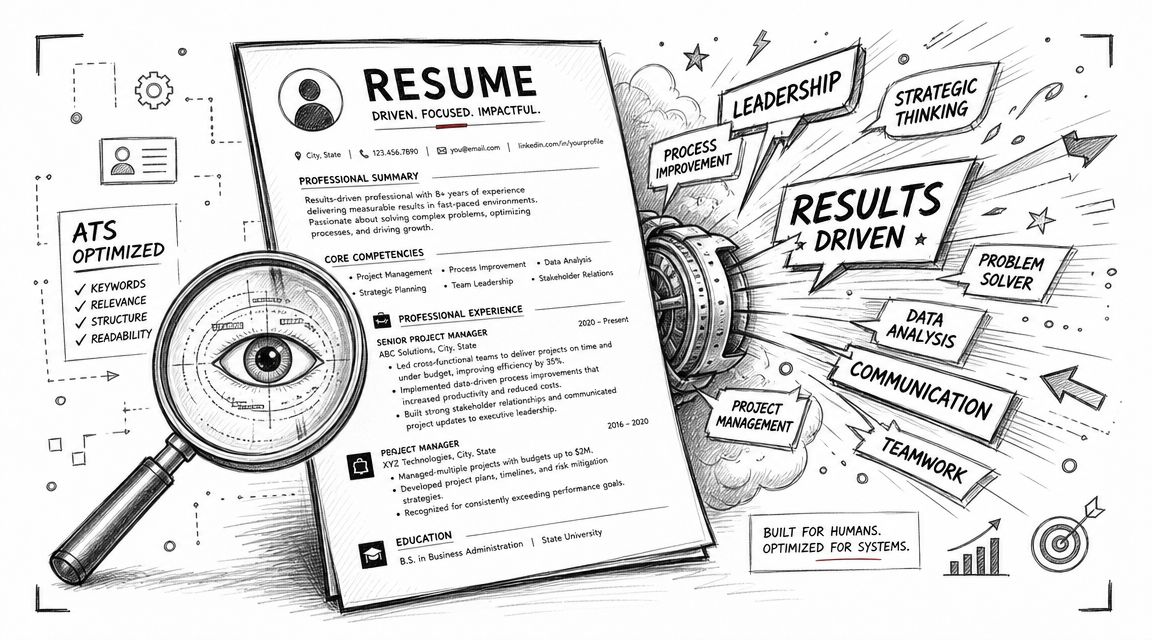
Himalayas’ car dealer resume guidance says the strongest skills stack combines product knowledge, CRM software, automotive-systems familiarity, sales negotiation, customer service, active listening, and conflict resolution, and it recommends tailoring those skills to the exact job description.
Mirror the posting without sounding fake
Start with the job ad. Pull out the words the store repeats. Then use those exact terms where they’re true.
If the posting says:
- internet sales
- CRM follow-up
- customer retention
- finance coordination
- bilingual communication
Use those phrases in your summary, experience bullets, and skills section if you’ve done that work. Don’t swap them for fancy synonyms. ATS systems and rushed managers both prefer direct matches.
Skills that belong on a dealership resume
Use a mix of hard and soft skills. Dealerships hire for both.
- Product knowledge. Vehicle features, trims, model comparisons, and customer-fit recommendations.
- CRM software. Lead management, follow-up logging, appointment tracking, and pipeline discipline.
- Automotive systems familiarity. Comfort with dealership systems, inventory tools, and sales process workflows.
- Sales negotiation. Desk communication, trade discussions, objection handling, and deal progression.
- Customer service. Delivery experience, issue resolution, expectation setting, and retention habits.
- Active listening. Qualifying needs instead of forcing the wrong unit.
- Conflict resolution. Handling friction around pricing, timing, trade value, or post-sale concerns.
A quick refresher on resume language helps here:
Add the inventory and business model language
Candidates have the ability to separate themselves. Not every store sells the same way.
If it applies, mention experience with:
- New vehicle sales
- Used vehicle sales
- Luxury brands
- Fleet or commercial accounts
- Digital retail tools
- F&I coordination
- Service-to-sales crossover
- BDC or internet lead handling
That last point matters more than many applicants think. A resume that matches the store’s actual sales model feels safer to hire.
The best keyword strategy is simple. Use the words the dealership uses, then prove them with bullets that sound lived-in.
A Winning Resume Template and Cover Note
A resume for this business should look like a sales asset. Clean. Direct. Focused on proof. If you want a practical template, use this structure and replace every placeholder with real dealership language.
Resume template
[Your Name]
[Phone] | [Email] | [City, State] | [LinkedIn]
Professional Summary
Automotive sales professional with [type of dealership experience] in [new cars / used cars / luxury / internet sales / service drive / F&I support]. Skilled in [relevant skills from the posting], with a track record of [top measurable or operational achievement]. Known for [customer, process, or pipeline strength].
Core Skills
Product Knowledge | CRM Software | Sales Negotiation | Customer Service | Active Listening | Conflict Resolution | Automotive Systems Familiarity | Lead Follow-Up | Appointment Setting | F&I Coordination
Professional Experience
[Job Title]
[Dealership Name], [City, State] | [Dates]
- [Action taken] that contributed to [units, gross, CSI, appointments, repeat business, or another relevant KPI].
- [Action taken] that improved [lead handling, follow-up consistency, test-drive flow, handoff to F&I, or customer experience].
- [Action taken] that supported [documentation accuracy, CRM hygiene, compliance training, or digital retail coordination].
[Earlier Job Title]
[Dealership Name], [City, State] | [Dates]
- [Achievement bullet]
- [Achievement bullet]
Education
[Degree or Diploma], [School Name]
Certifications
[Certification, if relevant]
Languages or Additional Sections
[Only include if they strengthen fit for the store]
Add trust and process, not just volume
Indeed’s car sales resume guidance highlights an angle many candidates miss. A stronger resume quantifies trust and process accuracy, not just sales volume, including items like CRM hygiene, documentation accuracy, compliance training, and coordination with F&I or digital retail tools.
That matters because modern dealership work isn’t only persuasion. It’s also process control.
Short cover note example
Use this in an email body or application note:
I’m applying for the Sales Consultant role at [Dealership Name]. My background includes dealership sales work focused on customer follow-up, CRM discipline, deal progression, and strong handoff to F&I. In my current or recent role, I’ve been recognized for consistent production and a customer-first process that supports repeat business and cleaner delivery experience. I’d welcome the chance to discuss how I can contribute to your floor quickly.
Keep it short. The purpose is to frame your resume, not repeat it.
Your Car Dealership Resume Questions Answered
How should I handle employment gaps
Don’t try to hide them with clever formatting. Dealership managers notice date games immediately.
Address the gap forthrightly and keep the explanation tight. If the time away included family responsibilities, education, another sales role, or a non-automotive position that kept your customer-facing skills sharp, make that visible. Then shift the focus back to readiness, stability, and why this move makes sense now.
What if I’m changing careers into auto sales
Lead with overlap, not with apology. If you’ve worked in retail sales, furniture, telecom, real estate, hospitality, banking, BDC, or service advising, you already understand parts of the dealership environment.
Focus on transferable strengths such as:
- Customer acquisition
- Follow-up discipline
- Objection handling
- Negotiation
- Appointment setting
- Retention and repeat business
- Process accuracy under pressure
If you’re newer, make education more prominent only when it supports the move.
Should I include a headshot on my resume
In the U.S. market, no. A headshot doesn’t help your case and often makes the resume feel less professional for this type of hiring.
Use the space for stronger content instead. A hiring manager would rather see one more bullet about lead conversion, CSI, or F&I coordination than a photo.
Your resume should answer one question fast: “Can this person help my store perform without creating extra problems?”
If you’re job hunting beyond the showroom, Remote First Jobs is worth a look. It pulls roles directly from the career pages of remote-first companies instead of recycling noisy listings from big job boards, which means fewer ghost jobs, less spam, and a better shot at finding fresh direct-hire opportunities before they get flooded with applicants.