If you’re still blasting your resume across massive job boards to find software engineer remote jobs, it’s time for a reality check. That strategy just doesn’t cut it anymore. Those platforms are black holes, flooded with thousands of applicants per role and riddled with “ghost jobs” that aren’t even real. Standing out is nearly impossible.
You need a new playbook—one that bypasses the noise and gets you in front of the right people, fast.
Rethinking Your Remote Job Search Strategy
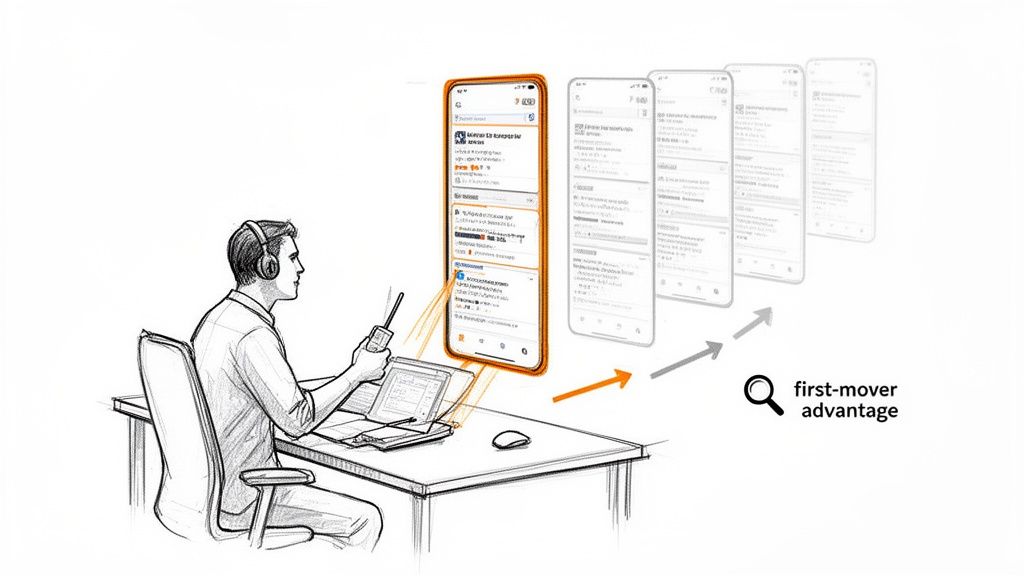
The market for remote software engineers has grown up. It’s no longer just about having the right skills; it’s about having the right strategy. Applying to a job that already has 1,000+ applicants is a losing game. The real key to landing a great role is getting there before the crowd does.
This means ditching the “spray and pray” marathon on platforms like LinkedIn and Indeed. Instead, your entire focus should be on high-quality sourcing channels that give you a serious speed advantage.
The most effective job seekers don’t just find jobs; they find them first. By sourcing directly from company career pages, you can apply hours after a role is posted, not days. This “first-mover” advantage is critical in a competitive market.
From High Volume to High-Quality Sourcing
I’ve heard the same story a hundred times. A senior engineer applies to 150 roles on big job boards and gets radio silence from more than half of them. It’s a soul-crushing, inefficient grind.
The smarter move? Use a direct-sourcing platform that pulls listings straight from company career pages in real-time. This simple shift ensures every single job you see is verified, active, and fresh.
Focusing on quality over quantity pays off big time:
- You beat the competition. You’re applying to roles before they get syndicated to the massive boards and attract a tidal wave of applicants.
- You dodge “ghost jobs.” Direct sourcing means you’re only seeing roles that are genuinely open, not stale listings kept alive for data harvesting.
- You save time and energy. Instead of firing off hundreds of applications into the void, you can invest your energy in crafting a few targeted applications for high-potential roles.
Let’s be clear: this strategic pivot is more important than ever. The software engineering job market is hot, with projections showing around 327,900 new developer jobs between 2023 and 2033. But with over half of these roles aimed at senior talent, the competition for experienced remote engineers is absolutely fierce.
It’s time to stop playing by the old rules. Take a look at how the job search game has changed.
Old vs New Job Search Strategies
| Method | The Old Way (LinkedIn/Indeed) | The New Way (Remote First Jobs) |
|---|---|---|
| Sourcing | Wait for jobs to appear on massive, aggregated boards days after posting. | Source jobs directly from company career pages in real-time. |
| Competition | Compete with thousands of other applicants for a single role. | Apply within hours of a job going live, often before the crowd arrives. |
| Job Quality | Sift through “ghost jobs,” expired listings, and recruiter spam. | Every listing is verified, active, and comes directly from the source. |
| Effort | “Spray and pray”—send out hundreds of generic applications. | Focus on a smaller number of high-quality, targeted applications. |
The takeaway is simple: a modern job search demands a modern toolkit.
The New Playbook for Finding Remote Roles
Ditching outdated tactics for a strategic, direct-sourcing approach can dramatically multiply your chances of landing interviews. It’s the difference between shouting into a stadium and having a direct conversation. As you rethink your strategy, you can even broaden your horizons and explore opportunities to work remotely from Spain, adding an exciting international dimension to your career.
The goal is to work smarter, not harder, to find the remote engineering role you actually want—and deserve.
Discovering High-Quality Job Channels
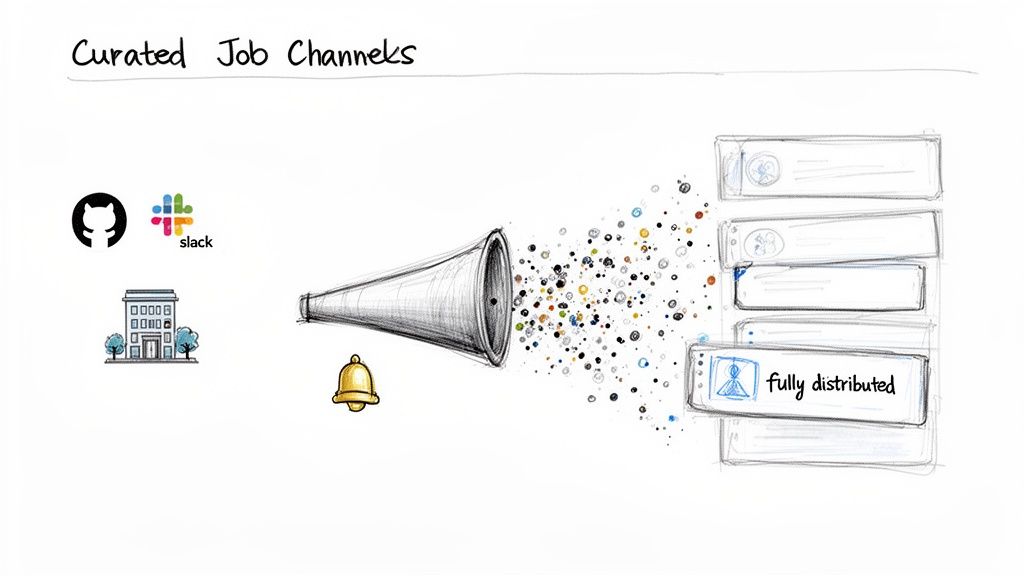
Let’s be honest: your job search is only as good as your sources. If you’re spending all your time on massive, oversaturated job boards, you’re fishing in a crowded public pond. Sure, you might get a few bites, but you’re fighting everyone else for the same tired fish.
To land top-tier software engineer remote jobs, you need to find better water. The whole game is about building a curated, high-signal feed of opportunities. This isn’t about the “spray and pray” method. It’s about strategic sourcing—finding the best roles before they hit the mainstream and get buried under an avalanche of applicants.
Tap into Direct-Sourcing Platforms
The biggest shift you can make is to prioritize platforms that pull jobs directly from company career pages. So many aggregators just scrape other job boards, which means you’re dealing with delays, outdated listings, and those frustrating “ghost jobs” that aren’t even real.
Direct sourcing cuts right through that noise.
Platforms that work this way are your secret weapon. For example, Remote First Jobs monitors over 21,000 remote-first companies, pulling in new listings just hours after they go live on a company’s own site.
This gives you a massive first-mover advantage. Instead of being applicant #1,357, you can be one of the first handful to apply.
Think about it like this: A hot fintech startup posts a Senior Go Engineer role on its website at 9 AM. A direct-sourcing platform spots it by 10 AM, and you get an alert. You’ve submitted your application by noon, a full two days before that same job gets syndicated to LinkedIn and collects a thousand other applicants. That’s the power of speed.
By setting up real-time alerts for your specific tech stack—say, “fully distributed” roles using “TypeScript” and “AWS”—you stop being reactive. You turn your search into a proactive, strategic hunt, where you only see the jobs that are a perfect match.
Go Where the Engineers Are
Beyond the specialized job boards, you’ll find the best gigs hiding in plain sight within the communities where engineers actually hang out. This takes a little more effort, but the payoff is huge.
GitHub and Open Source: Contributing to open source is so much more than just building a portfolio. It’s a direct line to the companies you admire. I’ve seen engineers get hired just by submitting thoughtful PRs and engaging in project discussions. There’s even a legendary story of a developer who landed a job at a database company by contributing to their open-source project from a prison cell. It’s a powerful reminder that in these spaces, your work truly speaks for itself.
Niche Slack and Discord Channels: Every tech stack has its watering holes. Find the Slack community for React developers, the Discord server for Rust fans, or the channel for data engineers. Hiring managers and team leads love posting here first, hoping to find someone already passionate about the tools they use.
Targeted Company Lists: Don’t just wait for a job posting to appear. Make a list of 20-30 remote-first companies you’d genuinely be excited to work for. Follow their career pages, connect with their engineers on professional networks, and actually read their tech blogs. This way, when a role finally opens up, you’re not a stranger—you’re already on their radar.
When you diversify your channels and focus on quality over sheer quantity, you sidestep the competition. You start building a pipeline of high-quality software engineer remote jobs that most people will never even see. This is how you go from being just another applicant to being the right candidate at the perfect time.
Creating a Resume That Beats the Bots
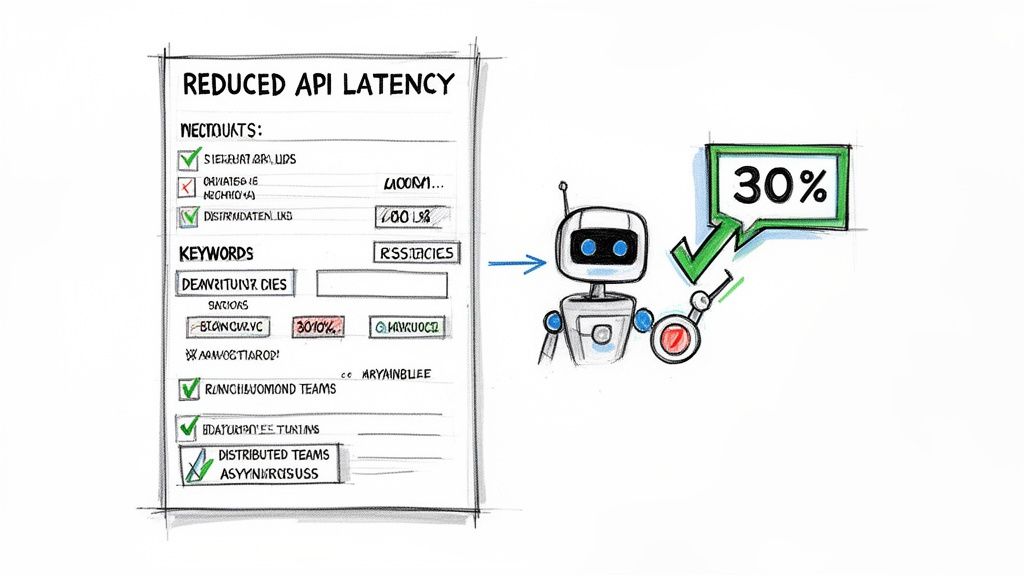
Before a hiring manager ever sees your resume, it has to get past the first gatekeeper: the Applicant Tracking System (ATS). It’s a hard truth, but over 90% of companies rely on these bots to filter applications. If your resume isn’t built to be read by a machine, it’s going straight to the digital recycling bin.
For engineers targeting software engineer remote jobs, this means your resume has two jobs. It must be perfectly parsable for the bots and compelling for the humans who will eventually read it. This isn’t about tricking the system—it’s about learning to speak its language.
The very first step is to ditch the fancy, design-heavy templates. Seriously. Those cool-looking layouts with multiple columns, text boxes, and funky fonts will scramble most ATS parsers. Your safest bet is a clean, single-column format with standard headings like “Work Experience” and “Skills.”
From Task-Based to Impact-Driven
Once your format is clean, it’s time to overhaul the content. Most engineers make the classic mistake of just listing their job duties. A senior engineer’s resume might say, “Wrote and maintained APIs.” This tells the reader what you did, but nothing about the value of that work.
The real key is to quantify your achievements. Instead of just listing tasks, you need to showcase your results. Every bullet point should be a mini-story about a problem you solved and the impact you made.
Here’s how you can reframe that same point to show real impact:
- Before: “Wrote and maintained APIs for the user profile service.”
- After: “Reduced API latency for the primary user profile service by 30% by optimizing database queries and implementing a multi-layer caching strategy.”
See the difference? The “after” version is powerful. It doesn’t just say what you did, but how well you did it. It proves you have technical chops, an awareness of the business, and a results-first mindset—all non-negotiable traits for a great remote engineer.
The Power of Keywords for Remote Roles
At their core, ATS bots are keyword-matching engines. To get past them, your resume needs to reflect the language in the job description. This is especially true for remote roles, which have their own specific lexicon.
Comb through the job description and pull out terms that signal remote work competency. You need to show you can thrive in a distributed setup.
Must-Have Remote Keywords:
- Collaboration: asynchronous communication, distributed teams, cross-functional collaboration, GitLab, Jira, Confluence
- Autonomy: self-managed, proactive, independent, full ownership
- Tools: Slack, Zoom, Miro, Figma, Notion
But don’t just create a “Skills” section and stuff it with these words. That looks lazy. Instead, weave them naturally into your experience bullets. For example: “Led a distributed team of 5 engineers in a fully asynchronous environment to deliver the V2 payment gateway ahead of schedule.”
A common mistake is creating one “master” resume and carpet-bombing applications with it. For the best results, you need a system to tailor your resume for each specific role. It sounds time-consuming, but with a solid master document, you can customize it in under 15 minutes per application.
The demand for flexible work is only growing. Recent surveys show that 87% of developers prefer hybrid or fully remote setups, a massive trend that is forcing companies to adapt. Organizations now use remote work as a key perk to attract top talent in a competitive market. To learn more about how developer preferences are shaping the industry, read the full report on the 2025 software engineer job market.
Your Digital Handshake: The Professional Summary
The top of your resume is prime real estate. It’s time to replace that old “Objective” statement with a short, powerful “Professional Summary” or “About” section. Think of it as your 3-4 line elevator pitch. It needs to immediately tell the reader your seniority, key specializations, and the value you bring to the table.
To help you nail that compelling ‘About’ section, you might want to try a tool like a LinkedIn Summary Generator. It can help you craft a strong opening that grabs a hiring manager’s attention right away.
By combining an ATS-friendly format, impact-driven metrics, and targeted remote keywords, you’ll turn your resume from a boring historical document into a powerful marketing tool. This is the first—and most critical—step in getting your application seen and landing your next great software engineer remote jobs opportunity.
Succeeding in Remote Technical Interviews
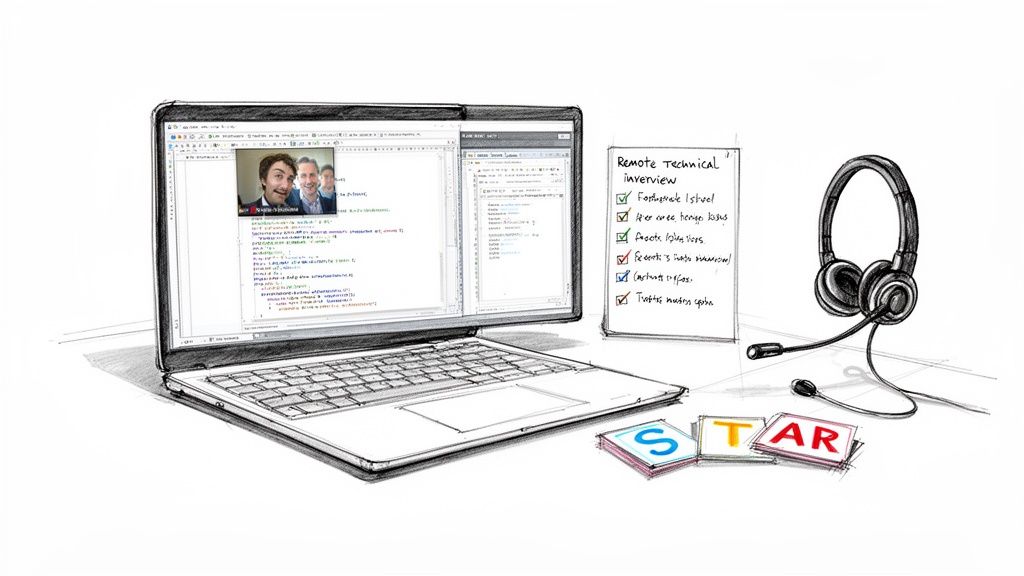
The interview process for software engineer remote jobs is a completely different game. It’s not just about proving you can write solid code; it’s about showing you can thrive in a distributed team. Your communication style, your level of autonomy, and even your home office setup are all being evaluated.
The single biggest mistake I see engineers make is treating a remote interview just like an in-person one, only over a video call. That’s a huge miss. Remote-first companies are scanning for specific signals that you can operate effectively without someone looking over your shoulder. Every interaction is a chance to prove you’re a proactive, self-managed pro.
Mastering the Remote Interview Environment
Before you even think about writing a line of code, you have to get your environment right. Technical glitches aren’t just small hiccups; they can be interpreted as a lack of preparation. A stable, professional setup is the absolute minimum requirement.
Here’s a quick checklist to run through before every single call:
- Internet Connection: Test your speed and, more importantly, have a backup. Your mobile hotspot is a cheap and effective insurance policy against a dropped connection.
- Audio and Video: Get a decent external microphone and webcam. Your built-in laptop gear often sounds tinny and makes you look like you’re calling from a cave. It can make you seem distant or unprofessional.
- Lighting and Background: Face a window for natural light or grab a simple ring light. Make sure your background is clean and free of distractions. A blurred background works, but a thoughtfully arranged, professional space is even better.
- Notifications: Silence everything. Close Slack, kill your email client, and shut down any other app that might pop up and shatter your focus.
A senior engineer I know bombed an interview for a fantastic role because their internet cut out during a critical system design session. The feedback wasn’t about their technical skills; it was that they “lacked a stable remote work setup.” Don’t let a preventable issue torpedo your shot.
Excelling in Asynchronous and Live Coding
Remote interviews often include take-home assignments or asynchronous coding challenges. These are about so much more than just getting the correct answer. They’re a direct test of your real-world work habits.
When you get a take-home, treat it exactly like you would a ticket at a real job. Write clean, readable code. Use meaningful git commit messages. And please, include a thorough README.md that explains your design choices and how to run the project. This is your best opportunity to show how you communicate through your work.
During live coding sessions, you need to become a narrator. Over-communicate your thought process constantly. Explain what you’re thinking, why you’re reaching for a specific data structure, and what trade-offs you’re actively considering. Silence is absolutely deadly in a remote coding interview.
Using the STAR Method to Showcase Remote Readiness
Behavioral questions are arguably more important in remote interviews. Companies need to be confident you can handle conflict, manage your time, and drive projects to completion without direct supervision. The STAR method (Situation, Task, Action, Result) is the perfect tool for this.
Instead of giving vague, generic answers, use STAR to build compelling narratives:
- Situation: Briefly set the stage with a challenge you faced on a project.
- Task: Clearly state what your specific responsibility was.
- Action: Detail the concrete steps you personally took to address it. This is where you shine by highlighting your autonomy and problem-solving skills.
- Result: Quantify the outcome. Always use metrics to demonstrate the impact of your actions.
For example, if you’re asked about resolving a disagreement, don’t just say, “I talked it over with my teammate.” Frame it with STAR: “On a previous project (Situation), we had conflicting ideas for our API design that was blocking progress (Task). I scheduled a call, but first, I created a document comparing the pros and cons of each approach with performance benchmarks. I used that to facilitate a discussion focused on the project’s goals (Action). We landed on a hybrid solution that ultimately reduced latency by 15% and we shipped the feature on schedule (Result).”
This structure proves you aren’t just a coder; you’re a proactive problem-solver who communicates effectively—the very heart of what companies look for when hiring for software engineer remote jobs.
Remember, your desire for flexibility isn’t just a preference; it’s a powerful asset in the current market. A 2022 survey found that 21% of software engineers would quit if forced back to the office full-time, and another 49% said they’d immediately start looking for a new job. You can explore the full software developer survey findings to see how these trends are shaping hiring. Use this industry-wide shift to find a role that genuinely embraces and supports remote work.
Alright, let’s rewrite this section. Here’s the human-written version, following the specified style and guidelines.
Negotiating Your Remote Compensation Package
Getting the offer is a huge win, but don’t pop the champagne just yet. Your work isn’t quite done. Now you’ve got to navigate one of the most important parts of landing great software engineer remote jobs: negotiating a compensation package that actually reflects your value.
This isn’t just about the base salary. It’s about building a total package that sets you up for success in a distributed role.
Lots of engineers get anxious just thinking about negotiation. But you need to remember something important: they’ve already spent a ton of time and money to find you. They want to hire you. That puts you in a surprisingly strong position to have a real conversation about what you need.
Understanding Remote Pay Structures
First thing’s first: you need to figure out how the company even thinks about pay. Remote companies usually fall into one of two camps, and knowing which one they’re in is critical for your strategy.
- Geo-Based Pay: Some companies anchor salaries to your physical location. If you’re in a lower-cost-of-living area, their offer might come in lower than what they’d offer someone in San Francisco for the exact same job.
- Location-Agnostic Pay: Others, especially more modern remote-first companies, pay for the role, not the real estate. They have a single salary band for a job, period. It doesn’t matter if you’re in Omaha or New York City.
Your first move is to find out their approach. You can just ask the recruiter directly. Try something like, “Could you walk me through the company’s philosophy on compensation? I’m curious if salaries are location-based or if you have unified pay bands for the role.” It’s not a challenge; it’s a request for information that shows you’re a thoughtful candidate.
When you negotiate, you’re not haggling over a price tag. You’re working with your future employer to define the value you’ll bring. Think of yourself as a strategic partner, not an opponent.
Benchmarking Your Market Value
No matter what their pay model is, you absolutely cannot go into this conversation without data. Don’t base your ask on what you think you should earn or, even worse, what you made at your last job. Real leverage comes from cold, hard data about what the market is paying for your skills right now.
Use sites like Levels.fyi, Glassdoor, and even specific job listings on Remote First Jobs to build your case. You need to find salary ranges for remote roles that are a close match to your:
- Tech Stack: A Rust developer with machine learning experience is in a different league than a generalist.
- Years of Experience: Make sure you’re comparing senior-to-senior roles, not a senior role to a mid-level one.
- Company Size and Stage: A scrappy Series A startup will pay differently than a public tech giant.
Once you have a solid, data-backed range, you can state your expectations with confidence. Instead of a vague ask, you can say something like: “Thanks so much for the offer! My research on senior remote roles focused on Go and distributed systems shows a market rate in the $170k to $190k range. I’d be thrilled to join if we could land closer to $185k.”
Negotiating Beyond the Salary
A great offer is a whole lot more than a number in your bank account every two weeks. This is especially true for remote work, where the right benefits can make a massive difference in your day-to-day effectiveness.
Don’t be afraid to push on the total package. Think about asking for other things that matter:
- Home Office Stipend: A one-time or yearly allowance to build out a killer workspace.
- Professional Development Budget: Money for courses, certs, or conferences to keep your skills sharp.
- Flexible Hours: Getting a clear agreement on asynchronous work and core hours.
- Stock Options or RSUs: This is huge, especially at startups where equity can be a major part of your long-term wealth.
If they won’t budge on the base salary, these other areas are often where you can find some wiggle room. You can frame it as a partnership. “I understand the salary band is firm. Could we look at increasing the professional development budget? I’d love to pursue a few cloud certifications this year that would add a lot of value to the team.” That’s an easy yes for them because it shows you’re already thinking about how to grow with the company.
Your Top Remote Job Search Questions, Answered
When you’re diving into the world of software engineer remote jobs, a lot of questions pop up. It’s a different game than the traditional in-office hunt. Let’s tackle some of the big ones I hear all the time from other engineers.
What If I Don’t Have “Official” Remote Experience?
This is a huge one, and the good news is, it’s rarely a dealbreaker. No one expects you to have a “Remote Engineer” title on your resume. What they do care about is whether you can work effectively without someone looking over your shoulder.
Think about it—you just need to prove you have the right DNA for a distributed team. Dig into your past projects and pull out examples that scream autonomy.
- Self-Management: Talk about a project where you were handed a problem and ran with it, owning it from initial spec to final deployment with minimal hand-holding.
- Written Communication: You’re already an expert here without realizing it. Mention how you live in Jira, Confluence, and Slack—the very tools that make async work possible.
- Independent Impact: Shift the narrative from “our team did X” to “I was responsible for Y, which contributed to Z.” Highlight your specific, measurable contributions.
Are Remote Software Engineer Salaries Always Lower?
Ah, the big money question. The answer is a classic “it depends,” but it’s trending in the right direction for us engineers.
Some companies still cling to geo-based pay, meaning they’ll adjust your salary based on the cost of living in your city. Frankly, this can lead to a lower offer if you’re not in a pricey tech hub like San Francisco or New York.
But here’s the thing: the best, most competitive remote-first companies have moved on from that model. They use location-agnostic pay, setting one competitive salary band for a role, no matter where you live. Your pay is based on your skill and the value you bring, not your zip code.
Always do your homework on a company’s pay philosophy before you get too deep in the process. And negotiate based on your worth, not your address.
What Are the Biggest Red Flags in a Remote Job Description?
You can learn a lot about a company’s culture from a single job post. Vague language is your first warning sign. If a post says “remote-friendly” instead of “fully remote” or “fully distributed,” be skeptical. It often means they see remote as a temporary perk, not a core part of their culture.
Here are a few other red flags that should make you pause:
- Mandatory “camera-on” policies: This can be a sign of micromanagement and a fundamental lack of trust.
- Vague details on remote culture: If they don’t talk about their communication norms, async processes, or how they build team connection, they probably haven’t thought about it.
- Productivity paranoia: Any language that hints at managers being worried about what remote employees are “really doing” is a major red flag.
A great remote job ad will be crystal clear. It will tell you how they work, communicate, and collaborate across time zones.
Stop wasting time on noisy job boards. Find your next role faster on Remote First Jobs, where we source thousands of verified roles directly from company career pages before the competition even sees them. Get started today.