
Tired of Ghost Jobs? Find Real Remote Appointment Setter Roles
You’ve seen the pattern already. A posting says “entry-level remote appointment setter,” promises huge income, and then falls apart the second you click. The listing is stale. The company barely exists. The recruiter wants to move you to WhatsApp. Or the role is really a commission-only churn machine wrapped in vague sales language.
That’s why searching for appointment setter jobs remote feels harder than it should. There are real jobs out there, but they’re buried under recycled listings, agency spam, MLM-style offers, and posts that stay live long after the role is gone. Big job boards create volume, not clarity.
The upside is that demand is real. There are 720+ active remote appointment setting openings across major platforms and 647+ work-from-home remote appointment setter positions on Indeed. The problem isn’t whether the market exists. The problem is getting to legitimate roles fast enough, and filtering out junk before you waste your afternoon.
That’s where a smarter toolkit matters. If you want a stable remote role, especially one with a real hiring process, defined expectations, and room to grow, you need more than a list of websites. You need to know where listings come from, how fast they appear, how to vet compensation structure, and how to apply in a way that gets noticed.
Some platforms are good for volume. Some are better for startup access. A few are better for validating whether a sales org is worth joining at all. One is especially strong if you’re tired of scraped listings and want direct-to-company applications before the crowd piles in.
Start with the sites below. Then use the hiring playbook at the end to turn a search into interviews.
1. Remote Tech Sales Jobs
If your biggest frustration is applying too late, this is the first stop.
Remote Tech Sales Jobs on Remote First Jobs is built for people who want direct-hire remote sales roles without digging through junk. That matters in appointment setting because low-quality listings are common, especially on boards that scrape each other and leave dead posts up for days or weeks.
What makes this board different is where the jobs come from. Remote First Jobs says it pulls roles directly from employer ATS pages and career sites, not from other boards. That cuts down on ghost jobs, agency reposts, and fake “remote sales” listings that turn out to be vague contractor funnels.
Why this one gets the featured spot
This is the strongest option for candidates who want speed plus quality. Remote First Jobs tracks 21,135+ remote-first companies, shows 44,000+ active verified remote jobs, and detects 200,000+ new opportunities monthly. For appointment setters, that direct-sourcing model is a significant advantage because timing matters almost as much as fit.
A lot of candidates make the same mistake. They wait until a role reaches LinkedIn or Indeed, then compete with a giant applicant pile. Direct-sourced boards can surface openings earlier, which is exactly what you want for SDR, BDR, lead-gen, and appointment-setting roles that often move quickly.
Practical rule: If a sales role looks strong, apply the same day. Better yet, apply the same hour.
This board is especially useful if you’re aiming above the lowest-quality commission-only listings. The broader appointment setter market still includes a lot of part-time and contractor noise, and one underserved segment is full-time salaried roles with benefits. In that context, a board focused on remote-first employers gives you a cleaner shot at direct-hire teams.
Best use case
Use this board when you want:
- Direct employer listings: Fewer recycled posts and less recruiter clutter.
- Fast filtering: Keyword and seniority filters help if you’re targeting SDR, BDR, inside sales, lead generation, or appointment setter titles.
- Remote-first companies: Better fit if you care about distributed culture, not just a temporary work-from-home exception.
- Quick-apply paths: Useful when speed is the edge.
There’s also a quality-of-life benefit here. You spend less time checking whether the post is real and more time deciding whether the company is worth your effort.
Trade-offs that matter
This isn’t the board for every remote sales search.
- Remote-first only: You may miss some hybrid or region-specific remote roles from companies that don’t identify as remote-first.
- Strong listings move fast: Early detection helps, but it also means the best jobs can fill quickly.
- You still need judgment: Direct-sourced doesn’t automatically mean “good comp plan” or “healthy team.” It means the post is more likely to be real and current.
For appointment setter jobs remote, that’s still a major upgrade over generic search. Start here if you want the cleanest pipeline and the best chance to apply before a good role gets flooded.
2. FlexJobs
FlexJobs is the board I’d recommend to people who care more about filtering than sheer volume. It has been around long enough to build trust with remote job seekers, and its biggest strength is simple. Human-vetted listings reduce the junk.
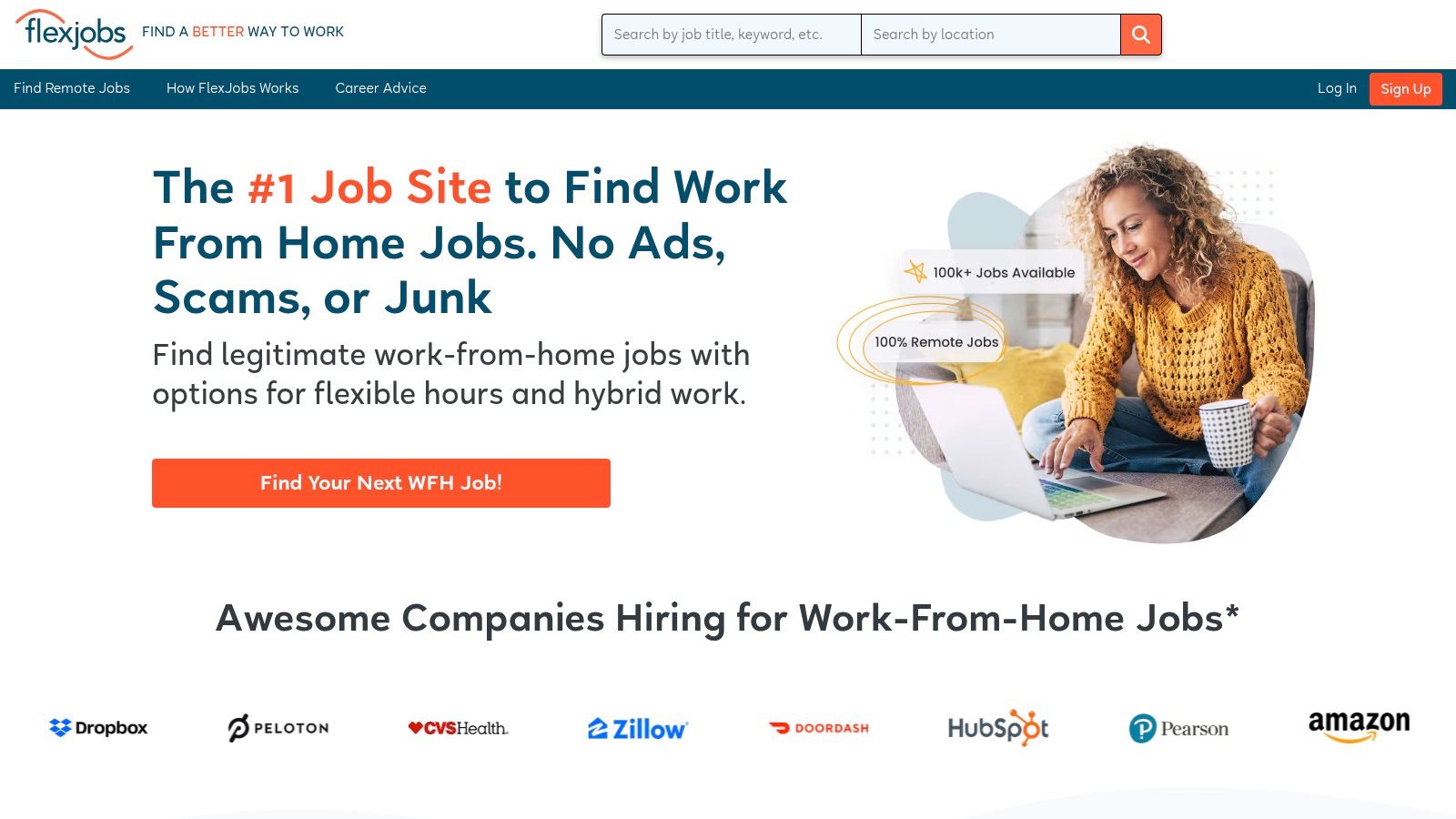
That matters because appointment setter roles attract low-quality employers. You’ll find legitimate jobs, but you’ll also run into offers with weak job descriptions, fuzzy compensation, and suspicious outreach methods. FlexJobs helps cut that down before you ever click apply.
Where FlexJobs helps most
The search filters are practical. You can narrow by remote level, career level, location, and employment type, which is useful if you’re trying to avoid contractor-heavy listings and focus on employee roles.
That filter stack matters more in this category than people realize. A lot of remote appointment setter listings look similar on the surface, but the gap between an employee role and a commission-only contractor role is huge in day-to-day reality.
Use FlexJobs when you want to separate:
- Employee vs contractor roles: Important if stability matters more than short-term upside.
- U.S.-only vs broader remote listings: Helpful if timezone or eligibility matters.
- Career level filters: Useful if you’re transitioning from customer success, admin, or support into sales development.
What works and what doesn’t
FlexJobs works well when you already know your criteria. It’s less useful if you browse casually and hope a perfect role appears.
The best FlexJobs users don’t search once. They set alerts, save searches, and check fresh listings on a tight schedule.
That’s the right way to use it because even strong boards can’t protect you from timing. Good remote sales roles still attract fast applications.
The obvious downside is the paywall. Some job seekers hate paying for access, and that’s fair. But if you’ve spent weeks applying through noisy boards, a paid filter can be cheaper than wasting hours on junk listings. The question isn’t “should a board cost money?” It’s “does it save enough time to justify it?”
For scam-wary applicants, FlexJobs usually does. For volume hunters, it may feel narrower than larger platforms.
3. Remote.co
You spot a fresh remote appointment setter listing at 8:10 a.m. By lunch, it already has a stack of applicants. That is why a focused board like Remote.co’s appointment setting page earns a place in the mix. It cuts out a lot of the noise that slows people down on bigger job sites.
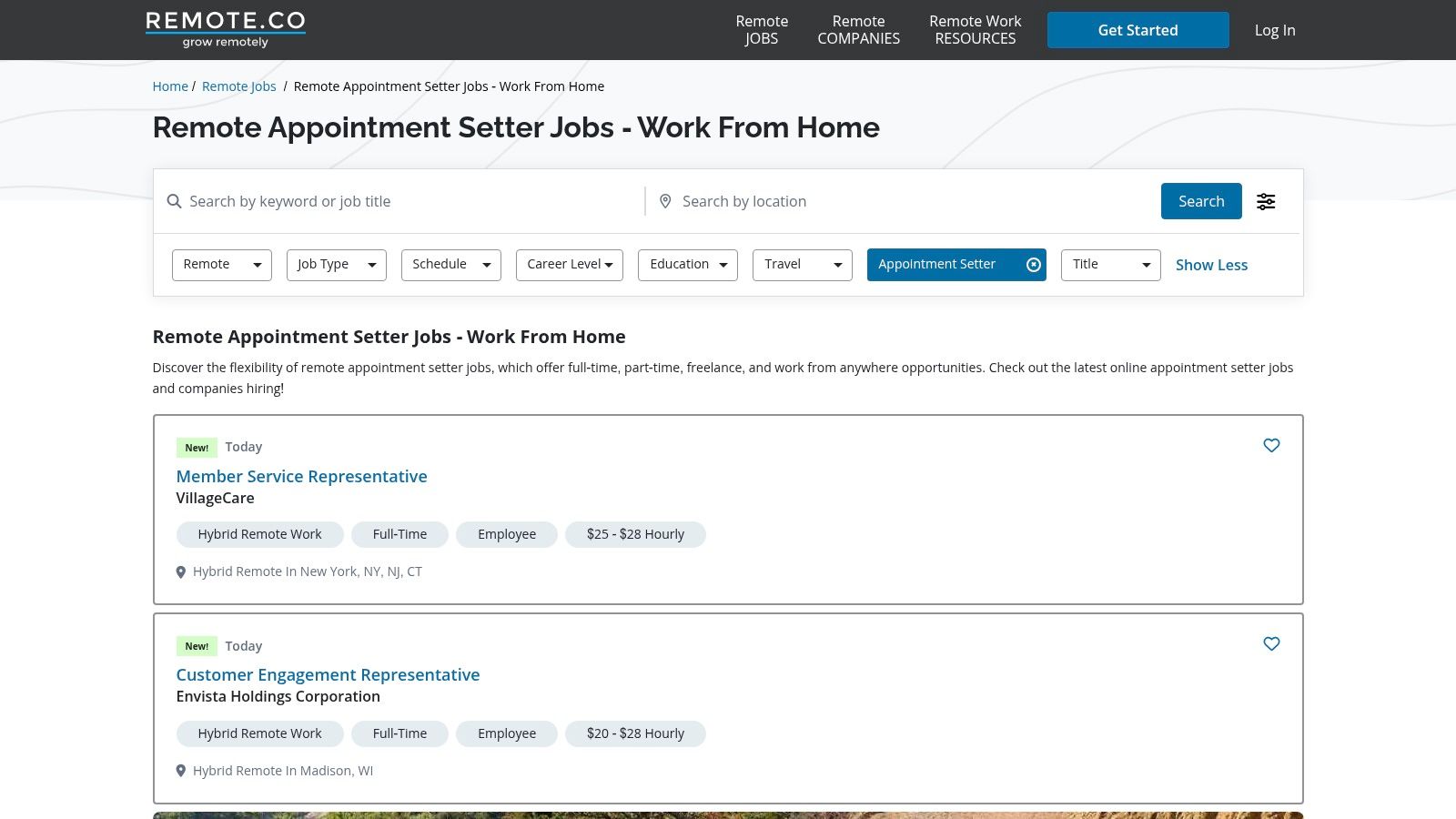
A key value here is speed with context. You are not starting from a blank search bar and then filtering out customer support jobs, generic virtual assistant posts, or shaky commission-only offers. You start inside a category already built around appointment setting and nearby sales roles, which makes it easier to review openings fast, shortlist the credible ones, and apply before the crowd piles in.
Remote.co works best as a precision tool. Use it to find clean, relevant listings, then vet each one like a recruiter would. Check whether the post names the product, sales motion, target market, and reporting line. A solid appointment setter listing usually makes those details clear. Vague posts often create problems later, especially around quota expectations, lead quality, or whether the role is really cold calling under a different title.
A practical search approach:
- Search title variations such as SDR, BDR, outbound specialist, lead generation, inside sales rep, and call setter.
- Read location rules closely. Some remote jobs still limit hiring by country, state, or time zone.
- Open the company site before you apply. Confirm the role exists there too and compare the wording.
- Keep a short application template ready so you can move fast when a strong listing appears.
Remote.co also fits the bigger job search strategy behind this guide. It is not just a place to browse. It is a starting point for direct sourcing. If a company posts here, look for the hiring manager, sales leader, or recruiter on LinkedIn and send a short, personalized note after you apply. That extra step helps when the board itself does not carry huge volume but does surface relevant companies.
The trade-off is simple. Remote.co is cleaner than many large boards, but the listing volume is lighter. Some weeks will produce only a few worthwhile openings. That is fine if your goal is better-fit roles and faster reviews, not endless scrolling.
For applicants who want signal over volume, Remote.co is one of the better tabs to keep open.
4. Wellfound
Wellfound is where startup hiring gets more transparent. If you’re open to SaaS, newer teams, and growth-stage companies, it’s one of the better places to find appointment-setting work that’s tied directly to pipeline generation rather than generic call center output.
That distinction matters. Startup appointment setter jobs often sit closer to SDR or BDR work, which can be a better path if you want upward mobility into full-cycle sales or account management later.
What you see here that other boards hide
Wellfound usually gives more company context than standard boards. Team size, funding stage, and sometimes equity details help you judge whether the company is early, stable, or trying to build a sales machine from scratch.
For candidates with some CRM or client-facing experience, this is a useful transition platform. A lot of mid-career professionals can reposition themselves into remote appointment setter roles by emphasizing transferable tools and process skills instead of traditional sales titles. That’s especially relevant because one overlooked path into this field is using existing CRM familiarity as proof you can handle lead tracking, follow-up discipline, and handoff quality.
If you’re changing lanes, don’t pitch yourself as “new to sales.” Pitch yourself as someone who already knows how to manage pipeline behavior.
How to search Wellfound without missing good fits
Startup titles are messy. The same job may appear as Sales Development Representative, Growth Associate, Pipeline Coordinator, Lead Generation Specialist, or Outbound Sales Rep.
That means you need a broader search pattern:
- Use multiple title searches: SDR, BDR, outbound, lead gen, pipeline, growth, and appointments.
- Read responsibilities, not just titles: Some of the best-fit roles won’t mention “appointment setter” anywhere.
- Check stage fit: Very early startups can be exciting, but they may expect more ambiguity and self-direction than established teams.
The trade-off with startup roles
Wellfound is strong for access, but startup compensation can be uneven. Some companies offer lower base pay with higher variable upside. Others expect broad responsibilities under a narrow title.
That’s not automatically bad. It just means you need to read the role with discipline. If the posting mixes prospecting, closing, account management, customer support, and scheduling into one job, the company may not know what it needs yet.
Still, for candidates who want a real career path instead of a static dialing role, Wellfound can be one of the best sources for appointment setter jobs remote in software and services.
5. RepVue
RepVue sales jobs earns its place in this list for one reason. It helps you avoid joining a sales team that looks fine on paper and breaks down in practice.
That matters more in appointment setting than many candidates realize. A remote role can advertise decent pay, flexible hours, and a clean title, then drop you into weak lead flow, confused handoffs, and managers who blame reps for a broken process.
RepVue is useful because it lets you examine the company behind the listing. Before you spend time on a custom application or a screening call, you can check how current and former reps rate leadership, quota fairness, culture, and product-market fit. That extra layer can save you from a bad six-month detour.
What RepVue is best at
RepVue works best as a vetting tool, not a primary source of appointment setter jobs remote.
Use broader boards to find openings. Then run the company through RepVue to answer the questions job descriptions avoid:
- Do reps believe the comp plan is fair?
- Are quotas realistic for the territory and lead flow?
- Does management have a reputation for coaching or churn?
- Are reps selling something buyers want?
I use this step late enough to stay efficient, but early enough to avoid wasted interviews. If a company has weak ratings, repeated complaints about turnover, or obvious friction around compensation, I move on fast.
How to use it in a real search process
RepVue gets better when you pair it with a higher-volume search source. For example, you can spot a fresh opening on a remote-first jobs board with direct-sourced listings, then use RepVue to decide whether the company deserves your time.
That approach gives you a stronger process than job-board browsing alone. You are not just collecting postings. You are checking listing quality, validating the employer, and filtering for teams where appointment setting can actually turn into meetings, pipeline, and career progress.
This is the trade-off. RepVue has less volume than the big boards, but the signal is often better.
Where candidates get this wrong
Candidates often judge remote sales roles by title and salary range alone. That is a mistake.
A healthy appointment setter role usually sits inside a clear sales motion. The targeting makes sense. The handoff to closers is defined. Managers can explain why reps hit quota and why they miss it. If none of that is visible during your research, the remote setup will not save the job.
RepVue will not answer every question for you. It will help you ask sharper ones in interviews and avoid sales orgs with a pattern of churn, distrust, or chaos.
The downside
RepVue is specialized, so the job flow is smaller than on broad remote boards. You will not use it the same way you use FlexJobs or We Work Remotely.
Use it as part of your toolkit. Find roles elsewhere, verify the company here, then write your application with more precision because you already understand the team you are applying to. That is how RepVue improves decision quality, even if it is not the board you check first thing every morning.
6. We Work Remotely
You sit down at 7:15 a.m., open three job boards, and half the listings are recycled, mislabeled, or already flooded with applicants. We Work Remotely Sales jobs is useful in that situation because it lets you scan a high volume of remote sales roles fast and spot fresh openings before the queue gets crowded.
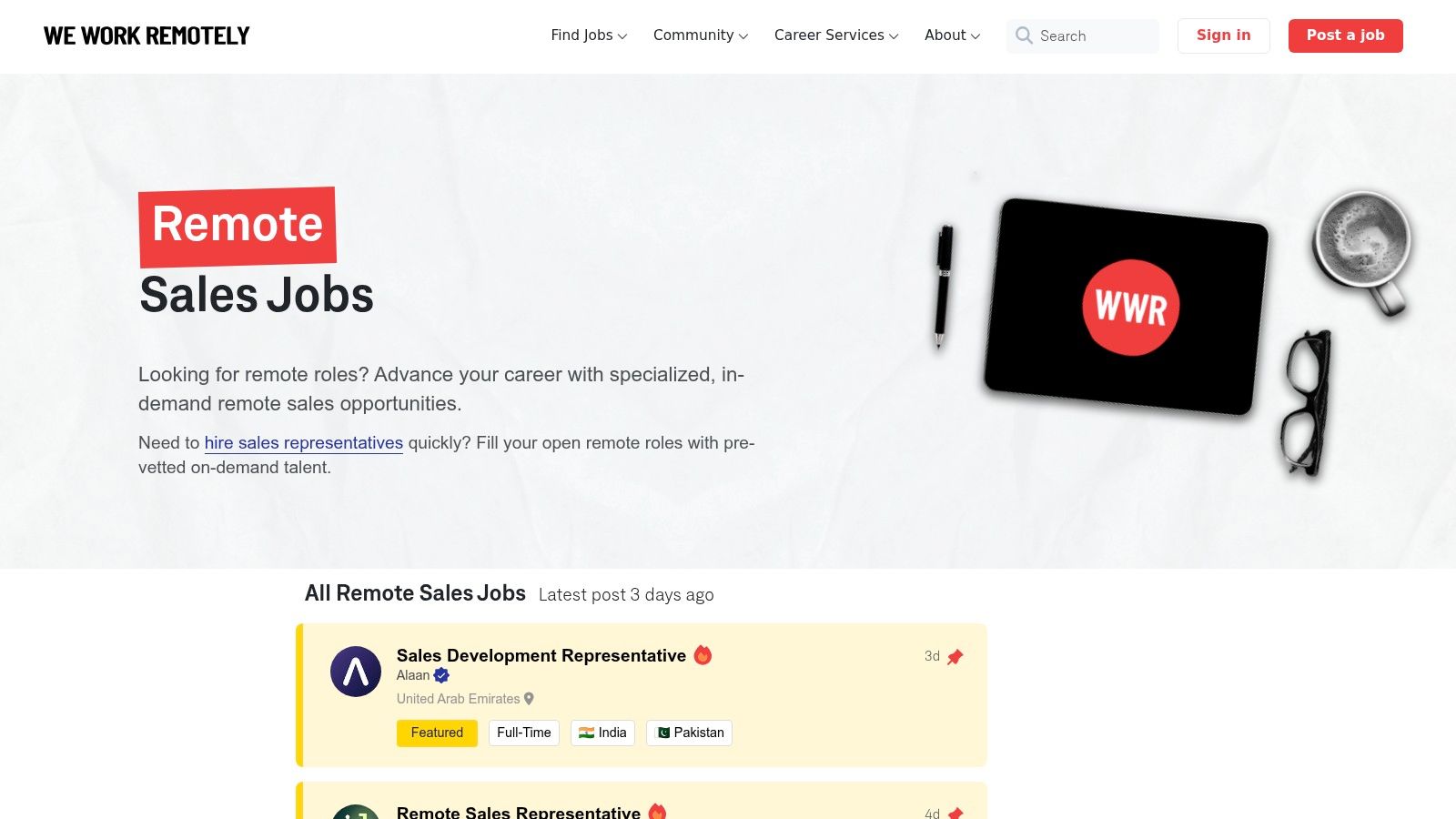
Its value is speed, not precision. You come here to widen the top of your funnel, then qualify hard.
How to use it well
Appointment setter jobs often show up under broader sales titles, so narrow keyword searches miss good leads. Search terms like sales development, SDR, outbound, lead generation, inside sales, and pipeline. Then open any listing that mentions prospecting, booking qualified meetings, CRM updates, or handing meetings to an AE or closer.
This board also works well alongside Remote First Jobs for direct-sourced remote listings. We Work Remotely helps you cover the broad remote market. Remote First Jobs helps you catch roles earlier and skip some of the repost noise. Used together, they give you better coverage and a cleaner application pipeline.
What to check before you apply
We Work Remotely has more listing variation than a tightly curated board, so weak filters will waste your time.
I would check these four things first:
- Title-to-duty match: Does the job involve outbound prospecting and booking meetings, or is it closer support, customer success, or full-cycle closing?
- Application route: Does the post send you to a real company careers page or a thin form with no company context?
- Offer clarity: Can you tell how pay works, what markets you will call, and whether the quota is based on meetings, opportunities, or revenue?
- Remote terms: Is the role fully remote, tied to certain countries or time zones, or implicitly hybrid?
One more move matters here. If the listing looks promising, go to the company site before you apply and check whether the same role is posted there. If it is, apply on the company page first when possible. You usually get a cleaner process, and you can tailor your application to the actual team language instead of the shortened board version.
Where it shines
We Work Remotely is strong for finding adjacent roles that can still fit an appointment setter skill set. That matters because plenty of employers avoid the title “appointment setter” even when the day-to-day work is prospecting, qualifying, booking meetings, and keeping CRM hygiene tight.
That creates a real trade-off. You get more volume, but you need stronger judgment. Candidates who read past the title, vet each company, and apply fast will get more from this board than candidates who treat every remote sales post as interchangeable.
7. NoDesk
You open a remote sales board expecting 200 listings and spend an hour sorting through junk. NoDesk solves a different problem. It gives you a smaller set of remote-first companies, which makes it useful for appointment setters who care more about fit and legitimacy than raw volume.
NoDesk sales jobs is built for candidates who want a cleaner search. The board tends to surface companies that already operate remotely, so you can spend less time decoding whether “remote” means home office stipend, async habits, and sane communication norms, or just a manager who expects you online all day.
That matters in appointment setting.
Weak remote employers show their problems early. The posting is vague, pay is hard to pin down, the hours are fuzzy, and the interview process feels improvised. A curated remote board will not remove that risk, but it does improve your odds of finding companies that have already made basic remote operations work.
Why NoDesk earns a spot
NoDesk is strongest as a research and shortlisting tool. I would not use it as my only source of leads. I would use it to find companies worth pursuing, then move fast off-platform.
The best approach is simple:
- Search the sales category with title flexibility
- Open companies, not just listings
- Check the company careers page for the live role
- Read the team page, product page, and hiring language before you apply
- Apply directly if the employer site gives you a clearer process
That last step is where candidates gain an edge. If a company appears on NoDesk, you can often identify the exact team, confirm whether the role is current, and write an application that matches the employer’s language instead of the shortened board copy. That fits the larger strategy for remote appointment setter jobs. Use boards to discover openings, then vet the company, tailor your pitch, and get your application in before the broad applicant pile builds.
The trade-off
NoDesk gives you better signal, but less volume. If you need a high daily application count, larger boards will still do more of the heavy lifting. If you want a tighter list of remote-first employers that are easier to vet, NoDesk earns a place in the stack.
It is especially useful for filtering out shaky offers. Remote appointment setter hiring still includes plenty of commission-heavy, contractor, and loosely defined roles, as noted earlier. A board centered on remote-first employers helps you concentrate on cleaner opportunities, then use direct sourcing and employer-site applications to reach the official hiring path faster.
Used that way, NoDesk is not just another place to browse jobs. It is a quality filter.
Top 7 Remote Appointment Setter Job Platforms Comparison
| Option | 🔄 Implementation complexity | Resource requirements | 📊 Expected outcomes / ⭐ Quality | 💡 Ideal use cases | ⚡ Key advantages |
|---|---|---|---|---|---|
| Remote Tech Sales Jobs (Remote First Jobs) | Low, simple filters and quick-apply | Minimal (free browse; account optional) | ⭐⭐⭐⭐, high-quality, verified remote listings | Mid-to-senior tech sales candidates seeking remote-first direct hires | ⚡ Fast detection of new roles; directly sourced, low spam |
| FlexJobs | Low, user-friendly with advanced filters | Paid subscription for full access | ⭐⭐⭐, well-vetted, lower fraud risk | Candidates wanting heavily screened, U.S.-focused remote roles | 💡 Human screening reduces scams; saved searches & alerts |
| Remote.co (Appointment Setting) | Very low, focused category page | Minimal (free browse; optional account) | ⭐⭐⭐, targeted appointment-setting listings | SDR/BDR and appointment setters who want category focus | 💡 Curated appointment-setting category via FlexJobs ecosystem |
| Wellfound (AngelList) | Low, startup-focused UI with filters | Free account required to apply/message | ⭐⭐⭐, strong startup fit; variable comp structures | Candidates seeking SaaS/startup roles and equity upside | ⚡ Direct apply to founders; transparent startup context |
| RepVue | Low–Moderate, job search plus crowd-sourced ratings | Free account (sign-in for full features) | ⭐⭐⭐⭐, high-quality validation of sales orgs | Researching sales culture, comp plans, and quota realism | 💡 Employer scorecards for comp, leadership, PMF insight |
| We Work Remotely | Low, simple, high-volume browsing | Minimal (free; email alerts available) | ⭐⭐⭐, steady flow but occasional noisy posts | Broad remote sales job hunting across startups & firms | ⚡ High visibility; frequent updates and recognizable employers |
| NoDesk | Low, curated board with focused categories | Minimal (free browse; alerts available) | ⭐⭐⭐, lower volume but reduced noise | Shortlisting legitimate, fully remote sales roles | 💡 Curation-first approach reduces spam and low-quality posts |
Beyond the Job Board
Finding a site is the easy part. Getting hired for appointment setter jobs remote takes a tighter process than many applicants employ. The strongest candidates don’t just apply more. They qualify the listing fast, tailor the message, and move before the role gets crowded.
That matters because this market is active, but it’s uneven. There are lots of openings, and there’s also a lot of noise. The difference between a good search and a frustrating one usually comes down to how quickly you can spot genuine jobs and present yourself like someone who already understands pipeline work.
How to spot a legitimate listing
The red flags are usually obvious once you know where to look.
Watch for vague company descriptions, personal email outreach, pressure to pay for training, or compensation language that sounds inflated but never gets specific about structure. If the company can’t explain what you’ll do, who you’ll report to, what tools you’ll use, or how appointments are qualified, skip it.
A credible appointment setter role usually includes clear expectations around calls, lead follow-up, qualification standards, and CRM usage. Many legitimate listings also standardize around real baseline requirements. For example, Indeed’s market snapshot notes that most remote appointment setter roles require 1 to 2 years of outbound phone-based appointment-setting experience and at least a high school diploma or equivalent. That doesn’t mean every good role requires the same background, but serious employers usually describe the role with that kind of clarity.
A messy posting usually leads to a messy job.
Another clue is hiring flow. A real company has a real process. You should see a professional site, a coherent application form, and an interview sequence that makes sense. If the “interview” jumps straight to a Telegram chat or asks for sensitive information too early, walk away.
What to write in your application
Most appointment setter applications fail because they sound generic. The candidate says they’re hardworking, organized, and passionate about helping people. That’s weak. Hiring managers want signs that you understand outbound work, follow-up discipline, and qualification standards.
Keep your message short. Focus on fit, tool familiarity, and evidence of execution.
Subject: Remote Appointment Setter Application
Hi [Hiring Manager Name],
I’m applying for your remote appointment setter role because my background aligns with outbound follow-up, lead qualification, and CRM-driven scheduling. I’ve worked in customer-facing environments where speed, consistency, and accurate handoff mattered, and I’m comfortable working from scripts while still sounding natural.
I’m especially interested in teams that care about lead quality, not just call volume. If helpful, I can walk through how I’ve handled follow-up cadence, objection responses, and CRM notes in prior roles. My resume is attached, and I’m available this week for a conversation.
If you have direct sales metrics from your own background, use them. If you don’t, don’t invent them. Talk about process instead. Mention scheduling accuracy, customer communication, CRM use, or experience supporting quota-carrying teams.
For career changers, transferable skills matter a lot. One overlooked path into this field is using CRM familiarity, client communication, or marketing coordination experience to reposition yourself into setter work. That approach is especially relevant because many job seekers still ask how to break into remote appointment setting without direct B2B experience, and that transition path is often underexplained in mainstream advice. The challenge is real, and The Curious Frugal’s discussion of the market notes rising demand alongside lower success rates for applicants who don’t use smarter targeting approaches.
How to apply before the crowd
Timing is one of the few advantages you can control.
Set alerts on two or three platforms, not ten. Too many boards create busywork. A better stack is one direct-sourced board, one curated remote board, and one broader remote board for overflow. Check them at fixed times each day and apply fast when a strong fit appears.
Then go one step further. Visit the employer’s own career page. If the job is live there, apply directly. That gives you a cleaner submission path and helps you avoid third-party lag. Direct-sourcing tools are useful in such situations. They shorten the gap between the company posting the role and you seeing it.
Quick tips for the interview
For interviews, be ready to talk about daily execution. Employers want to know whether you can handle repetition, rejection, and detail without losing pace.
Good questions to ask:
- What counts as a qualified appointment on your team
- How do you measure success during ramp
- Which CRM and outreach tools does the team use
- How are leads sourced and prioritized
- What happens after I book the meeting
You should also ask whether the team values raw activity or meeting quality more. That answer tells you a lot about management style.
The strongest remote appointment setter candidates come across as calm, process-oriented, and hard to rattle. They understand that the job is part sales, part operations, and part discipline. If you can show that clearly, you’ll outperform applicants who only talk about enthusiasm.
One more thing. Your online presence still matters. If your profile is thin or outdated, fix that before you send another batch of applications. This guide on how to improve your LinkedIn profile is a useful place to start.
If you’re done wasting time on stale listings and recruiter spam, try Remote First Jobs. It’s built for people who want verified remote roles sourced directly from employer career pages, which gives you a better shot at finding real appointment setter opportunities before they blow up on the major boards.