If you want to stand out in today’s job market, you have to be faster than everyone else. The real secret isn’t just a prettier resume; it’s getting your application in before a role gets blasted across oversaturated job boards. By focusing on quality and being one of the first candidates a recruiter sees, you give yourself a massive advantage right from the start.
Winning the Modern Job Search Before You Even Apply
Does applying for remote jobs feel like sending your resume into a black hole? You’re not wrong. The competition is genuinely fierce. A remote job posting attracts a staggering 340% larger candidate pool than a similar on-site role. Think about that. The local job that gets 50 applicants might pull in over 200 when it’s remote.
This completely changes the rules of the game. The old playbook of spending hours on massive job boards and hitting “apply” a dozen times a day just doesn’t work anymore. It lands your carefully crafted application in a digital pile with hundreds of others, all competing for a few seconds of a recruiter’s time. To get noticed, you need a smarter strategy, and it all boils down to timing.
The First-Mover Advantage in Job Applications
Hiring managers are human. The first handful of applications they review almost always get the most thorough look. This is the first-mover advantage. When you apply within the first 24-48 hours, you catch recruiters when they’re fresh, engaged, and haven’t yet developed “decision fatigue” from sifting through a mountain of resumes.
But how do you get there first?
The problem with traditional job boards is the delay. A company posts a new role on its own careers page first. It can often take several days for that job to be scraped and re-posted on platforms like LinkedIn or Indeed. By the time you see it, the early-bird advantage is long gone.
The only way to consistently beat the crowd is to find jobs directly from the source—company career pages—the moment they go live. A few smart applicants are already doing this. They get notified instantly and can act immediately, long before the masses even know the job exists.
The single best way to stand out is to be one of the first people the hiring manager sees. Your application’s quality is crucial, but its timing can be the deciding factor between getting an interview and getting lost in the pile.
This proactive approach is a huge part of learning How to Stand Out in Job Applications.
The Old Way vs. The Smart Way
Let’s break down exactly why this strategic shift is so powerful. Applying on huge job aggregators feels productive, but you’re often competing against impossible odds.
| Metric | The Old Way (LinkedIn, Indeed) | The Smart Way (Direct Sourcing) |
|---|---|---|
| Timing | Days-old listings | Real-time, fresh from the source |
| Competition | 200+ applicants | Often less than 25 in the first 48 hours |
| Job Quality | High chance of “ghost” or expired jobs | Verified, active jobs only |
| Visibility | Low; you’re one of hundreds | High; you’re one of the first reviewed |
| Strategy | Reactive, quantity-focused | Proactive, quality-focused |
The difference is clear. Instead of competing with the entire market, you’re competing with a small, select group.
This isn’t just about applying faster; it’s about applying smarter. You can do this manually, but it’s incredibly time-consuming. Or, you can use a tool built for this exact purpose. Our direct-sourcing engine at https://remotefirstjobs.com/ was designed to give you this edge, monitoring thousands of company sites 24⁄7 to deliver fresh opportunities straight to you.
How to Create an ATS-Optimized Resume That Gets Seen
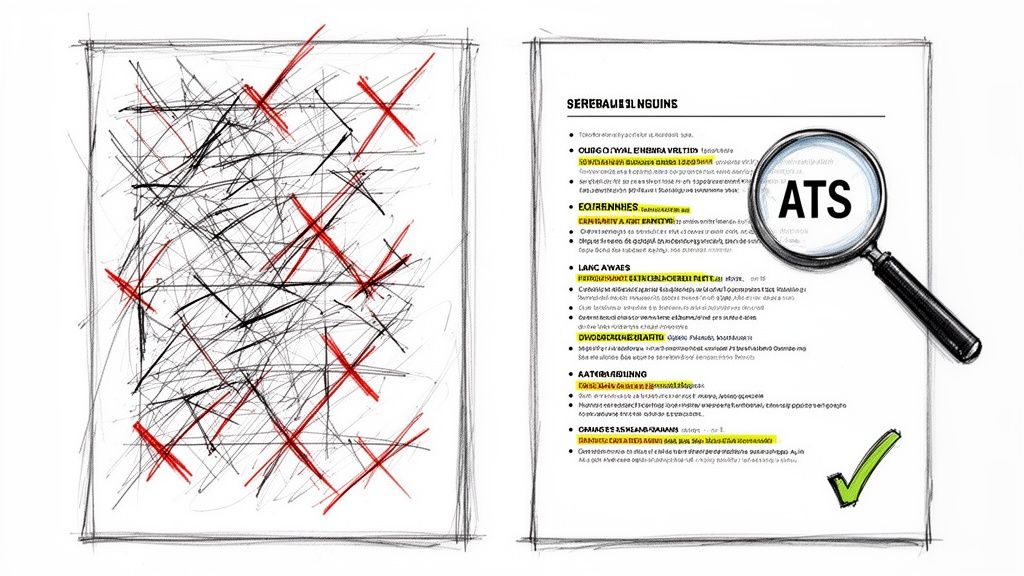
Before a hiring manager ever reads your name, your application has to get past the first line of defense: the Applicant Tracking System (ATS). Think of it as a robotic gatekeeper. These systems are programmed to scan every application, ranking them based on how well they match the job description. If your resume isn’t formatted for them or doesn’t contain the right keywords, it’s headed straight for the digital rejection pile.
This is the first major hurdle for anyone wondering how to stand out in job applications. It’s a shocking statistic, but a whopping 75% of qualified applicants have their resumes tossed by an ATS due to simple formatting mistakes or keyword mismatches. If you’re new to this, it’s worth reading a definitive guide to understanding Applicant Tracking Systems to get a feel for what you’re up against.
Master the Language of the Job Description
The most powerful thing you can do is speak the company’s language. An ATS isn’t smart; it’s a matching tool. It’s looking for the exact skills and qualifications listed in the job post. If the description calls for experience with “go-to-market strategy,” you can’t just write “product launch planning” and expect the system to connect the dots.
Here’s a practical approach I always recommend:
- Dissect the Job Post: Zero in on the “Responsibilities” and “Qualifications” sections. This is your treasure map.
- Mine for Keywords: Pull out the specific skills, software, and duties they list. Pay attention to what’s repeated.
- Weave Them In: Naturally sprinkle these exact phrases throughout your experience and skills sections.
This isn’t about mindlessly cramming in keywords. It’s about strategically aligning your experience with their stated needs. When you use their terminology, you’re signaling to both the software and the eventual human reader that you are a perfect fit.
Structure Your Resume for Both Bots and Humans
Those beautiful, creative resume templates with columns, icons, and fancy fonts? They’re often poison for an ATS. The software can get completely scrambled trying to read text in columns or inside graphics, turning your carefully crafted experience into an unreadable mess.
Stick to a clean, single-column layout with a standard font like Arial, Calibri, or Helvetica. Use boring but effective section headings like “Work Experience,” “Education,” and “Skills.” This ensures the ATS can parse your information correctly.
This simple structure isn’t just for the bots. It’s also a gift to the human on the other side. Recruiters spend an average of just seven seconds on their first glance at a resume. A clean, predictable format allows them to find exactly what they’re looking for, fast. Make their job easier, and they’ll see you more favorably.
Quantify Your Impact to Prove Your Value
Okay, so your resume made it past the ATS. Now you have to actually impress a person. The quickest way to do that is to show, not just tell. Vague statements about your duties won’t cut it; you need to highlight your accomplishments with cold, hard numbers.
Let’s imagine a content marketer applying for a role.
Before (Duty-Focused):
- Responsible for writing blog posts and managing the company’s social media accounts.
After (Impact-Focused):
- Authored 15+ long-form blog posts that drove a 40% increase in organic search traffic in just six months.
- Grew social media engagement by 200% by launching a new strategy centered on user-generated content and video.
See the difference? The second version tells a story of tangible business impact. It transforms your resume from a boring list of tasks into a compelling case study of your value, making it impossible for a hiring manager to ignore.
Writing a Cover Letter That Actually Gets Read
Let’s be honest about cover letters. Ever send one off and wonder if a real human being will even glance at it? In a pile of hundreds of applications, your cover letter isn’t just a formality—it’s your one shot to grab a hiring manager’s attention.
The purpose of a cover letter has changed dramatically. It’s no longer a long, formal essay rehashing your resume. Think of it as a short, direct pitch that proves you’re the exact solution to a company’s problem. Recruiters spend mere seconds on each one, so if you give them a wall of text, they’re going to skip it. The key is making it scannable, direct, and focused on their needs, not just your history.
The Problem with Most Cover Letters
So many job seekers fall into the trap of sending a generic, one-size-fits-all letter. Even worse, many now use AI to generate a “perfectly” tailored letter that just parrots the job description. The result? A bland, predictable mess that sounds exactly like the fifty other AI-written letters they received that day.
Hiring managers are drowning in these. Any letter that opens with something like, “I am writing to express my enthusiastic interest in the [Job Title] position…” is practically begging to be ignored. To break through the noise, you need to sound like a real person who has actually thought about the role.
Use the T-Format for Maximum Impact
I’ve seen one method work wonders for making a cover letter impossible to ignore: the T-Format. It’s a simple two-column table that draws a direct, visual line between what the company wants and what you offer.
This simple layout trick makes it incredibly easy for a busy recruiter to see why you’re a great match in under ten seconds. Instead of a long story, you’re giving them a clear, side-by-side comparison. It shows you respect their time and are confident in your qualifications.
The T-Format forces you to be concise and results-oriented. It shifts the focus from a list of your past duties to a direct response to the employer’s needs, proving at a glance that you’re the right person for the job.
Here’s how it looks in practice. Imagine you’re applying for a Senior Marketing Manager role. You’d write a quick, engaging opening sentence or two, and then drop in this table:
| Your Requirements | My Qualifications |
|---|---|
| 5+ years experience in B2B SaaS marketing. | 7 years leading marketing at two SaaS startups, contributing to $4M in ARR growth. |
| Proven success with Go-to-Market strategy. | Drove GTM strategy for a new product, achieving 1,500 new sign-ups in the first quarter. |
| Expertise in leading cross-functional teams. | Managed a team of 5 (content, SEO, social) to execute integrated campaigns. |
This approach does all the heavy lifting for the recruiter. It proves you didn’t just read the job description—you analyzed it and have the specific experience to back it up. It’s a powerful and direct way to make sure your cover letter actually gets you noticed.
Prove It: Why a Standout Portfolio is Non-Negotiable
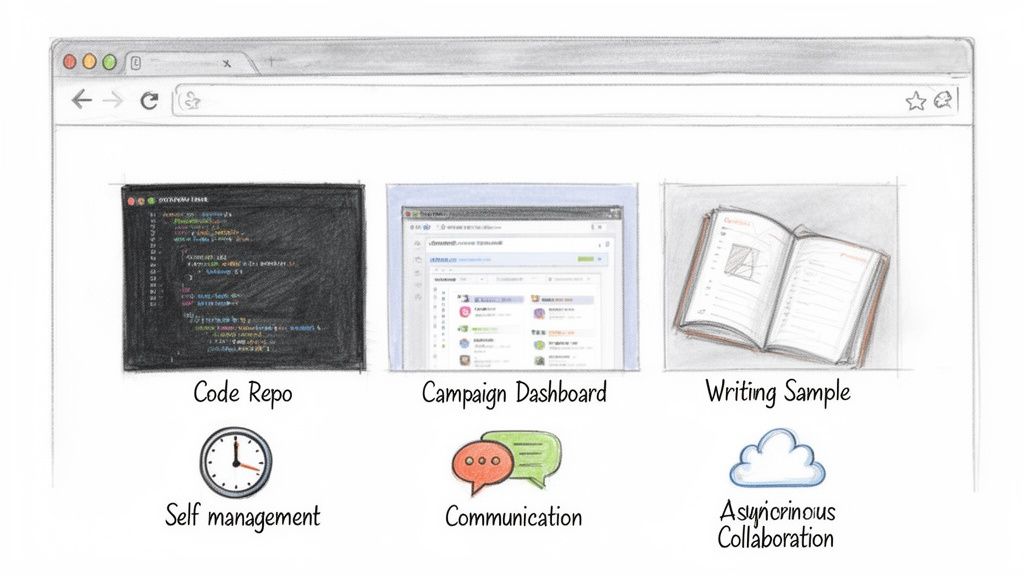
In the remote job world, your resume makes a promise, but your portfolio delivers the proof. It’s one thing to list your skills, but it’s another thing entirely to show a hiring manager exactly what you can build, design, or write. A well-crafted portfolio is one of the most powerful tools in learning how to stand out in job applications because it moves the conversation from theory to reality.
And no, this isn’t just for designers and developers anymore. Every professional can—and should—create a curated showcase of their proudest accomplishments. Think of it as your personal evidence locker, giving recruiters a firsthand look at your talent and the tangible results you produce.
What to Include in Your Portfolio
A great portfolio isn’t a brain dump of every project you’ve ever touched. It’s a strategic, curated collection of your best work that speaks directly to the job you’re applying for. Quality over quantity is the name of the game.
For every piece you include, think about the impact it had.
- Marketers: Don’t just link to a campaign; show the results. Share a screenshot of the analytics dashboard with a quick note: “This campaign drove a 25% increase in MQLs.” Or, link to a piece of content with the context, “This blog series generated 10,000 new email subscribers.”
- Developers: Your GitHub profile is your living portfolio. Make sure your best repositories are pinned, public, and have a crystal-clear README. Explain what the project is, why you built it, and what technologies you used.
- Project Managers: You can create simple case studies. Redact sensitive information and walk through a project’s lifecycle. Show a project plan, explain how you navigated a tight deadline, or even include a short, anonymized testimonial from a stakeholder.
- Writers: A clean, simple website with your 3-5 best clips is perfect. Pick articles that demonstrate your expertise in the company’s niche and showcase your range as a writer.
This focused approach immediately tells an employer that you’ve done your homework and have the specific skills they need to solve their problems.
Your portfolio isn’t just a gallery of past work—it’s a collection of success stories. Frame each project as a mini-case study: Here was the problem, here’s what I did about it, and here are the measurable results.
Frame Your Work to Highlight Remote Skills
For remote roles, your portfolio has to pull double duty. It must showcase your professional skills and prove you have what it takes to thrive in an autonomous, asynchronous setting. This is your chance to proactively answer the unspoken questions every remote hiring manager has.
As you describe each project, be explicit about the remote-friendly skills you used.
Weave in short, powerful statements that demonstrate your readiness:
- Self-Management: Instead of just describing the project, add a sentence like, “I owned this initiative from concept to launch with minimal supervision, hitting every deadline along the way.”
- Asynchronous Communication: Show, don’t just tell. Try something like, “Our team was spread across three continents, so all progress was tracked in detailed Notion docs and daily Slack updates to keep everyone aligned without constant meetings.”
These small details are huge. They signal to hiring managers that you’re not just a great contributor but also a low-risk, high-impact hire who already gets how to work effectively on a distributed team.
Use Speed as Your Secret Weapon
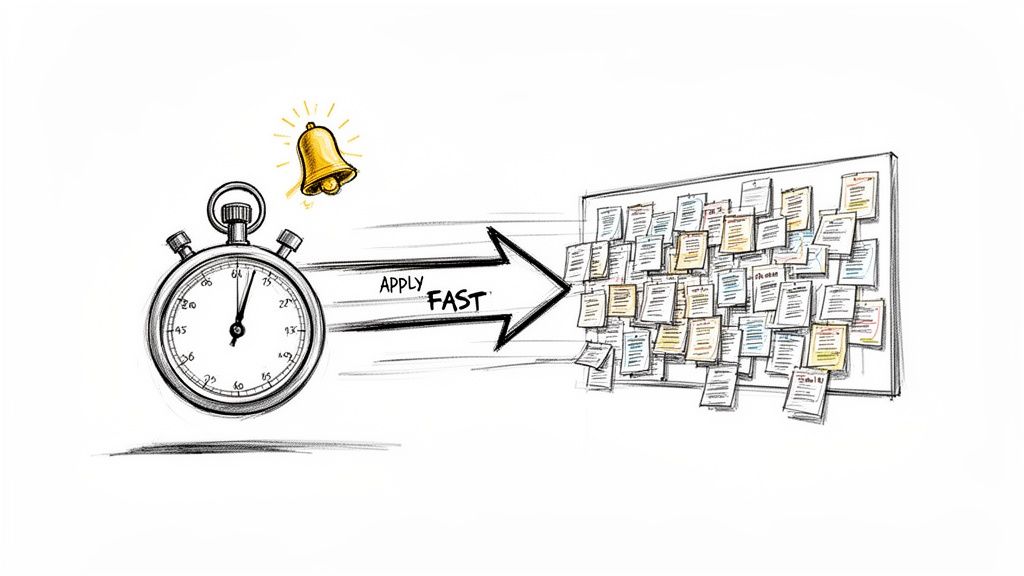
When an amazing remote job appears, the race is on. Seriously. The entire hiring process for remote roles often moves 16% faster than for traditional office jobs. Why? Companies have a global talent pool to pick from, so they don’t waste any time. If you want to get noticed, you have to be faster than everyone else. We’ve seen this time and again in our analysis of remote hiring data.
The biggest roadblock for most job seekers is the built-in delay on major job boards. By the time a role shows up on a massive aggregator, it’s already old news. Companies almost always post openings on their own career pages first, and it can take hours—sometimes days—for those jobs to get scraped and republished elsewhere.
That initial 24-48 hour window is golden. It’s when recruiters are most focused and before they’re buried under hundreds of resumes. Getting your application in early means you’re reviewed by fresh eyes, not by someone experiencing decision fatigue. This is your chance to make a real impression while the competition is still low.
Get Ahead by Going Directly to the Source
The only way to consistently beat the crowd is to find jobs the second they’re posted on a company’s own website. This isn’t about luck; it’s about using the right tools. Instead of waiting for opportunities to trickle down, the most successful applicants find them at the source.
This is where a direct-sourcing engine like Remote First Jobs comes in. Our system is built to continuously scan thousands of company career pages. The moment a new remote job is posted, we find it. This gives you a critical head start, letting you put together a thoughtful application before the masses even know the job exists.
The first-mover advantage is a real thing. It’s far better to be one of the first ten applicants than the one-hundredth, even if your resume is identical.
This strategy isn’t about firing off a rushed, sloppy application. It’s about having a system that helps you move quickly without cutting corners. You get the alert, you have the time to tailor your materials properly, and you still submit your application before almost anyone else.
Build Your High-Speed Application System
Getting real-time alerts is just the first step. You have to be ready to act on them instantly. Here’s a simple but powerful workflow I recommend to everyone.
- Set up your early-warning system. Use a direct-sourcing job finder to create alerts for the exact roles, keywords, and companies you’re targeting.
- Keep a “master” resume. This is a private, comprehensive document listing every skill, project, and accomplishment you have. Nobody sees this but you.
- Have your building blocks ready. Pre-write a few variations of your professional summary and key bullet points. When a promising job alert comes in, you’re not starting from scratch—you’re just copying, pasting, and tweaking your pre-written snippets to perfectly match the job description.
With this approach, you combine speed with precision. You get an instant notification and can put together a perfectly customized application in minutes, not hours. By the time that same job finally appears on a major board and the flood of applications begins, yours is already being reviewed. That’s how you get ahead.
Navigating Common Application Hurdles
Let’s be honest, even the most polished job seeker hits a few snags. You run into an unexpected required field, find a job description that feels like a bit of a stretch, or worse—you hear nothing but crickets after hitting “submit.” These moments can throw you off your game.
It’s not about finding some secret trick. It’s about approaching these situations with a little strategy and a lot of confidence. Let’s walk through a few of the most common roadblocks I see people face all the time.
What Should I Do If an Application Asks for a Salary Requirement?
You’ve found the perfect remote role, and then you see it: the dreaded “Desired Salary” field. This is a classic, and it’s there to screen you out early. Put in a number that’s too high, and you’re out of the running. Too low, and you’ve just anchored yourself to a disappointing offer before you’ve even had a conversation.
First, try to sidestep it. I’ve seen plenty of applicants successfully enter “0,” “1,” or just “Negotiable” if the field allows text. This signals that you’d rather talk about money after they’ve seen the value you bring to the table.
If the system forces you to enter a number, your best bet is to provide a well-researched range, not a single figure.
Here’s how to frame it: If you get a text box, use it. Instead of just dropping in numbers, try something like, “My salary expectations are flexible and depend on the full compensation package, but my research for a role with this scope indicates a range of $95,000 - $110,000.”
This little bit of text does two things: it shows you’ve done your homework and it keeps the conversation open for a real negotiation down the line.
Should I Still Apply If I Only Meet 70% of the Requirements?
Yes. A thousand times, yes. One of the biggest mistakes you can make is rejecting yourself before the company even has a chance to.
Think of a job description as a wish list, not a legal document. It’s what the hiring manager would get in a perfect world. Research has shown that many people (especially women) hesitate to apply unless they check every single box, while others will throw their hat in the ring with far less. Be the person who throws their hat in the ring.
If you can confidently handle the core duties of the job, just apply. Your ability to learn and grow is often way more valuable than having every single “preferred” skill on day one.
Here’s how you play it:
- Go All-In on What You’ve Got: Make sure your resume and cover letter laser-focus on the requirements you do meet. Make them impossible to miss.
- Frame Gaps as Strengths: In your cover letter, you can tackle a potential gap head-on and spin it into a positive. For instance, “While most of my direct experience is in marketing automation, I quickly ramped up on data visualization tools in my last role, proving my ability to become an expert in new domains on a tight timeline.”
Suddenly, a potential weakness becomes a story about how adaptable and proactive you are.
How and When Should I Follow Up After Applying?
Okay, so you sent your application into the digital void. Now what? The silence can be maddening, but a polite, well-timed follow-up can put your name back on top of the pile without coming across as pushy.
The sweet spot for following up is about 5-7 business days after you apply. That’s usually enough time for the hiring team to get through the first wave of applications.
Whatever you do, avoid the generic, “I’m just checking in on my application” email. It adds no value. Instead, make your follow-up another chance to shine.
Your message should be short and to the point.
- Start by briefly restating your excitement for the role and the company.
- Then, remind them of your value with one key achievement or skill that’s perfectly aligned with the job.
- End with a polite question about their timeline.
This approach reinforces your interest and gives them another reason to pull up your resume. It’s a positive touchpoint, not a pestering one.
Stop wasting time on oversaturated job boards. At Remote First Jobs, we source thousands of fresh, verified remote roles directly from company career pages, giving you a critical head start. Find your next opportunity before the competition does.