You’re probably seeing the same pattern everywhere right now. Remote customer success roles look promising on paper, but the search feels noisy, the titles blur together, and too many listings hide the job until you are deep in the interview process.
That confusion is expensive. It wastes applications, weakens your positioning, and pushes you toward roles that are not built for the kind of work you want to do.
Remote customer success can still be an excellent career path. It gives strong operators a rare mix of customer strategy, revenue impact, product influence, and location flexibility. But the people who win in this market do not apply blindly. They read roles like insiders, package their experience like revenue contributors, and move early before a posting turns into a pile of generic applications.
The Evolving Environment of Remote Customer Success
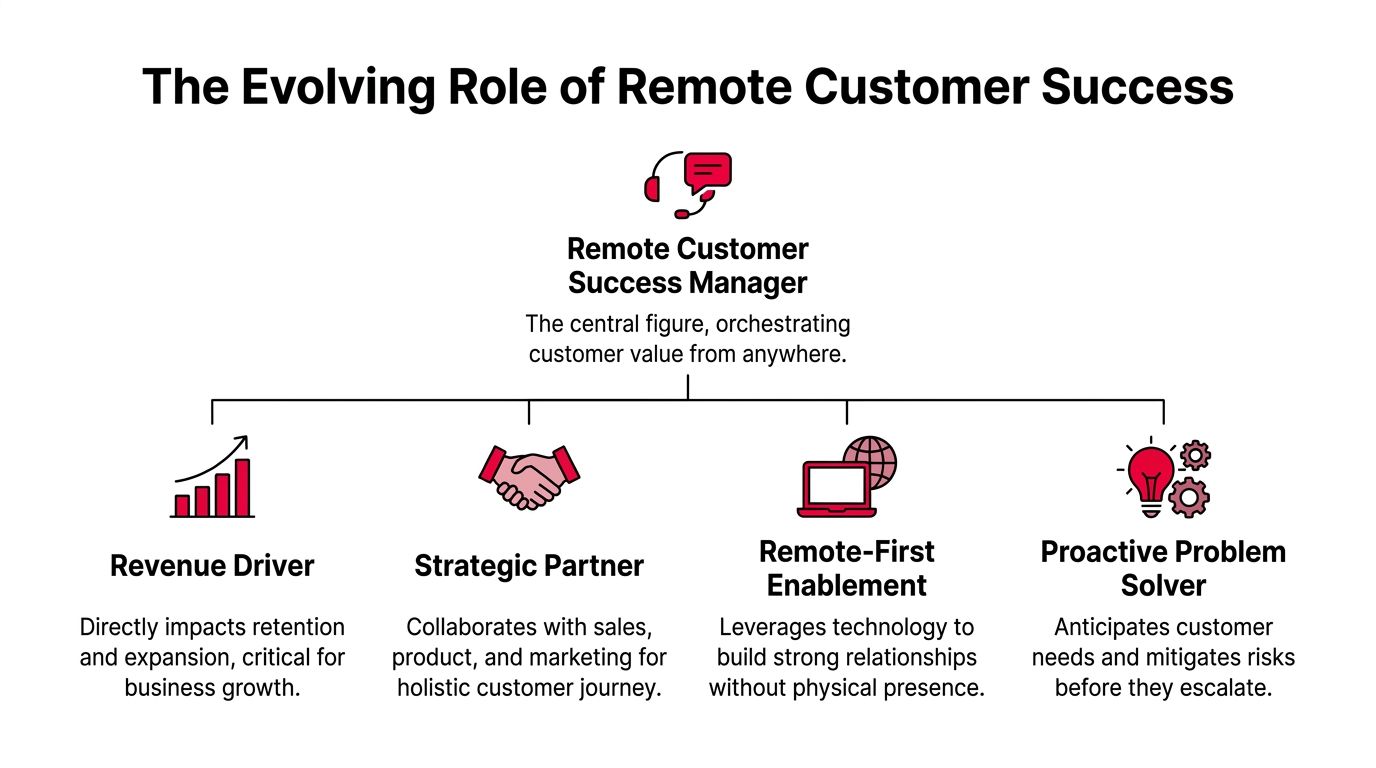
A modern remote customer success team does far more than answer questions and calm unhappy accounts. In SaaS, approximately 40% of revenue now comes from renewals and expansion, and 83.6% of Customer Success Leaders expect to generate more expansion revenue in 2025 according to Gainsight’s analysis of customer success and revenue growth. That changes how companies design these jobs, how they measure performance, and what they want from candidates.
If you still think of customer success as post-sale support, you will undersell yourself. Good companies do not. They treat remote customer success as a revenue and retention function with operational depth.
What remote customer success owns
The best remote CS teams sit in the middle of several business motions.
They help customers adopt the product fast enough to see value. They spot risk before the renewal is in danger. They coordinate with sales when expansion makes sense. They relay adoption friction back to product and support. In a distributed company, they also have to do all of this without hallway conversations or in-person rescue work.
That last part matters. In-office CS can sometimes survive on charisma and quick internal access. Remote customer success requires systems. Notes have to be clean. Follow-up has to be reliable. Handoffs have to work even when people are asleep in another time zone.
Remote customer success rewards operators who can create clarity without needing constant meetings.
The role titles are not interchangeable
Many applicants lose time because they treat all CS titles as roughly the same. They are not. A role can sit close to onboarding, sales, support, or account strategy, and each version favors a different candidate.
| Role Type | Primary Goal | Key Metrics | Typical Sales Involvement |
|---|---|---|---|
| Onboarding CSM | Get customers to first value quickly | Implementation progress, product adoption, launch completion | Low to moderate |
| Growth or Commercial CSM | Drive renewals and identify expansion opportunities | Renewal outcomes, expansion pipeline, account health | Moderate to high |
| Strategic or Enterprise CSM | Protect and grow complex accounts | Executive relationship strength, retention, success plan execution | Moderate |
| Technical CSM or TAM-adjacent CS | Solve adoption blockers with technical depth | Product usage, issue resolution progress, integration success | Low direct selling, high technical influence |
| Support-led CS hybrid | Manage ongoing customer needs in smaller books of business | Response quality, account stability, issue trends | Usually low, but can vary |
The mistake is chasing the title instead of the operating model.
A former account manager with renewal exposure may fit a commercial CSM role well. A product-savvy onboarding specialist may thrive in implementation-heavy CS. Someone with strong technical instincts can outperform in a hybrid CS role even without classic enterprise sales polish.
How to read a remote CS posting like a practitioner
Look past the headline and scan for these signals:
- Revenue language: If the posting talks about renewals, expansion, account growth, or commercial ownership, it is a revenue-facing CS role.
- Adoption language: If it emphasizes implementation, onboarding, training, or value realization, it is likely earlier in the customer journey.
- Technical language: If the role mentions integrations, APIs, solutions design, or troubleshooting with product teams, technical fluency matters.
- Portfolio language: “High-volume book” and “pooled accounts” usually signal one operating rhythm. “Named accounts” and “executive business reviews” signal another.
A lot of frustration disappears when you stop applying to “remote customer success” as a category and start applying to the exact CS motion you can execute well.
What companies value most now
Companies want CSMs who can hold the line between service and strategy.
That means helping customers achieve outcomes without acting like unpaid support. It means protecting renewals without turning every call into a sales pitch. It means understanding the commercial reality of the role while still earning trust.
The strongest candidates show they understand that balance. They do not position themselves as “great with people.” They position themselves as operators who improve retention, adoption, customer confidence, and account growth through disciplined execution.
The Remote CSM Skillset and Tech Stack
Hiring managers say they want strong communication. That is true, but it is incomplete.
In remote customer success, the valuable skill is not just speaking well on Zoom. It is creating momentum when no one is in the same room, no one sees the same customer issue at the same time, and the account still needs progress by the end of the week.
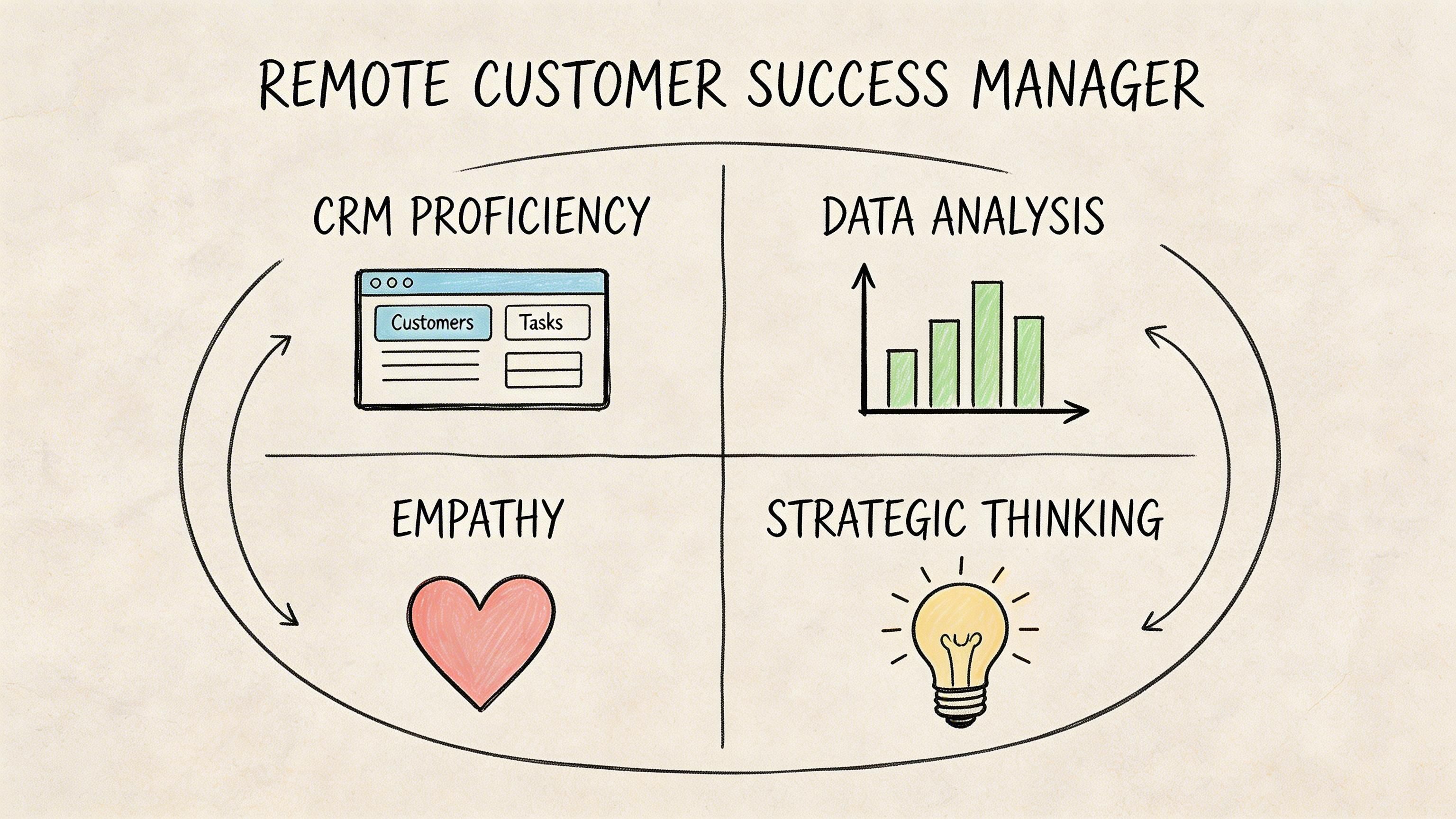
Table stakes skills
Every serious remote CSM needs a baseline set of skills. These are not your differentiators. These are your license to compete.
- Customer communication: You need to run calls, summarize next steps, and write follow-ups that customers can use.
- Account organization: You should be able to track open risks, owners, deadlines, and dependencies without losing context.
- Product fluency: Not expert-level engineering depth in every role, but enough product understanding to connect features to business outcomes.
- Cross-functional coordination: Sales, support, product, and implementation teams all touch your accounts. You need to move work across those boundaries.
- Basic commercial judgment: You do not need to be aggressive. You do need to know when usage patterns, new stakeholders, or roadmap needs create an expansion conversation.
If any of those are weak, fix them first. Remote work exposes gaps quickly.
The differentiators that get interviews
Strong candidates separate from polite candidates here.
Asynchronous communication mastery
A remote CSM who writes vague updates creates drag for everyone. A strong one can brief an account in a few lines, note the risk, assign next actions, and make the next person productive without another meeting.
If your updates require a live call to decode, you are not operating at a high remote level yet.
Good async communication looks like this: what changed, why it matters, who owns the next step, and when the team should revisit it.
Data comfort
You do not need to be a data scientist. You do need to work from evidence.
That means reading product usage, looking at account history, noticing drops in engagement, and using that information to shape outreach. Strong remote CS teams live inside account signals, not just customer sentiment.
Prioritization under ambiguity
Remote environments create less visible urgency. Nobody taps you on the shoulder. Your calendar can fill up while your most important account slips.
The skill is deciding what matters before the quarter forces the answer.
The remote CS tech stack that matters
You do not need to know every platform. You do need to understand the categories and why they matter.
Core systems
Most remote CS work runs through a few layers:
- CRM: Salesforce and HubSpot are common anchors for account data and commercial history.
- Customer success platform: Gainsight, Vitally, Planhat, and similar tools help teams track health, tasks, renewals, and success plans.
- Support and ticketing: Zendesk and similar systems matter because customer risk often shows up there first.
- Communication hubs: Slack, Zoom, Notion, and shared docs become the operating system for distributed teams.
Enablement and intelligence tools
The strongest teams also add tools that reduce friction.
Call recording and note tools help preserve context. Internal knowledge systems shorten ramp time. Product analytics platforms help CSMs speak concretely about adoption rather than relying on general impressions. If you are trying to understand how AI is reshaping this stack, this breakdown of a conversational AI CRM for customer engagement is useful because it connects automation to real customer workflows instead of vague AI hype.
Audit yourself like a hiring manager would
Ask three blunt questions:
- Can I manage a customer relationship without relying on constant live interaction?
- Can I explain account risk and opportunity using actual customer signals?
- Can I produce clean handoffs, notes, and action plans that make a distributed team faster?
If the answer is yes, your profile is stronger than most applicants realize. If not, the fix is usually practical. Run better notes. Learn your tools. Tighten your writing. Shadow stronger operators. Remote customer success favors disciplined habits more than polished buzzwords.
Building a Resume That Bypasses Filters
Most customer success resumes fail for a simple reason. They read like job descriptions.
Recruiters do not need proof that you attended meetings, answered emails, or “managed customer relationships.” They assume that already. What they want is evidence that you moved an account base toward value, stability, retention, or growth.
A strong resume for remote customer success does two jobs at once. It clears filters by matching the language of the role, and it convinces a human that you understand the business side of CS.
Stop listing duties and start showing contribution
A well-designed Customer Success program can deliver 91% ROI over a three-year period according to Vitally’s summary of Forrester research on customer success statistics. That matters for your resume because it tells you how employers think. They are not hiring “relationship managers.” They are hiring people who contribute to retention, conversion, upsell potential, and customer efficiency.
Your bullet points should reflect that logic.
Bad bullets describe activity. Good bullets describe why the activity mattered.
Before and after examples
Here is how to reframe common resume language.
Before
Managed a portfolio of customer accounts and conducted regular check-ins.
After
Owned an active book of business, ran structured check-ins, and surfaced renewal risks and adoption blockers early enough for cross-functional action.
The second version is stronger because it implies judgment, not just attendance.
Before
Helped onboard new customers and answered product questions.
After
Guided new customers through onboarding, clarified use cases, and reduced early confusion by translating product workflows into practical next steps.
This version shows value creation. It connects your actions to customer progress.
Before
Worked closely with sales and support teams.
After
Partnered with sales and support to coordinate handoffs, resolve account friction, and keep post-sale customer momentum intact.
Again, more specific. More commercial. More believable.
How to write bullets that survive ATS and impress humans
Use a simple formula:
- Start with ownership: owned, led, partnered, coordinated, guided, improved
- Add the customer or business motion: onboarding, renewal readiness, adoption, account health, stakeholder alignment
- Finish with the result of your involvement: reduced friction, surfaced risk, supported expansion, improved handoff quality, accelerated time to value
You do not need a number in every bullet. In fact, if you do not have a verified metric, do not force one. Clear cause and effect still beats vague filler.
Match the role without sounding robotic
Remote CS resumes should mirror the language of the posting, but not by stuffing keywords.
If the role emphasizes onboarding, your experience section should highlight implementation rhythm, customer education, and first-value milestones. If it leans commercial, foreground renewals, account planning, and expansion discovery. If it is more technical, make your product fluency and cross-functional problem-solving easy to spot.
A practical way to do that is to review the posting line by line before every submission. This guide on tailoring your resume to job description is useful because it focuses on adapting your resume to what the employer screens for.
The remote-readiness signals recruiters look for
A resume for remote customer success should answer a few doubts before they arise.
Can this person work independently
Show ownership. “Supported” is weaker than “owned” when you owned the motion.
Can this person communicate clearly
Your bullet points are writing samples. If they are bloated, abstract, or repetitive, recruiters will assume your customer communication is too.
Can this person operate in distributed teams
Mention workflows that imply remote maturity: async updates, documented handoffs, cross-functional coordination, customer follow-through, tool proficiency.
A resume that reads cleanly is already proving one of the most important remote CS skills.
A better summary line
Skip the tired “results-driven professional with excellent interpersonal skills” opener.
Use something tighter and more useful, such as:
Remote customer success professional with experience in onboarding, account growth, and cross-functional customer delivery. Strong at turning product complexity into clear next steps, managing distributed stakeholder communication, and protecting long-term customer value.
That summary tells a hiring manager what bucket to place you in. That is the job of the top third of your resume.
The Insider Playbook for Finding Verified Roles
The old approach to job hunting is simple. Search broad terms on giant boards, skim titles, send applications, and hope timing works in your favor.
That approach is broken for remote customer success.
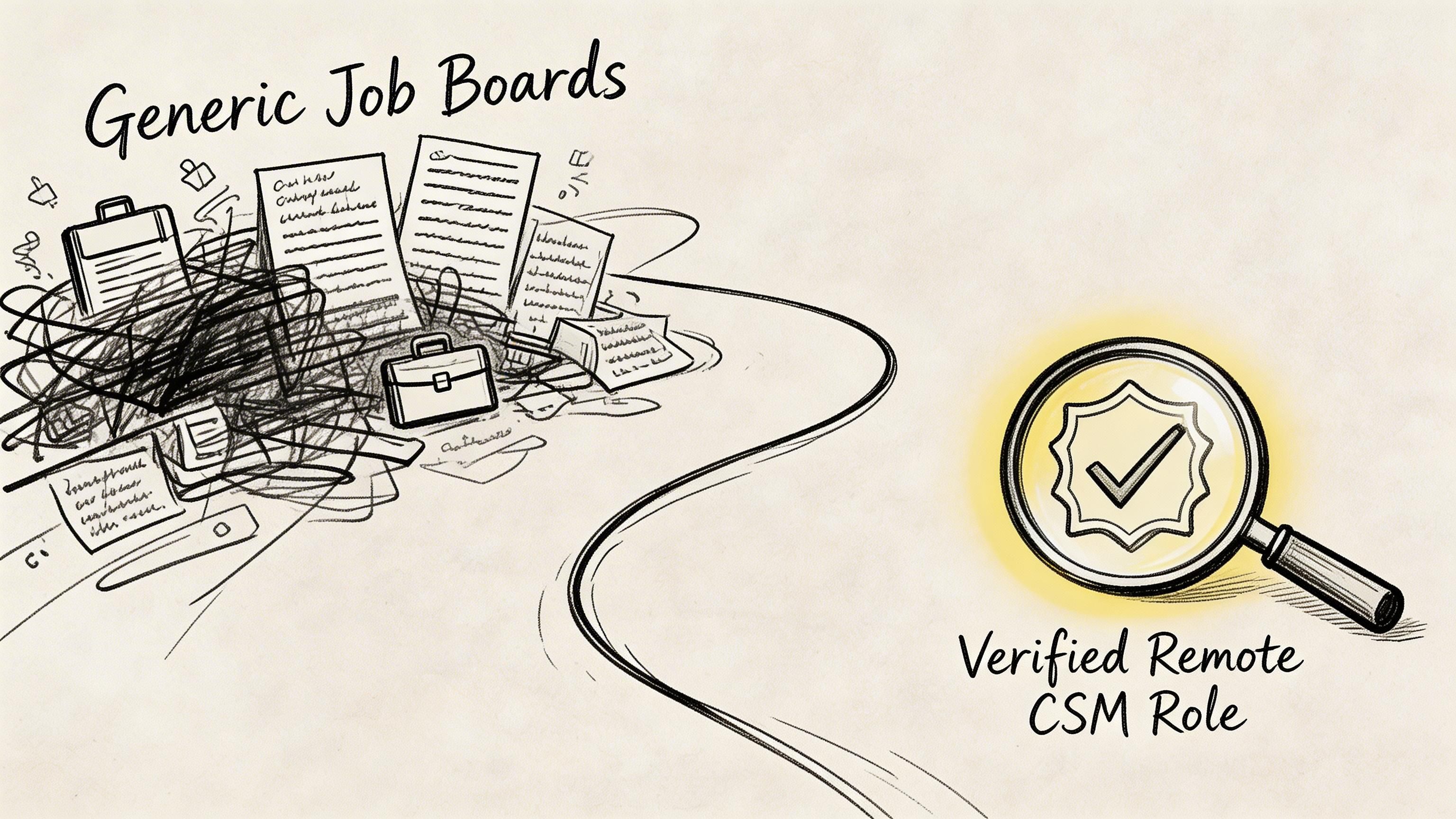
By the time a promising role is widely circulated, it often has a crowded applicant pool, vague reposts, recruiter duplication, or a listing that tells you almost nothing about the operating model. Worse, some “customer success” jobs are not customer success jobs at all.
The hidden trap in remote CS listings
Many remote customer success listings do not disclose whether the role includes aggressive selling. Some candidates only discover after starting that they are expected to hit sales targets disguised as customer metrics, as noted in this discussion of bait-and-switch customer success roles on major job boards.
This is one of the biggest career traps in the category.
A legitimate commercial CSM role is not the problem. Plenty of excellent CS jobs include renewals, expansion conversations, and revenue accountability. The problem is concealment. If a company wants a quota-carrying closer but advertises a relationship-focused success role, your search process needs stronger filters.
How to vet a posting before you apply
Read the description like someone trying to disprove the fit.
Look for red flags such as:
- Quota without clarity: The role references upsell, pipeline, closing, or target attainment, but never explains how much of the job is commercial.
- Support load plus selling load: You are expected to handle tickets, onboarding, renewals, and expansion at once. That usually means the company has not designed the function well.
- Title inflation: “Strategic customer success” paired with transactional tasks and little mention of account planning or business reviews.
- Compensation opacity: If the role hints at incentive-heavy pay but does not explain structure, ask early.
A clean job description does not need to reveal every detail, but it should tell you whether the company sees CS primarily as onboarding, retention, support, or revenue growth.
The first-mover advantage is real
In remote hiring, timing affects outcomes more than many candidates admit. Good roles attract attention fast. The earlier you apply, the more likely a recruiter sees you before pattern-matching fatigue sets in.
That is why direct-to-company sourcing matters more than scrolling recycled listings. Instead of relying on boards full of reposts and noise, use tools that surface roles closer to the company source. For verified direct-hire remote opportunities, Remote First Jobs is built around that exact advantage.
That kind of workflow does two things. It improves quality, and it preserves your energy.
When every application is deliberate, your materials stay sharper. You spend less time on listings that were stale from the beginning. You also get a better read on the market because you are seeing how real remote-first companies describe the role on their own career pages.
A smarter search rhythm
Treat your search like account management, not roulette.
Build a target list
Choose the types of CS roles you want. Onboarding-heavy. Strategic enterprise. Technical post-sale. Commercial growth. Then define your company preferences around product complexity, customer size, and team maturity.
Read the company before the role
A weak company page often predicts weak role design. If the company cannot explain its product, customer profile, or distributed culture clearly, the CS team will likely inherit that mess.
Apply with speed, not haste
Fast does not mean sloppy. It means you already know your target profile, have resume variants ready, and can decide within minutes whether a role deserves your time.
A useful mindset shift helps here. You are not trying to apply to everything. You are trying to become one of the first strong applicants to the right jobs.
A quick visual overview can help sharpen how you think about remote hiring workflows and role quality:
What works better than volume
Volume feels productive because it is measurable. But for remote customer success, precise targeting beats application count.
Strong candidates win by doing a few things well:
- They specialize their search. They know which CS motion fits them.
- They read for role design. They do not get fooled by generic titles.
- They move early. They value timing because recruiter attention is finite.
- They avoid bait-and-switch jobs. They would rather skip a bad listing than rationalize it.
That is the unfair advantage. Not more effort. Better filtration.
Winning the Remote Interview Process
A remote interview reveals more than whether you can answer questions. It shows how you will operate when customers, teammates, and executives only know you through a screen.
In customer success, that matters immediately. If you ramble, dodge specifics, or rely on charm instead of structure, interviewers will assume your customer calls feel the same way.
What interviewers are really testing
A remote CS interview usually checks four things under the surface:
- Can you create clarity quickly
- Can you handle customer ambiguity without drama
- Can you balance empathy with commercial awareness
- Can you work independently without becoming isolated
That is why generic answers fail. “I’m a people person” tells them nothing. A stronger answer explains how you manage account priorities, communicate asynchronously, and pull in the right internal team without losing momentum.
Questions you should expect
Prepare for questions that reveal how you think, not just what you have done.
How do you manage a portfolio remotely
Interviewers want to hear your system. Talk about prioritization, account signals, follow-up discipline, and how you separate urgent noise from actual renewal risk.
How do you build relationships without meeting customers in person
Good answers focus on consistency. Clear next steps. Strong meeting preparation. Reliable follow-through. Thoughtful outreach tied to customer goals.
How do you handle a customer who is not adopting the product
Show that you diagnose before you react. Is the issue unclear value, weak onboarding, internal stakeholder misalignment, technical blockers, or timing?
Strong candidates answer with a process. Weak candidates answer with personality traits.
Questions you should ask them
Candidates often waste their advantage here.
Remote customer success salaries can range from $64k to $155k, but the spread varies by experience, specialization, and remote work policy according to ZipRecruiter’s listing overview for remote customer success roles. Because the range is so wide, you should ask sharper questions than “What does success look like?”
Use questions like these:
- How is the book of business structured across the team
- What part of the role is focused on onboarding, retention, renewals, or expansion
- Which metrics define top performance in the first few months
- How are customer success managers supported by support, solutions, and product teams
- How does the team handle time zone coverage and internal handoffs
- What does progression look like from this role into senior or strategic paths
- How is compensation structured across base pay, incentives, and any commercial expectations
Those questions do two things. They make you sound experienced, and they help you avoid walking into a poorly designed role.
How to present yourself on screen
Remote interviewing is operational theater. Your setup becomes part of the signal.
Keep your environment simple. Good light. Stable audio. Camera at eye level. Notes nearby, but not so obvious that you sound scripted. When you answer, land the point first, then add context.
Also, do not wait until the end to prove remote readiness. Show it in the interview itself. If a question is broad, structure your answer. If a scenario is fuzzy, clarify assumptions. If they ask about conflict, explain the communication loop you used to resolve it.
The best closing move
At the end, summarize your fit in the language of the role.
Not a rehearsed speech. A short calibration.
Something like this works well: based on our conversation, it sounds like this role needs someone who can manage customer adoption, keep internal teams aligned, and handle a mix of retention and growth without losing trust. That is the kind of environment where I do my best work.
That tells the panel you listened, you synthesized, and you understand the job they are hiring for.
Your 30-60-90 Day Plan for Remote Impact
The first challenge in remote customer success is not learning the product. It is learning how work moves when nobody is sitting next to you.
Miscommunication across time zones, broken meeting context, and inconsistent follow-up can slow a new hire fast. Teams handle that better when they standardize asynchronous communication, use time-zone-aware scheduling, and rely on tools that preserve meeting context, according to Bain’s discussion of customer success operating pitfalls.
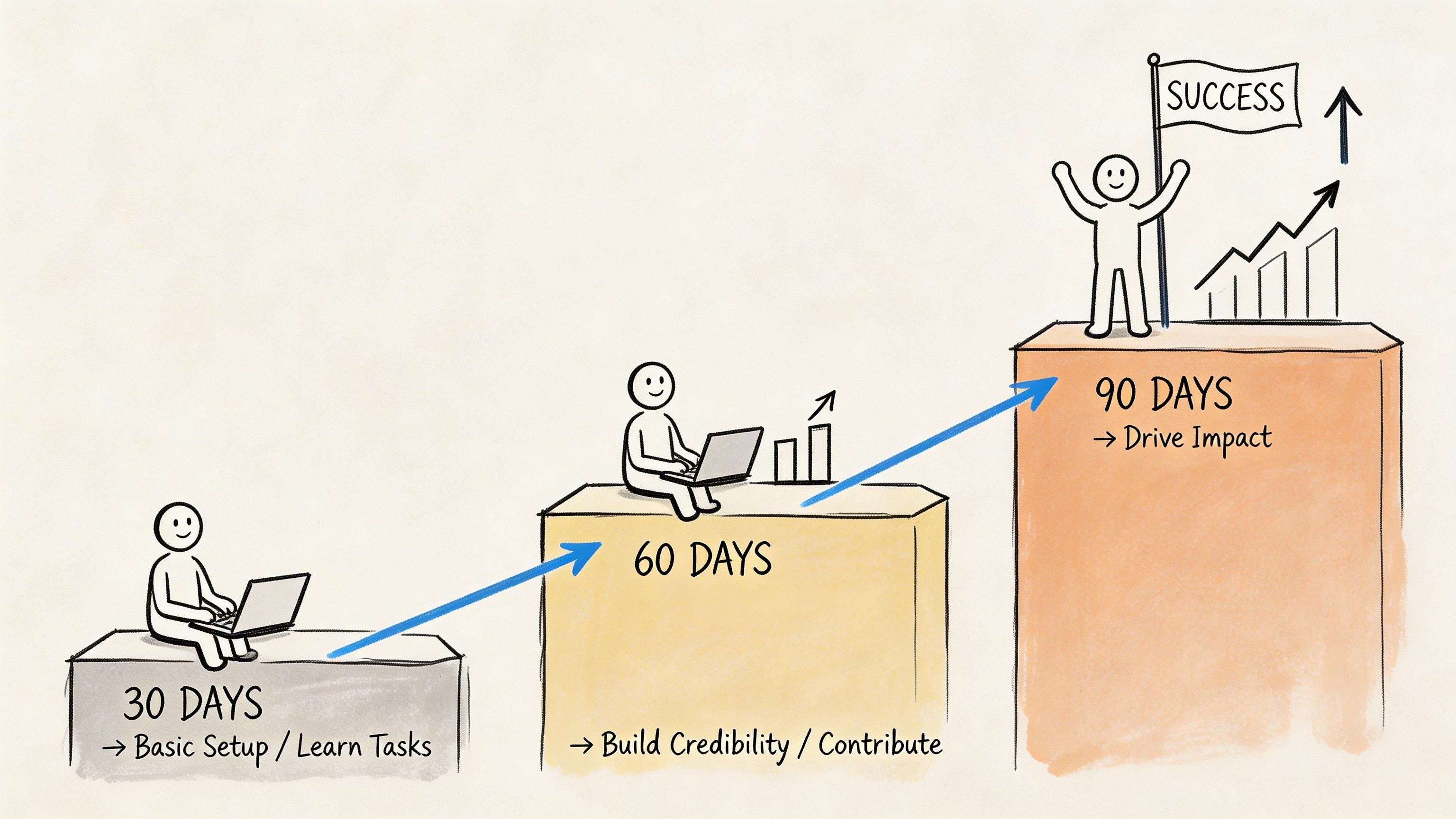
That means your first ninety days should not be passive onboarding. They should be a deliberate campaign to build visibility, reduce confusion, and create trust.
First 30 days
Your job is to absorb the operating system of the team.
Learn the product, but also learn where account truth lives. Is it in Salesforce, Gainsight, Slack, Notion, Zendesk, call recordings, or all of the above? Figure out how managers review risk, how handoffs happen, and what a clean customer update looks like in this company.
Focus on these actions:
- Map the workflow: Follow one account from sale to onboarding to ongoing success.
- Build your internal network: Meet people in support, sales, product, and implementation early.
- Adopt the team’s async style: Watch how strong operators write updates and copy the discipline.
- Create your own reference system: Keep a personal log of recurring product issues, stakeholder names, and internal shortcuts.
In this phase, ask more questions than you answer. But make them informed questions.
Days 31 to 60
Now you start taking visible ownership.
By this point, you should understand the customer journey well enough to run smaller interactions confidently and manage pieces of the account motion without heavy supervision. Your manager should see fewer “what do I do next” messages and more concise updates with options.
A practical focus list helps:
- Own a slice of customer communication: Lead follow-ups, prep materials, or run lower-risk calls.
- Spot patterns: Which accounts stall in onboarding? Which requests keep looping back? Which stakeholders go quiet?
- Improve one operating habit: Better notes, cleaner handoffs, tighter QBR prep, sharper escalation summaries.
- Establish reliability: Do what you said you would do, when you said you would do it.
Early credibility in remote customer success comes from predictability. People trust the teammate who closes loops.
Days 61 to 90
You stop looking new now.
You should have enough context to manage your work with judgment, not just effort. That does not mean pretending to know everything. It means understanding where you can create value without waiting for permission on every move.
At this stage, push toward three outcomes.
Build a clear view of your accounts
Know the key stakeholders, current goals, adoption blockers, recent support friction, and likely risk areas. If your company uses health scores or success plans, your updates should now reflect that language naturally.
Deliver one visible improvement
Do not chase heroics. Pick one practical fix. Improve an onboarding checklist. Clean up meeting recap format. Create a reusable customer resource. Tighten the way risks get escalated.
Align with your manager on the next level
Ask what would make you strong in the role over the next quarter. Not “doing well.” Strong. That phrasing usually produces more useful guidance.
The mindset that works
New remote CSMs often wait too long to make themselves legible.
They work hard, but invisibly. They solve small problems, but do not document them. They notice patterns, but do not share them. In a distributed team, unseen effort is easily discounted.
Your job in the first ninety days is to combine learning with signal. Show that you can absorb context, communicate clearly, and reduce friction for both customers and teammates. That is how you become valuable fast.
Remote customer success is a strong path if you approach it with precision instead of volume. If you want a cleaner way to find verified remote roles before they get flooded with applicants, Remote First Jobs gives you a direct line to fresh openings sourced from real company career pages, which is the kind of unfair advantage serious job seekers should use.