When a hiring manager slides the question, “So, what are you looking for in this job?” across the table, it’s not just small talk. They’re digging deeper. It’s a test of your self-awareness, your career goals, and most importantly, whether your ambitions actually line up with what the company can offer.
A solid answer proves you get the role, you get the company, and you see exactly how you can start adding value from day one.
Why Interviewers Ask This Deceptively Simple Question
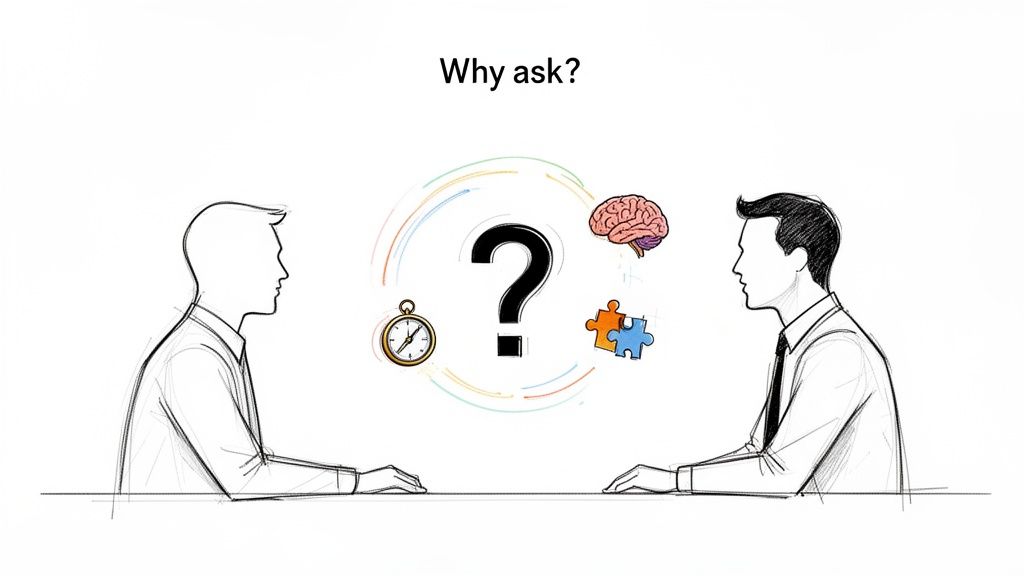
Think of this question as a high-powered filter. It instantly separates the candidates who just want any job from the ones who are genuinely invested in this specific job. A generic answer about “growth opportunities” or “a new challenge” is a massive red flag. It tells them you haven’t bothered to do your homework or you just don’t care that much.
In reality, they’re probing for a few key things with this one question.
Assessing Your Motivations
First and foremost, they need to understand what actually drives you. Are you just chasing a bigger paycheck, a fancier title, or a better work-life balance? Or are you genuinely fired up by the company’s mission, the tough problems you’ll get to solve, or the chance to make a tangible impact?
There are no universally “wrong” answers here, but some motivators are definitely wrong for a particular role. For example, if you say you’re looking for a fast-paced, constantly changing environment but you’re interviewing at a stable, slow-and-steady company, you’ve just signaled a major culture clash.
Key Insight: Your answer reveals if your personal career roadmap is headed in the same direction as the company’s. A mismatch almost always leads to a short-term hire, which is a costly mistake for everyone involved.
Checking for Company and Role Alignment
A thoughtful answer is your best proof that you’ve done your research. It shows you’ve looked past the job title and really understand the day-to-day responsibilities and how they slot into the company’s bigger picture. They’re looking for signs that you’ve figured out:
- What the company does: Their products, mission, and where they stand in the market.
- What the role is really about: The specific duties and challenges you’ll face.
- How you can help: The unique skills you bring that solve their specific problems.
A candidate who can clearly connect their personal goals to the company’s needs is instantly more compelling. For instance, mentioning your passion for working on large-scale data projects is the perfect move if you’re interviewing for a Data Scientist role at a company that just landed new funding for its data infrastructure.
This kind of answer shows you aren’t just looking for another job—you’re looking for the right job.
Crafting Your Answer with the Company-Role-Future Framework
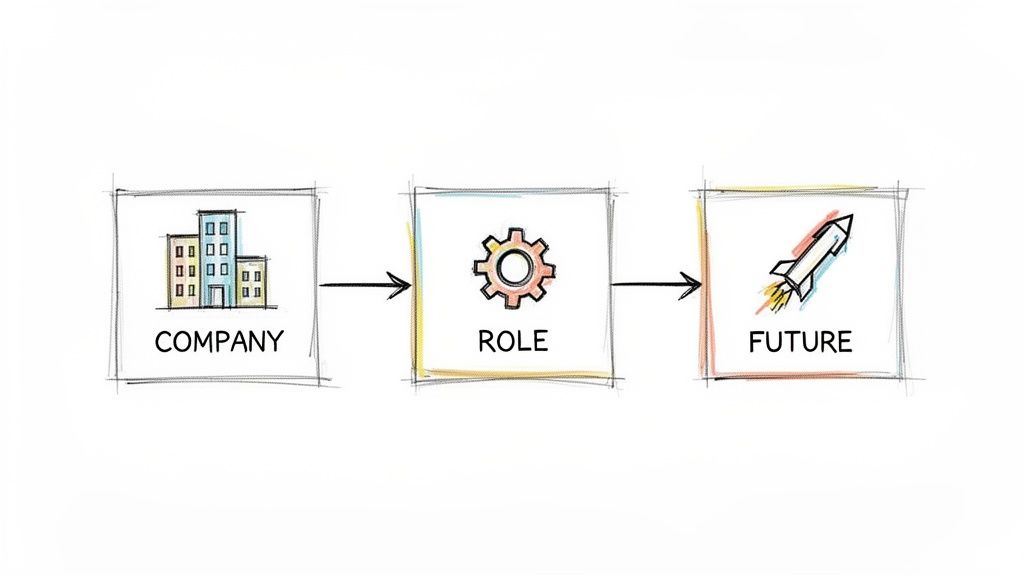
You don’t need a perfectly memorized script to knock this question out of the park. What you need is a simple, solid structure for your thoughts. I call it the Company-Role-Future framework.
This simple, three-part approach keeps your answer balanced and powerful. It proves you’re genuinely interested in them, you’re qualified to do the work, and you’re thinking about a long-term partnership. It’s the perfect recipe for showing a hiring manager you see this as a mutual opportunity, not just a paycheck.
Start with the Company
First, kick things off by showing you’ve done your homework and are genuinely excited about the company itself. This is your chance to prove you’re not just firing off random applications. You want to connect with their mission, product, or culture on a specific, personal level.
What you say here is your first real test for culture fit. Mentioning how you admire their open-source projects or a recent product feature shows you’re paying attention and that your values align with theirs.
Focus your research on one or two points that really resonate with you:
- Their Mission or Values: “I’m really drawn to your commitment to sustainability, especially the recent initiative for a zero-carbon footprint. That’s a cause I care about personally, and I’m looking to contribute to it professionally.”
- A Product or Service You Admire: “I’ve been using your project management tool for years. I’ve always been impressed by its intuitive design, and the chance to help improve a product I already believe in is a huge motivator for me.”
- Their Reputation or Market Position: “The way this company has disrupted the fintech space is seriously impressive. I’m looking for a role in a forward-thinking organization that isn’t afraid to challenge the status quo, and it’s clear that’s your DNA.”
Pivot to the Role
Once you’ve established your interest in the company, it’s time to connect the dots to the job itself. This is where you directly link your skills and experience to the responsibilities they’ve outlined. The goal is to show them you understand their immediate problems and can start delivering value from day one.
This part of your answer silently answers the manager’s biggest question: “Can you actually do this job?” Be direct. Use the language from the job description to make the connection crystal clear.
A common mistake is just listing your skills. Instead, frame them as solutions. Rather than saying, “I know Python,” try this: “I saw the role involves automating data pipelines. I’m excited to apply my experience with Python and Airflow to build more efficient and reliable systems, which seems to be a key priority here.”
End with the Future
The final piece of the puzzle is tying it all together with your own career goals. This shows the interviewer you’re not just looking for a temporary gig or a stepping stone. You’re looking for a place to grow, and you see that future with them.
Hiring managers want people who will stick around—turnover is a huge expense. In fact, replacing a single employee can cost anywhere from 50-60% of their annual salary. Showing you’ve thought about your long-term fit makes you a much safer—and smarter—investment.
Here are a few ways to talk about your future aspirations:
- Growing Your Skills: “I’m looking for a position where I can really deepen my expertise in machine learning. I know your team is working with advanced models, and I’m eager to contribute what I know while learning from senior engineers on the team.”
- Your Career Path: “My long-term goal is to grow into a product leadership role. This position seems like the perfect foundation, letting me master the product lifecycle and user feedback before taking on more strategic responsibilities down the line.”
To help you put this all together, here’s a quick reference table.
Building Your Three-Part Answer
| Framework Part | What It Demonstrates | Example Focus Point |
|---|---|---|
| The Company | Genuine interest, culture fit, and diligence. | “I’m inspired by your ‘work from anywhere’ philosophy and your focus on asynchronous communication.” |
| The Role | You have the skills to solve their immediate problems. | “I’m eager to apply my UX design skills to help improve the mobile app’s user flow.” |
| The Future | Ambition, long-term commitment, and a desire to grow with them. | “I want to grow my skills in data science, and I see a clear path to do that here.” |
By weaving these three elements together, you’re not just answering a question—you’re telling a compelling story about why you belong on their team.
Answering for Remote and Hybrid Roles
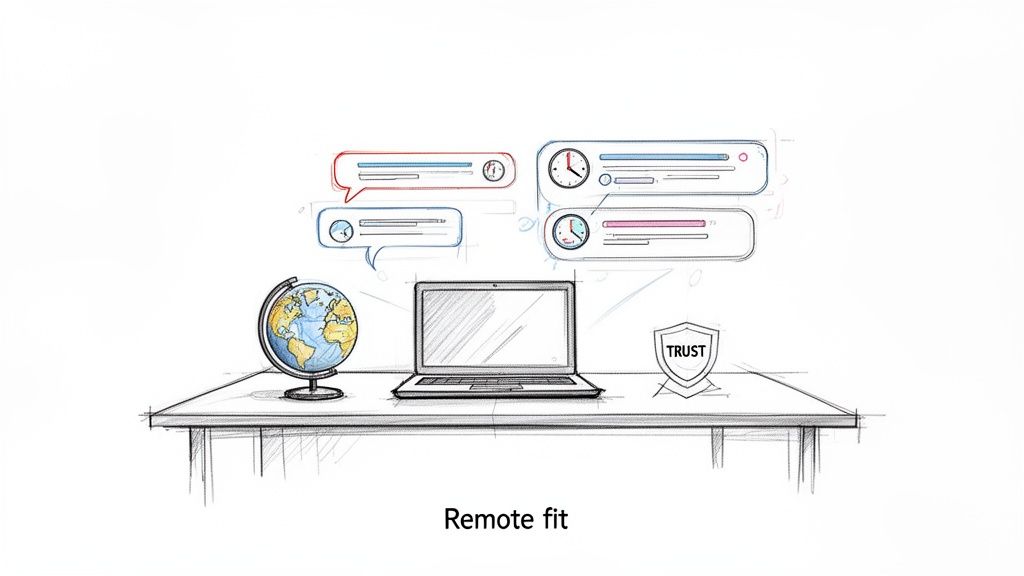
When you’re interviewing for a remote or hybrid job, “What are you looking for?” is a trickier question than it seems. The hiring manager isn’t just looking for a culture fit; they’re trying to figure out if you have the discipline and mindset to thrive without someone looking over your shoulder.
Your answer has to do double duty. It needs to show you’re a great candidate for the job itself, but it also needs to prove you’re a trustworthy, low-risk, and productive remote employee. This means you have to frame your desire for flexibility not as a personal perk, but as a key ingredient for doing your best work.
Show You Get How Remote Teams Work
Remote-first companies are built on a bedrock of trust, autonomy, and a focus on results. A generic answer about “work-life balance” can backfire, making it sound like you’re just looking for an excuse to slack off. Instead, you need to show you’re actively seeking an environment where you can be more focused and effective because of those principles.
Prove you understand the unique rhythm of a distributed team. You can do this by highlighting things like:
- Proactive Communication: Talk about your experience with asynchronous tools like Slack, Notion, or Asana. Mention your habit of over-communicating to make sure everyone stays in sync, even across different time zones.
- Self-Discipline and Autonomy: Frame this as a core strength. Explain that you’re looking for a role where you’re trusted to manage your own time and projects, because that’s how you deliver top-quality work without needing to be micromanaged.
- A Results-Oriented Culture: Make it clear you prefer an environment where success is measured by your output and impact, not by the number of hours you spend at a desk.
Key Takeaway: Your goal is to position yourself as someone who doesn’t just put up with remote work—you actively thrive in it. You see autonomy as a responsibility that makes you more productive, not a benefit you use to check out.
This is more important than ever. By 2026, an estimated 32.6 million Americans will be working remotely. While the number of fully in-office jobs has dropped, remote and hybrid positions are holding strong. Companies are also getting smarter about it, with AI adoption in remote roles jumping from 28% to a staggering 66% since Q2 2023. You can find high-quality remote opportunities on dedicated platforms like https://remotefirstjobs.com/.
Frame Flexibility as a Productivity Tool
When you discuss what you’re looking for, always tie flexibility back to performance. Don’t just say you want it; explain why it makes you a better employee.
Here’s a great example for a software developer:
“I’m looking for a role in a company that trusts its engineers with autonomy, which is one of the things that drew me to your remote-first model. In my last job, I discovered that having uninterrupted blocks of focus time allowed me to solve complex coding challenges about 30% faster than when I was in a noisy office. I’m really looking for an environment that champions deep work, clear documentation, and asynchronous communication, because I know that’s where I can write my most impactful code.”
This answer is so effective because it:
- Ties remote work to a hard business outcome (solving problems faster).
- Uses the language of a healthy remote culture (autonomy, deep work, asynchronous).
- Shows you’re self-aware and know what you need to succeed.
Real-World Sample Answers for Different Careers
Alright, let’s move from theory to practice. Knowing the Company-Role-Future framework is one thing, but seeing it come to life is how you’ll really master it.
The true magic of this approach is its flexibility. It’s not a rigid script. Instead, it’s a blueprint you can shape to fit your exact career level, your industry, and the specific remote job you’re chasing.
We’re going to walk through a few different scenarios so you can see how it works on the ground. Let’s look at examples for a software engineer, a product manager, and a marketing coordinator. Pay attention to how each one is tailored—this is your key to creating your own authentic answer.
Mid-Level Software Engineer Example
As a mid-level engineer, you’re past the “just happy to be here” stage. You need to signal that you’re a solid technical contributor and a thoughtful team player who sees the bigger picture.
Scenario: You’re interviewing at a high-growth tech company that’s known for its remote-first culture and innovative products.
“To start, I’m genuinely impressed by your company’s mission to democratize data analytics. I’ve been following your open-source contributions for a while, and that level of commitment to building tools for smaller teams really resonates with me.”
“In this role specifically, I’m looking for the chance to really sink my teeth into building scalable back-end systems. When the job description mentioned migrating to a microservices architecture, I got excited. It’s a perfect opportunity to bring my experience with Go and Kubernetes to the table and help make that transition a success.”
“Long-term, I’m aiming to grow into a senior role where I can start mentoring junior engineers and taking on more architectural design work. Your company’s track record for promoting from within and investing in its people makes this feel like the right place to build my career, not just take another job.”
This answer lands perfectly because it hits all three points: genuine admiration for the company, specific skills tied to the role’s challenges, and a clear vision for a future within their walls.
Senior Product Manager Example
For a senior PM, the game changes. Your answer needs to scream “strategy.” You’re not just building features; you’re driving vision, owning outcomes, and leading from the front.
Scenario: You’re in talks with an established SaaS company that wants to inject new life into its flagship product.
“What I’m really looking for at this stage in my career is the opportunity to take ownership of a mature product and steer its next evolution. Your company has a fantastic reputation, and I’m fascinated by how you’ve maintained such a loyal user base while still pushing to innovate.”
This opener immediately positions you as a strategic thinker, not just a task manager.
“Within the role itself, I’m most excited about working cross-functionally to uncover new market opportunities. My entire background is rooted in user research and data-driven roadmapping, and I’m eager to apply that discipline here to help sharpen the product vision and deliver a real, measurable impact.”
Finally, you connect your personal aspirations to the company’s broader goals.
“Ultimately, I want to be in a position where I can help shape product strategy at a high level. My goal is to eventually lead a product division, and this role feels like the perfect environment to deepen my expertise in a complex market while directly contributing to the company’s long-term growth.”
Marketing Coordinator (Remote) Example
In a remote marketing role, you have to prove two things: your marketing chops and your ability to thrive in a distributed team. Great communication and collaboration skills are non-negotiable.
Scenario: You’re applying for a fully remote position on a marketing team that prides itself on being highly collaborative.
“I’m looking for a company that doesn’t just tolerate remote work but truly embraces it. Your team’s public emphasis on asynchronous communication and clear documentation immediately caught my eye—it shows you’ve built a strong remote culture.”
“This Marketing Coordinator role is exactly what I’m looking for right now. It’s a chance to apply my skills in content creation and social media management to support your campaigns. I’m especially excited about the prospect of working with different specialists across the team on everything from blog posts to webinars.”
“Looking forward, my goal is to grow into a well-rounded digital marketing strategist. I’m seeking a team where I can get hands-on experience with all facets of marketing, from SEO to paid ads. I see a clear path to learn and contribute here, helping the team hit its targets while I build my own expertise.”
For more strategies on acing your virtual interviews, including other essential remote job interview questions you should have ready, diving into expert guides is a great next move.
Common Mistakes That Weaken Your Answer
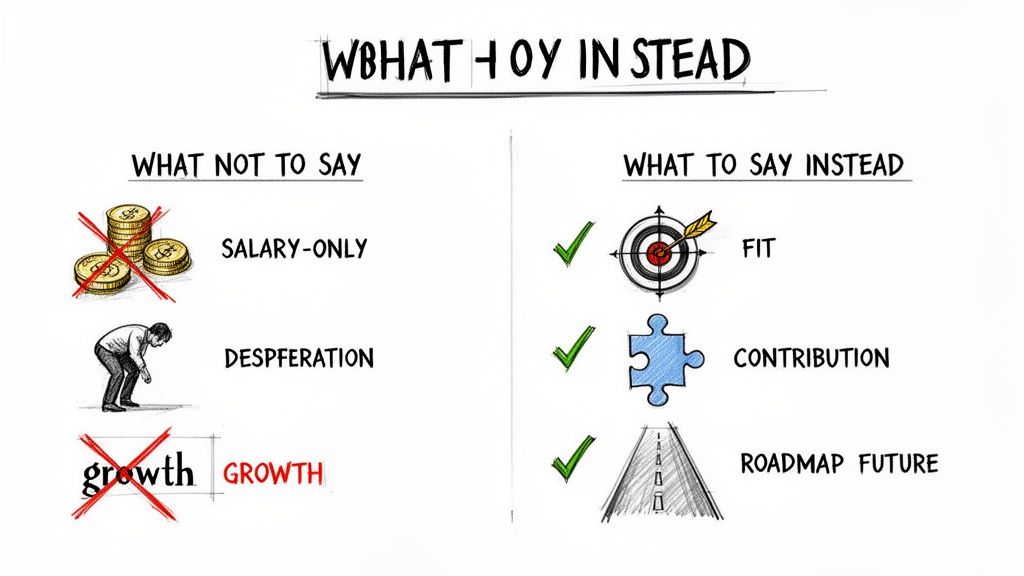
Knowing what to say is one thing. Knowing what not to say is just as crucial. I’ve seen countless strong candidates accidentally torpedo their interviews with a few poorly chosen words. It’s surprisingly easy to do.
These common mistakes can raise immediate red flags for hiring managers. But once you know what they are, you can confidently steer clear and keep your answer focused on what really matters: proving you’re the right person for the job.
Being Too Focused on Yourself
This is the big one. If your answer immediately jumps to salary, benefits, or how the company will advance your career, you sound self-serving. The hiring manager isn’t looking for someone to help—they’re looking for someone who can help them.
Your answer shouldn’t sound like a list of demands. Instead, frame your personal goals in a way that shows how they benefit the company.
- What Not to Say: “I’m looking for a job that pays at least $90,000 and has a great benefits package. I also need flexible hours and a clear path to promotion within two years.”
- What to Say Instead: “I’m looking for an opportunity where I can apply my project management skills to drive tangible results. While competitive compensation is certainly a factor, my main driver is finding a role where I can make a significant impact on team efficiency.”
Sounding Vague or Generic
Answers like “I want to grow” or “I’m looking for a new challenge” are interview clichés. They’re completely hollow without any specifics and signal that you haven’t put much thought into the role.
Answering with platitudes is a missed opportunity. Every part of your answer should be tailored to the specific company and role, showing you’ve done your research and are genuinely invested in this specific opportunity, not just any job.
Instead, tie your desire for growth directly to something you’ve learned about the company. Show them you see a future there.
- What Not to Say: “I’m just looking for a good company where I can grow my career.”
- What to Say Instead: “I’m looking for a place to deepen my expertise in product marketing. I saw your team is expanding into video content, and I’m excited by the chance to grow my skills in that area while helping you reach a new audience.”
Badmouthing a Previous Employer
This is an absolute deal-breaker. Never, ever speak negatively about a past job, boss, or company. It’s unprofessional and instantly makes the hiring manager wonder if you’re difficult to work with or unable to take ownership.
No matter how bad a past situation was, you have to frame your reasons for leaving in a positive, forward-looking way. It’s about what you’re moving toward, not what you’re running from.
- What Not to Say: “My last boss was a terrible micromanager, and the company culture was toxic. I’m looking for anything better than that.”
- What to Say Instead: “I learned a lot in my previous role, but I realized I thrive in an environment that offers more autonomy and a collaborative, remote-first culture, which seems to be a core part of your team’s DNA.”
A Few Lingering Questions?
Even with the best game plan, a few questions always pop up. Let’s run through some of the most common ones I hear from job seekers about tackling this interview question.
How Long Should My Answer Be?
You’re aiming for the sweet spot: between 60 and 90 seconds. That’s it.
Anything less can make it seem like you haven’t given it much thought or, worse, aren’t that interested. If you go on for too long, you’ll see the interviewer’s eyes start to glaze over. The idea is to be compelling, not to ramble.
Pro Tip: Don’t just think about your answer—say it out loud. Time yourself with your phone’s stopwatch. This is the single best way to catch awkward phrasing and make sure you sound smooth and confident, not like you’re searching for the right words.
What If I Don’t Know My Long-Term Career Goals?
First off, that’s completely okay. It’s actually more common than you think, especially when you’re starting out or making a career shift. Honesty and a willingness to learn are far more impressive than a rigid five-year plan you just made up.
Instead of inventing a specific goal, anchor your answer in your passion for growth and learning. Talk about the skills and experiences you want to gain right now.
- Focus on Gaining Skills: “Right now, I’m focused on finding a role where I can really sink my teeth into B2B content marketing. My immediate goal is to join a strong team, absorb everything I can about building effective campaigns, and start contributing to lead generation.”
- Show You’re Eager to Learn: “To be honest, I don’t have a specific job title in mind for five years from now. My main objective is to be in an environment where I’m constantly challenged and learning. This role really stood out because I’d get exposure to both the product development and user feedback sides of the business.”
Is It Okay to Talk About Work-Life Balance?
Yes, but you have to be smart about it. When you bring up work-life balance, it shouldn’t sound like you’re asking to work less. Frame it as the key to sustainable, high-quality performance—which is especially critical in a remote job.
Don’t position it as a demand. Instead, connect it directly to your ability to do great work. You need to show them you understand that a healthy work rhythm is what allows you to be focused, energized, and at your best every single day. For example, you might mention you’re looking for a culture that values focused work time because that’s how you produce your best, most creative results.
Of course, you can’t answer these questions without getting the interview first. A powerful way to jump the line and land more interviews is by mastering the cold email for a job.
Ready to stop fighting for stale jobs on crowded boards? With Remote First Jobs, you get access to over 44,000 verified remote jobs sourced directly from company career pages, giving you a crucial head start. Find your next opportunity before everyone else at https://remotefirstjobs.com.