For unemployed job seekers in the United States, the October 2026 median unemployment duration was 11.9 weeks. The mean was much higher at 27.1 weeks, making the median the better benchmark for a typical search.
That gap matters more than a single average suggests. It means you need separate answers to two questions: when might a search reach a useful milestone, and how much financial uncertainty should you prepare for?
Typical Job Search Length and Why Averages Mislead
Unemployment duration benchmarks
| Measure | Value | What it tells you |
|---|---|---|
| Median unemployment duration, December 2025 | 11.4 weeks | Half of unemployed people had searched less, half more |
| Median unemployment duration, annual 2025 (11-month average) | 9.9 weeks | Midpoint of ongoing unemployment spells across the year |
| Average unemployment duration, annual 2025 (11-month average) | 23.0 weeks | Pulled upward by the long tail |
| Median unemployment duration, October 2026 | 11.9 weeks | Median benchmark for ongoing unemployment |
| Mean unemployment duration, October 2026 | 27.1 weeks | Useful context for financial runway planning |
| Share of unemployed searching 27 weeks or more, October 2026 | 27.6% | Size of the long-tail group |
The BLS unemployment-duration table reports the December 2025 median of 11.4 weeks. The BLS annual averages table gives a 2025 median of 9.9 weeks and average of 23.0 weeks (an 11-month average, since October 2025 data were not collected). The BLS employment situation duration table gives the seasonally adjusted October 2026 median of 11.9 weeks and mean of 27.1 weeks for the same month.
These figures provide a population-level reference, not an appointment with your next employer. They also don’t tell you how many applications you’ll need, whether your next interview will succeed, or when a signed contract will arrive.
What the median and mean actually measure
The median is the midpoint. Half of the unemployed people measured had been unemployed for less time, and half for longer.
The mean, often called the average, combines everyone’s unemployment duration and divides it by the number of people. Long spells therefore have more influence on it.
Think of a room where many earn modest incomes and a few earn exceptionally large sums. The average income rises sharply, even though nobody else’s circumstances change. A similar effect occurs when some job seekers remain unemployed much longer than others.
But there’s a further complication: these are unfinished unemployment spells. Someone counted today might accept an offer tomorrow, or continue searching for months.
The same BLS duration table shows how long that tail is: 27.6% of unemployed workers had been searching for at least 27 weeks in October 2026. Calling the midpoint a guaranteed time to employment would turn a snapshot into a prediction it cannot support.
Planning rule: Use the median to orient expectations, not to set a deadline. Use the long tail to test whether your financial plan can withstand a slower outcome.
The mean isn’t a recommended savings target either. Your expenses, household income, benefits, debt obligations and willingness to accept interim work determine the reserve you need.
Separate the milestones before comparing timelines
When someone asks how long it takes to find a job, they may mean entirely different things. A useful tracker distinguishes:
- Time to first interview. This tests whether your targeting and application materials are getting you into conversations.
- Time to first offer. This includes the effort needed to enter an employer’s process and progress through it.
- Time from application to signed contract. This includes negotiation, approvals and any remaining conditions.
- Time until income resumes. A signed agreement and a first paycheck aren’t the same event.
Say you’re receiving interviews but waiting for an employer to approve headcount. Rewriting your resume won’t resolve that delay. Conversely, interview practice alone won’t help much if eligible employers aren’t seeing relevant evidence in your applications.
For personal planning, choose a baseline review window and a separate downside scenario. Treat both as planning assumptions, not findings about your individual prospects. Maintain several viable employer conversations rather than making your entire schedule depend on a single promising process.
Timelines by Occupation and Seniority
| Occupation or segment | Median unemployment duration | Main reason for the gap |
|---|---|---|
| Management, professional and related occupations | 13.2 weeks | Specialized matching and compensation requirements may contribute |
| Professional and related occupations | 13.6 weeks | Role-specific requirements and interview complexity may contribute |
| Service occupations | 10.4 weeks | Different recruitment requirements and hiring processes |
The BLS occupation-duration table reports October 2026 U.S. medians of 13.2 weeks for management, professional and related occupations, 13.6 weeks for professional and related occupations alone, and 10.4 weeks for service occupations.
Those medians measure elapsed unemployment: how long people in each occupation group had already been unemployed. They do not measure time to a first offer. They also are not a direct reading of executive, product, or fully remote searches. A software engineer seeking a distributed leadership role should not treat an occupation midpoint as a personal forecast.
The spread itself is modest. Service occupations sit at 10.4 weeks, and the two professional groups sit near 13 to 14 weeks. That pattern fits slower matching when hiring depends on specific experience, more interview stages, and tighter pay bands. It does not prove that every senior search must run longer, and it does not score ability.
A longer search can reflect a smaller intersection between your requirements and employers’ requirements. It doesn’t automatically demonstrate weak candidacy.
A senior product candidate with strong consumer-app experience who targets enterprise infrastructure leadership can be capable and still miss the brief an employer needs filled now. Pay and title language shrink the overlap again. The candidate may be able to do the work, yet want a larger remit than the approved budget, or hold a title that means something different at the next company. The occupation figures leave the cause of each gap open. Narrower matching is one diagnostic possibility.
Use the closest occupation median as a benchmark, then test your own match with a four-week funnel diagnosis.
Over those four weeks, sort activity into four bins: applications whose responsibilities match the target scope, employers that start a conversation, processes that stop on location or hiring eligibility, and processes that stop on compensation or seniority. Relevant interviews with few offers point to friction inside a live process. No conversations after a month of scoped applications point to a narrow market match, not a weak record. Change one constraint at a time, such as role scope or pay range, and only when the resulting job is still one you can accept.
What Slows Down a Remote Job Search
A remote search can stall before an employer ever evaluates your skills. The practical task is to distinguish competition, eligibility and process delays, because each needs a different response.
Constraints you can test before applying
Seniority and specialization. A niche profile needs a specific match, not merely a familiar title. A data leader with regulated-industry experience might find that an apparently suitable opening requires hands-on infrastructure ownership. Quick test: underline the responsibilities you can demonstrate directly, then check whether they include the job’s central purpose.
A fully remote requirement. Remote work is a work arrangement, not permission to work from anywhere. A distributed employer may still restrict hiring to particular countries or time zones. Quick test: read the location and working-hours requirements before tailoring your application.
Geography and work authorization. Cross-border employment may require an employer to support a particular employment arrangement. Don’t assume a company can hire you because its employees work from home. Quick test: distinguish eligible locations, sponsorship availability and contractor arrangements rather than treating them as interchangeable.
Salary expectations. A strong conversation can still end when your minimum compensation exceeds the approved band. For example, a product manager may satisfy the experience requirements but seek compensation the role cannot support. Quick test: establish whether the published range covers your minimum before investing in assessments.
Listings and employer processes need separate checks
Stale listings and duplicates. Repeated versions of a vacancy aren’t necessarily separate opportunities. Equally, a long-standing posting isn’t proof of a fake job, although some old listings are ghost jobs that nobody plans to fill. Quick test: locate the employer’s own application page, compare the requisition identifier and check whether you’ve already applied.
Interview complexity. Assessments, panel scheduling and approval steps can extend a process after an encouraging introduction. Don’t infer the remaining timeline from the tone of a recruiter call. Quick test: ask what stages remain, who makes the decision and whether the employer has an intended decision date.
These checks help you avoid misclassifying the problem. If an employer cannot hire in your location, better interview answers won’t change that constraint.
Likewise, don’t respond to a narrow pool of eligible roles by automatically lowering your salary expectations. First determine which restriction excludes suitable opportunities. Changing an unrelated preference creates a compromise without necessarily improving your prospects.
Where Your Search Stalls and How to Fix It
If targeted applications aren’t producing recruiter screens, inspect the entry point before assuming your entire candidacy needs rebuilding. A funnel review should identify where progress stops, not generate a longer list of things to worry about. Our guide on why you may not be getting interviews covers the most common causes at this stage.
Search symptoms, likely causes and fixes
| Symptom | Likely cause | Fix to try first |
|---|---|---|
| No recruiter screens after about four weeks | Targeting or resume keyword mismatch | Narrow role targeting and align resume wording with listings |
| Screens but no interviews | Portfolio or proof gap | Add measurable evidence and tighten the opening pitch |
| Interviews but no offers | Level calibration or compensation mismatch | Check role level, salary range and final-round feedback |
| Applications unanswered for weeks | Applying late to saturated listings may contribute | Prioritize newly posted, verified employer listings |
| Few applications sent overall | Low activity may limit opportunities | Set alerts and commit to a sustainable application target |
Treat this as a working diagnostic, not a causal test. An unanswered application doesn’t reveal whether an employer rejected you, paused hiring or hasn’t reviewed submissions yet.
Review a rolling four-week window
Use the interval as an operating routine, not a scientifically established deadline. Count qualified applications, recruiter screens, interviews and late-stage processes in a spreadsheet.
Keep the definitions stable. A qualified application should meet the essential requirements and hiring-location conditions, while a late-stage process should mean something consistent, such as reaching the employer’s final assessment.
Then inspect the earliest weak transition. If applications rarely become screens, focus on role selection and the evidence visible in your resume. If screens progress but later interviews don’t, review how you explain your work and demonstrate the level required.
Diagnostic discipline: Change the earliest weak stage first. Improving a stage you’re already passing won’t resolve the stage that’s stopping you.
Don’t compare fresh applications with older applications as though both have had equal time to receive a response. Record pending outcomes separately so an employer’s response delay doesn’t look like a rejection.
Run a controlled change
Choose an adjustment narrow enough to interpret. For instance, replace a generic resume summary with a role-specific description of relevant responsibilities and outcomes, while keeping your target occupation stable.
For a proof gap, prepare a concise case study in Google Slides or a portfolio document. Explain the problem, your contribution, the trade-offs and the result, using only outcomes you can substantiate.
For late-stage losses, write down which questions were difficult and what feedback you received. Check whether the employer wanted a different scope of responsibility before deciding you need more credentials.
There’s no defensible universal promise that keyword edits or portfolio revisions will produce results within a particular number of days. Evaluate the next comparable set of applications and conversations, and keep track of what changed.
How to Apply Early and Shorten Your Search
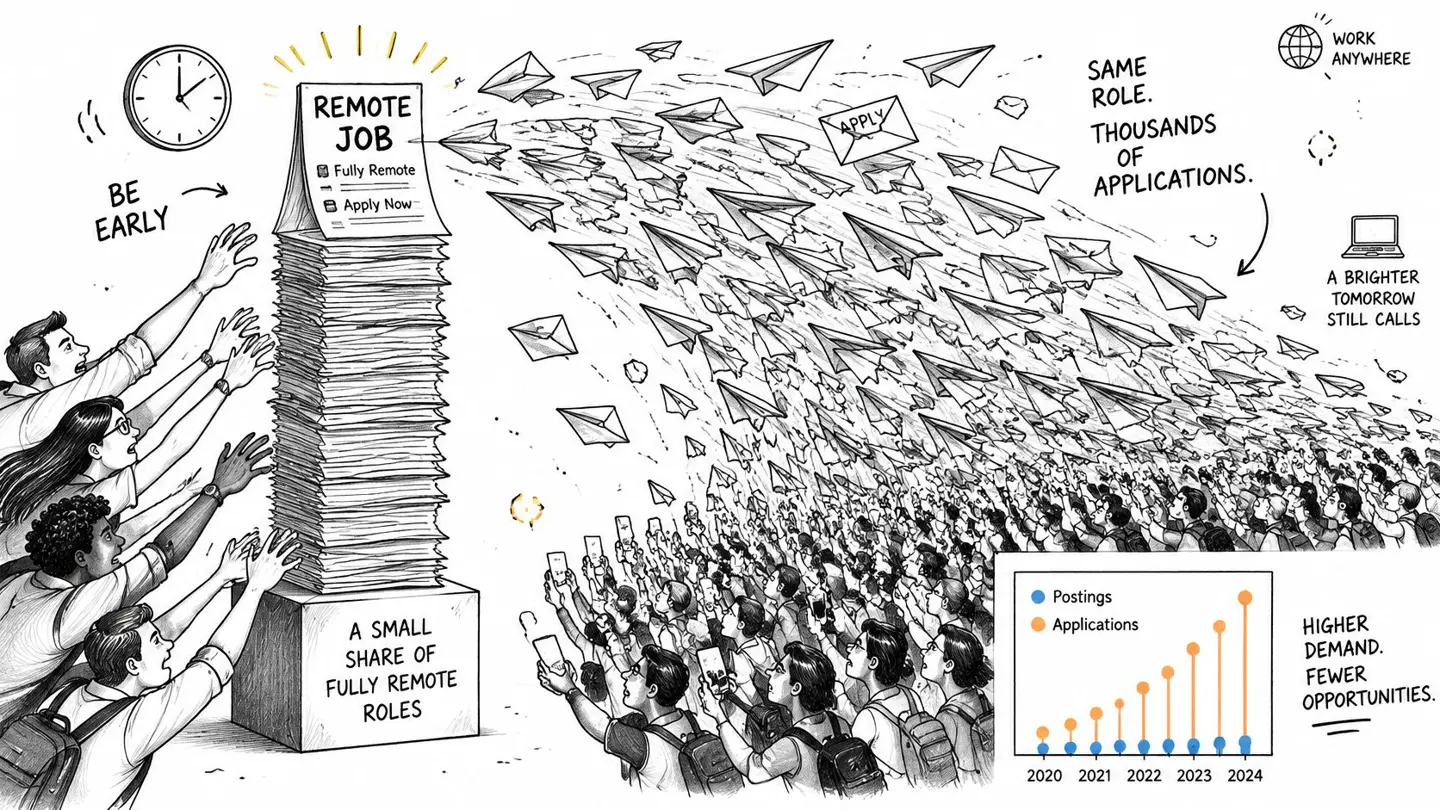
About 8% of paid job postings on LinkedIn in the US offered remote work but drew 35% of applications (September 2025), according to LinkedIn data reported by Business Insider. Separately, the Huntr Q3 2026 Job Search Trends Report puts the median time from search start to first offer at 102 days in Q3 2026, up from 91 days in Q2 2026 and 78 days in Q3 2025, while the median time from interview to offer fell from 9 to 7 days.
Those findings suggest that entering an employer’s hiring process deserves attention. They don’t establish that submitting earlier causes a faster offer, or that every occupation faces the same conditions.
The illustration captures the practical problem of concentrated applicant demand.
Time to first offer and interview-to-offer trend
| Period and stage | Median days | Stage measured |
|---|---|---|
| Q3 2025, search start to first offer | 78 days | Search through first offer |
| Q2 2026, search start to first offer | 91 days | Search through first offer |
| Q3 2026, search start to first offer | 102 days | Search through first offer |
| Q2 2026, interview to offer | 9 days | Interview-to-offer interval |
| Q3 2026, interview to offer | 7 days | Interview-to-offer interval |
These figures describe Huntr’s job-tracker users, not a universal hiring clock. Interview-to-offer also shouldn’t be read as pure employer decision time, since the interval may include activities between interviews and the offer.
Make early applications a repeatable routine
Set narrowly defined alerts. Use titles, skills and eligible locations that describe work you’d accept. The purpose is to reduce discovery delay without filling your inbox with unsuitable vacancies.
Confirm the employer’s listing. Open the company career page and verify the role and application destination. If you encounter several copies, use the employer’s requisition as the reference point rather than counting each copy as a new lead.
Keep an application pack ready. Maintain a current resume, accessible portfolio and short introductory note. Choose a prompt submission target for suitable roles, but don’t sacrifice accuracy to meet an arbitrary clock.
Tailor the opening evidence. Adjust the resume’s opening lines to reflect the listing’s central requirements where they truthfully describe your experience. Follow with concrete work examples, not a string of copied keywords.
Record posting age and outcomes. In Google Sheets, Excel or a job application tracking template, log the employer, role, posting date, submission date, eligibility checks and response. Mark an unknown posting date as unknown rather than treating discovery time as publication time.
Compare like with like. At your review, compare earlier and later submissions for similar roles and markets. Use that comparison to choose your next experiment, not to claim that timing alone caused the result.
At Remote First Jobs, we track 21,000+ company career pages and update listings from them continuously. Because we check those pages directly, roles often appear before they reach the big boards, which shortens the time between publication and discovery.
That is a discovery advantage, not an offer guarantee. Employers still assess relevance, evidence, eligibility and the needs of their teams.
This video offers another format for considering the search process.
Measure timing without confusing it with fit
A useful comparison keeps other conditions reasonably similar. Earlier applications to closely matched roles shouldn’t be compared with later applications to jobs outside your specialty.
Watch for selection effects, too. You may act fastest on your strongest matches, which means stronger fit could explain some of the response difference. A modest personal tracker won’t eliminate that uncertainty, but it can reveal which routine is worth continuing.
Speed matters only when the fit is real. Don’t skip location restrictions, misstate experience or submit broken portfolio links just to arrive earlier.
Plan Your Timeline and Start Searching Today
A workable search plan combines a financial boundary, a sustainable routine and a scheduled decision point. It shouldn’t depend on treating a population midpoint as your personal finish date.
Set the financial boundary first. Calculate essential expenses against dependable resources, and identify when you’d need to expand the search or consider interim income. Don’t wait until that boundary arrives to decide which compromises you’d accept.
Put decisions on the calendar
Write down your search assumptions. Specify the role scope, eligible locations, compensation floor and work arrangement you need. Separate genuine requirements from preferences so adjustments remain deliberate.
Choose an application commitment you can sustain. Protect time for discovery, thoughtful submissions and interview preparation. A target that forces careless applications isn’t a useful productivity measure.
Schedule the funnel review. Bring your application tracker and stage counts, including pending processes. Review outcomes rather than relying on how busy or discouraged you feel.
Select the next change in advance. If role targeting isn’t producing conversations, change the targeting or opening evidence. If employers are advancing you but declining at the end, investigate scope, communication and compensation before rewriting everything.
Your calendar should also protect preparation time. An interview invitation isn’t just a scheduling task: it creates work to understand the employer, select relevant examples and prepare useful questions.
Finish today with a usable shortlist
A short list of eligible, verified openings is more actionable than a large collection of saved links. Read each role closely enough to explain why you’d be a credible candidate and why the employer could hire you.
On our Remote First Jobs website, we verify job listings and companies, and our automated system filters out spam, junk and fake jobs. Verification doesn’t guarantee that a vacancy will remain open or that an employer will respond, so keep tracking outcomes.
Before you finish today, check that:
- Discovery is running. Your alerts reflect the work and locations you can accept.
- Your tracker is ready. Posting dates, application dates and employer responses have separate fields.
- A review is scheduled. You’ve reserved time to inspect stage progression and choose a focused adjustment.
- Your shortlist is actionable. Each role has an employer application page and a clear fit rationale.
- Your next submission is prepared. The resume, supporting evidence and contact details are accurate.
The useful answer isn’t a guaranteed number of weeks. It’s a benchmark you understand, a downside you can plan for and a process that tells you what to change before more time passes.
Remote First Jobs lets you search, browse and apply for free, with no account needed or hidden fees, and filter openings by the last 24 hours, last 3 days or last week. Browse remote jobs on Remote First Jobs to build a shortlist of fresh, verified employer listings and start with the roles that match your requirements.